

Although Prime Minister Narendra Modi rarely makes changes to his cabinet,but he can do anything to gain power. The current changes to Prime Minister Narendra Modi’s cabinet can be viewed from this perspective. The Uttar Pradesh Assembly elections are scheduled for March-April 2027. Uttar Pradesh Chief Minister Yogi Adityanath is working hard to win there. Despite this, Prime Minister Narendra Modi is leaving no stone unturned in his preparations for victory in Uttar Pradesh. While the BJP may be buoyed by the West Bengal election victory, Narendra Modi feels a significant threat from the UGC bill, which has been stalled due to the Supreme Court’s activism. In this scenario, Narendra Modi could create a major political upheaval in Uttar Pradesh, which could help him win elections there and later in other states. To do so, he will need to make significant changes to the Union Cabinet.
To attract upper caste voters in Uttar Pradesh, angered by the UGC bill, Prime Minister Narendra Modi could place a significant bet on Rajnath Singh, as he commands considerable trust among both upper castes and other castes. However, this isn’t a matter of Prime Minister Narendra Modi removing Rajnath Singh from the post of Defense Minister and making him Chief Minister of Uttar Pradesh. He would have to be given a more prominent position beyond the Defense Ministry. For this, Narendra Modi won’t appoint him Prime Minister. And Rajnath Singh won’t accept any position below the Defense Ministry. Then, only one position remains: President. This clears the way for Modi to win the Uttar Pradesh elections and fulfills Rajnath Singh’s ambition to occupy the highest office. Even Rajnath Singh, who is approaching 80 years old, would find it impossible to occupy the Prime Minister’s post. In such a scenario, Prime Minister Narendra Modi will persuade Draupadi Murmu to resign before her term expires on July 27th, citing specific reasons, and then hold the presidential election, and then install Rajnath Singh, who hails from Uttar Pradesh and belongs to the upper caste community, as the President. This would necessitate a reshuffle in Narendra Modi’s Union Cabinet, as Rajnath Singh, after being elected to the presidency, would have to resign from his post before being sworn in.
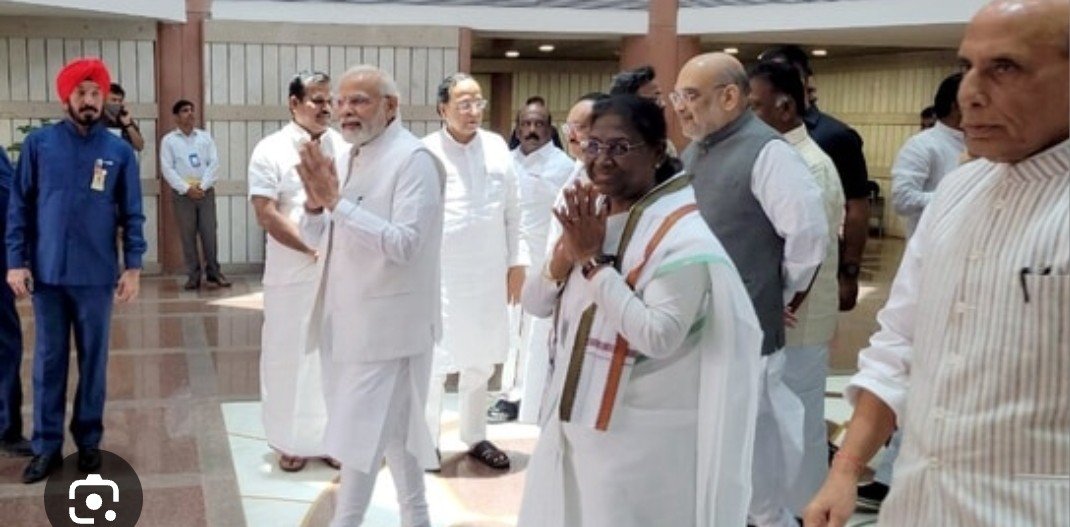
Considering all these factors, Prime Minister Narendra Modi’s recent meeting with President Draupadi Murmu appears significant. It is noteworthy that Prime Minister Modi met President Draupadi Murmu on June 23rd during the Padma Awards ceremony at Rashtrapati Bhavan. Two days after this meeting, Union Home Minister Amit Shah met with the President on June 25th, further fueling these speculations. However, officials described these meetings as courtesy visits and stated that both leaders meet with the President regularly. However, it is highly likely that all these issues were discussed in detail during the Prime Minister’s meeting with the President.
In this context, a reshuffle in the Union Cabinet led by Prime Minister Narendra Modi now appears likely. According to indications from the top echelons of the ruling party, this reshuffle could take place anytime now, possibly before the start of the monsoon session of Parliament. Sources have stated that the reshuffle in the Union Council of Ministers will coincide with the announcement of the party’s new team under the leadership of Bharatiya Janata Party President Nitin Naveen. The BJP’s top leadership has finalized the list of office bearers, and the “Nitin Naveen Team” is expected to be announced soon. Young faces from the party are likely to be given key organizational positions.
According to sources, the BJP President also held discussions with some Union Ministers of State last week. It is highly likely that some Union Ministers will be sent to assume organizational roles within the BJP, and party officials will be included in the Modi Cabinet. There is also speculation that some ministers’ portfolios may be changed.
Uncertainty also looms over the future of Education Minister Dharmendra Pradhan due to several controversies surrounding the ministry, including the leak of the National Eligibility cum Entrance Test (NEET) question paper and irregularities in the Central Board of Secondary Education (CBSE)’s digital evaluation system. Sources indicated that if a reshuffle occurs, it could happen sometime in July.
The monsoon session of Parliament usually begins in the third week of July. The date of the cabinet reshuffle is likely to be decided keeping in mind the Prime Minister’s busy schedule. Prime Minister Modi is on a three-day visit to Seychelles from June 27 to 29. He is also expected to visit Indonesia, Australia, and New Zealand between July 6 and 11. Japanese Prime Minister Sanae Takaichi is also scheduled to visit New Delhi from July 1 to 3.
According to sources, there is a growing consensus among top government officials that new faces need to be included in key ministries. Furthermore, there are political compulsions to balance the Council of Ministers, taking into account regional, state-wise, caste-based, and political allegiances. Two Union Ministers, Pankaj Choudhary and Harsh Malhotra, have already been assigned to the BJP’s Uttar Pradesh and Delhi units, respectively.
There is a strong possibility that the BJP will adhere to its “one person, one post” rule, which could force the two to step down from the government. Two other Union Ministers, George Kurien and Ravneet Singh Bittu, were not nominated again by the party for the recently concluded Rajya Sabha elections. Their terms in the Upper House ended on June 21. Kurien has already resigned from his post, while Bittu remains a minister.
It is reported that the top leadership has asked Bittu to focus on the upcoming Punjab Assembly elections. Bittu, a former Congress leader and grandson of former Punjab Chief Minister Beant Singh, is a prominent figure in the influential Jat Sikh community. Assembly elections are due in Uttar Pradesh, Uttarakhand, and Punjab next year, so more representatives from these three states are likely to find a place in Modi’s cabinet. Following the BJP’s landslide victory in West Bengal, some of the party’s MPs from that state may also be included in the Union Cabinet.
Representatives from the rebel factions of the Trinamool Congress and Shiv Sena (Uddhav Balasaheb Thackeray) are also likely to receive ministerial positions. There is also a possibility that a senior Shiv Sena leader led by Shinde could be appointed as a cabinet minister. Sources indicate that one or two of the seven Rajya Sabha members who left the Aam Aadmi Party (AAP) and joined the BJP may be included in the cabinet.
However, any decision to include members of the rebel factions of the Trinamool Congress and Shiv Sena (Uddhav Thackeray) in the cabinet will depend on the decision of the Lok Sabha Speaker. Both parties have demanded the termination of their membership under the anti-defection law.