

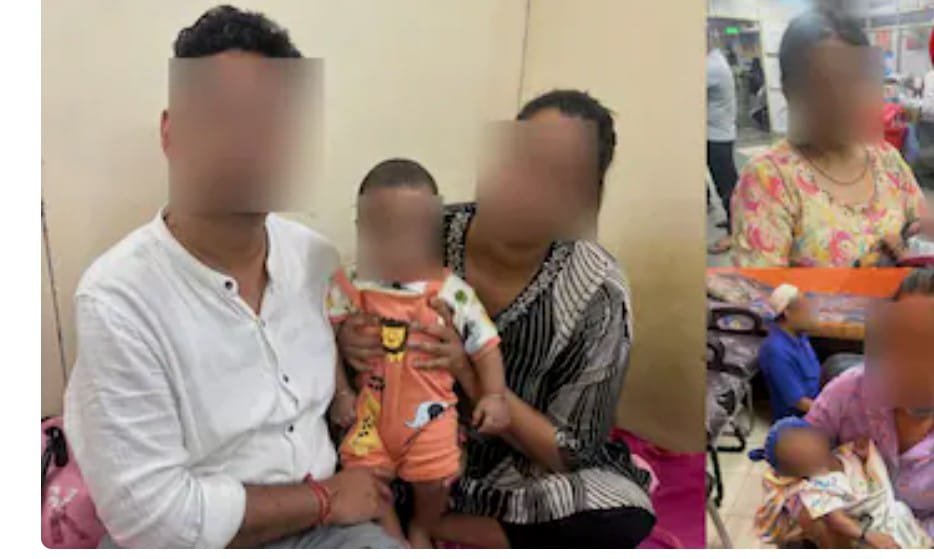
The Central District Police of Delhi Police has uncovered an interstate child trafficking syndicate that took newborn babies from poor and destitute families and sold them for lakhs of rupees to childless couples or families seeking a son. Police investigations have revealed that this was not a small gang, but an organized network spanning several states, involving middlemen, hospital operators, lab technicians, ASHA workers, drivers, child suppliers, purchasing couples, and even, in some cases, the biological parents of the children.
According to Delhi Police, 23 accused have been arrested so far in this case. These include hospital operators, child supply agents, purchasing couples, middlemen, and biological parents. Nine innocent children have been rescued from this network. Police say the investigation is ongoing and more arrests are likely in the coming days.
According to DCP Rohit Rajbir Singh, the entire case began not with a tip-off from a major agency, but with the vigilance of a private citizen. A man informed the police that a woman was frequently seen in the Paharganj area with different newborn babies. Sometimes she had a boy, sometimes a girl. A few days later, the same woman would be seen with a different child. Her activities seemed suspicious, and the information reached the police.
As soon as the information was received, the Central District Operations Unit was activated. Police first began scanning CCTV footage from Paharganj and the surrounding area. After reviewing the footage for several days, the woman was identified as Jyoti alias Kamlesh.
After identifying the woman, the police did not act hastily. Her activities were continuously monitored. Information was gathered about the people she met, and efforts were made to find out what she was doing with the children. During the investigation, it was discovered that she was involved in the trafficking of newborn babies. Following this, the police planned a decoy operation to catch her red-handed.
A policeman was posed as a customer and contacted Jyoti. During the conversation, Jyoti claimed she could provide a newborn baby. A deal was struck, and the accused demanded an advance of 20,000 rupees. Following this, the police devised a plan and laid a trap near the RK Ashram Metro Station at the agreed time.
On June 5, 2026, Jyoti, alias Kamlesh, along with her two accomplices, Shalu and Lalit, arrived at the RK Ashram Metro Station with a four- to five-day-old baby boy. As the baby was being handed over to the customer, a police team already present surrounded the three. The four- to five-day-old newborn was safely recovered from the scene. The police also recovered a token amount of 20,000 rupees. An FIR was registered at the Paharganj police station under the BNS and Juvenile Justice Acts.
Initially, the police believed it was simply a case of buying and selling a baby. However, as the interrogation of the three accused progressed, surprising information emerged. Investigations revealed that the gang was active in several states and had been trafficking children for the past year and a half.
Given the seriousness of the case, a Special Investigation Team (SIT) was formed under the leadership of Additional DCP-2 Prashant Choudhary. This team included ACPs, SHOs, special staff, female police officers, and legal experts to ensure that no legal aspects were overlooked during the investigation.
The SIT launched a simultaneous investigation in Delhi, Haryana, Uttar Pradesh, Uttarakhand, Gujarat, Rajasthan, and Madhya Pradesh. Through mobile locations, bank accounts, CCTV footage, call detail records, digital payments, and technical surveillance, each link was established, gradually revealing the entire network.
The investigation revealed that the gang operated in a highly organized manner.
Some individuals sought out poor families.
Some monitored pregnant women.
Some maintained contact with hospitals.
Some transported newborn babies from one state to another.
Some found buyers.
Some handled financial transactions through bank accounts.
While others prepared fake documents, the role of each individual in the entire network was pre-determined.
Police investigations revealed that Jyoti, also known as Kamlesh, was the most important member of this network. She worked as an ASHA worker in Haryana. However, according to the police, her real role was to facilitate the trafficking of children. She would arrange for children from different states and then deliver them to the families who would purchase them. According to Delhi Police, Jyoti has previously been arrested in human trafficking cases. A case has been registered against her at the Punjabi Bagh police station under sections 363, 370, 370A of the Indian Penal Code, and the POCSO Act.
After questioning Jyoti, police arrested Pratibha and Vipin. They were planning to negotiate a deal for another child. When they were apprehended, they found ₹292,400 in cash. During interrogation, it was revealed that this amount was intended for the purchase of a newborn baby.
Pratibha was a freelance lab technician by profession and was associated with Hira Multi-Specialty Hospital. Vipin, meanwhile, was the driver for the entire network, transporting the children and the accused from one location to another.
As the investigation progressed, the most shocking revelations were made by the police regarding Hira Multi-Specialty Hospital in Begumpur, Delhi. The police allege that this hospital
It wasn’t just a treatment center, but had become a key link in this network of illegal newborn trafficking. According to the investigation, the hospital’s operator, Dr. Viveki Kapoor, was in contact with other members of the gang. It is alleged that the hospital housed newborns brought in by the gang from various states.
The investigation revealed that the gang’s biggest suppliers were Sahiba, also known as Kalia Gamar, and her associate, Shankar Gamar. They would travel to poor and tribal areas in Gujarat and Rajasthan to seek out economically vulnerable families. According to the police, they lured many families with a few lakh rupees and stole their newborns. The children were then sent to Delhi and other states, where willing buyers awaited.
After technical surveillance and relentless pursuit, the police tracked Shankar Gamar and the other accused. The biological parents, Kantibhai Gamar and Sugnaben Gamar, were also arrested in Gujarat’s Sabarkantha district. The investigation revealed that they had handed over their newborn babies to the gang in exchange for money. Later, the same child was sold to another family for a much higher price. Police claim that Kalia Gamar has already supplied more than 30 children to this network. The investigation into his entire network is ongoing.
Poverty, helplessness, and social pressure were exploited.
The investigation also revealed that the gang not only targeted poor families, but also identified women who were unmarried or, for some reason, were unwilling to raise a child. In one such case, a young woman from Delhi refused to keep the child because she was unmarried. According to the police, after delivery, instead of returning the child to the mother, it was kept in the gang’s custody and later sold to another family. The biological mother was not paid any money.
Demand first, child later.
The most important revelation from the police investigation was that this gang did not seek children first, but rather sought customers. Couples who were childless, or who already had daughters and wanted a son, were contacted. Once a buyer was found, the gang would arrange for a newborn baby through their network. The entire business operated on a demand-and-supply model.
Demand First, Child Later
The most significant revelation from the police investigation was that the gang did not seek out children first, but rather sought customers. Couples who were childless, or who already had daughters and wanted a son, were contacted. Once a buyer was found, the gang would arrange for a newborn baby through their network. The entire business operated on a demand-and-supply model.
How was the price of the children determined?
According to the police investigation, the gang would acquire newborn babies from poor families for 1.5 to 2 lakh rupees. The same child was then sold for 6 to 8 lakh rupees. In some cases, the price reached 9 lakh rupees. The price depended on the child’s age, whether it was a boy or a girl, the buyer’s wealth, and the buyer’s need.
In the latest operation, police safely recovered four more children: a 16-day-old newborn from Rohini.
A boy from MM Kamat, a one-month-old newborn from Rishikesh, a child of approximately one year and one month from Mathura, and an approximately eight-month-old child from Haridwar.
Five children had previously been rescued from various locations, including Haryana, Panipat, and Gwalior. These included several newborns, including 27-day-old twins. According to police, four of the rescued children belong to tribal families.