

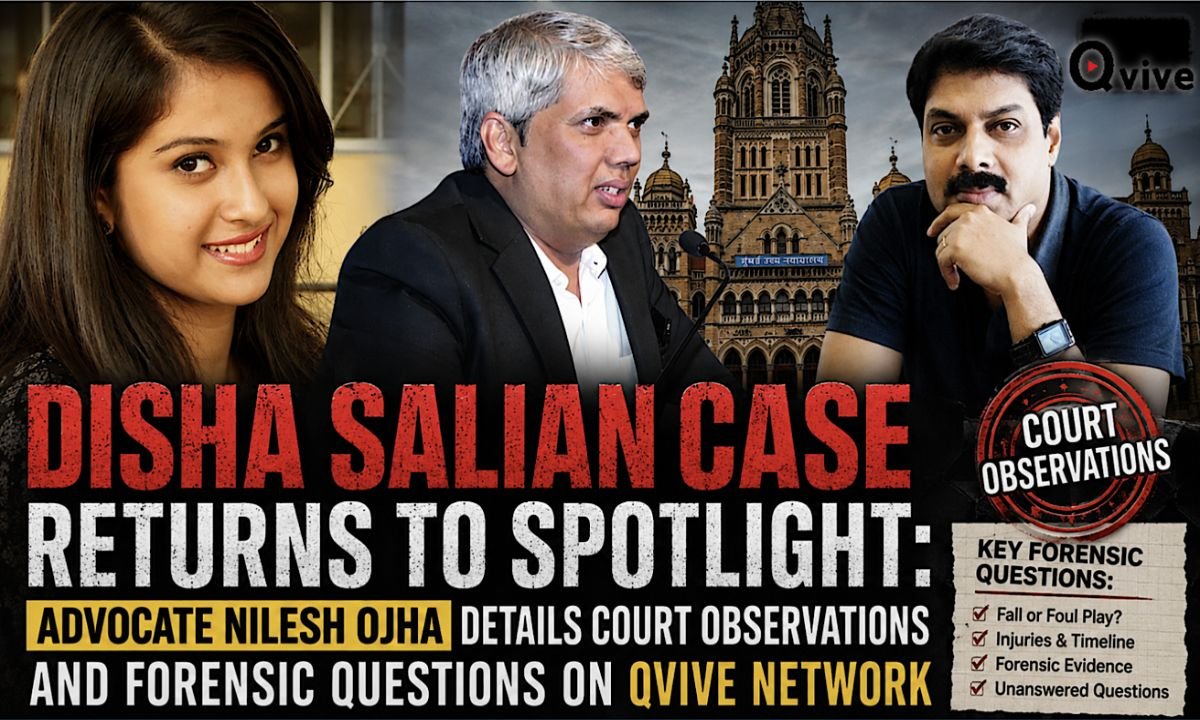
The Disha Salian death case has once again come into sharp focus after the Bombay High Court directed the Central Bureau of Investigation (CBI) to register an FIR and conduct a fresh, comprehensive investigation into the circumstances surrounding her death in June 2020.
The development came on September 2, 2026, when a division bench of Justices Sarang Kotwal and Ranjitsinha Bhonsale directed the CBI to appoint an experienced investigating officer, record the statement of Disha Salian’s father Satish Salian and examine all aspects surrounding the circumstances in which she died.
The court’s intervention has given new momentum to a case that had remained the subject of intense public debate for more than six years. Importantly, however, the court did not declare any particular individual guilty or an accused. It specifically directed that nobody should be treated as an accused unless sufficient material and reasonable grounds emerge during the CBI investigation.
[In March 2025, Satish Salian, through Adv.Nilesh Ojha, submitted a complaint to Mumbai Police seeking registration of an FIR and naming several people, including Aaditya Thackeray, Dino Morea, Sooraj Pancholi, Parambir Singh, Sachin Vaze and Rhea Chakraborty. Nilesh Ojha publicly described the complaint as containing allegations of gang rape, murder and an alleged cover-up.]A Detailed Discussion on Qvive Network with Chief Editor Ashutosh Pathak
Speaking on Qvive Network with Chief Editor Ashutosh Pathak, advocate Nilesh Ojha discussed what he described as serious questions concerning the original investigation, particularly the handling of forensic material and the manner in which the case was initially investigated.
The discussion repeatedly emphasized one central principle: the truth must ultimately be determined by evidence, and every piece of relevant evidence must be preserved and investigated according to law.
A Case That Has Continued for Years
Opening the discussion, Ashutosh Pathak described the matter as a long-running legal battle that began in the courts and has now reached proceedings involving the Central Bureau of Investigation.
The discussion adopted an extremely forceful tone, with the presenters arguing that if the allegations are established, those responsible must face criminal proceedings and punishment under the law.
Advocate Nilesh Ojha stated that his position regarding allegations of gang rape and murder had remained consistent and that, in his interpretation of court proceedings, questions surrounding those allegations warranted investigation.
It is important to emphasize, however, that allegations of rape, murder, conspiracy or evidence manipulation must ultimately be established through admissible evidence and judicial proceedings.
The Focus on Forensic Evidence
Nilesh Ojha then shifted the discussion toward what he described as the most significant aspect of the case: the forensic material allegedly collected during the postmortem examination.
According to the documents discussed during the programme, the postmortem documentation allegedly referred to preservation of:
- Anal swab for examination
- Vaginal swab for examination
- Blood for chemical analysis
Nilesh Ojha argued that these entries were particularly significant because they appeared in more than one document associated with the postmortem process.
He referred to the postmortem report and other medical documentation and maintained that the records indicated that biological material had been preserved for forensic examination.
The programme also discussed a death certificate and a Form II document that, according to Nilesh Ojha, contained similar references.
The June 2020 Communications
The discussion then moved to correspondence allegedly exchanged between police authorities and the forensic laboratory in June 2020.
According to Nilesh Ojah’s account, a communication dated June 12, 2020, requested forensic examination of material collected during the postmortem process.
He further referred to another communication dated June 16, 2020, which he said specifically sought examination for the possibility of DNA belonging to more than one male individual.
Nilesh Ojha argued that these communications were important because, in his interpretation, they demonstrated that investigators were initially treating the forensic material as significant.
The August 2020 Development
The discussion then focused heavily on August 2020.
According to the programme, police authorities subsequently communicated with the forensic department and requested an urgent report, citing the sensitivity of the matter and concerns relating to law and order.
Nilesh Ojha alleged that forensic examination was initiated and that questions subsequently arose concerning the interpretation and documentation of the biological samples.
The broadcast claimed that the forensic process initially involved swabs but that subsequent documentation referred instead to smears.
This distinction became one of the central arguments presented during the programme.
Swab Versus Smear
Nilesh Ojha explained the difference between a swab and a smear to the audience.
A swab is a collection method in which biological material is obtained and the sample itself can be preserved for further examination.
A smear, by contrast, involves transferring material onto a slide for examination.
The legal and forensic significance of this distinction depends on the particular circumstances, collection protocol, laboratory procedures and applicable evidentiary standards.
Nilesh Ojha argued that if the original documentation specifically recorded preservation of vaginal and anal swabs, but later documentation described the material as smears, that discrepancy required explanation.
He maintained that the difference could be particularly important when investigating allegations of sexual assault.
The Alleged Change in Records
One of the most serious claims made during the discussion was that the description of the forensic material subsequently changed.
Nilesh Ojha referred to a later communication in which, according to his account, officials indicated that the material received by the forensic laboratory consisted of smears rather than swabs.
He further stated that the doctor involved subsequently characterized the earlier reference to swabs in Form II as a mistake.
Nilesh Ojha questioned that explanation by pointing out that, according to his presentation, references to swabs were not limited to a single form.
He argued that similar references appeared in the postmortem documentation and death certificate.
This, he said, created a question that investigators needed to resolve.
Why the Alleged Discrepancy Matters
The core question raised during the programme can be summarized as follows:
If the original medical documents recorded preservation of specific forensic samples, why did later documentation describe the material differently?
There can be legitimate explanations for inconsistencies in official records, including clerical mistakes, terminology differences, documentation errors or procedural confusion.
However, if an alteration was deliberate and materially affected the investigation, it could become a serious issue of investigative integrity.
Therefore, the appropriate way to resolve the dispute is to examine the original records, laboratory registers, chain-of-custody documentation, sample containers, dispatch records and testimony of the officials involved.
The Role of the High Court
A major part of the discussion concerned judicial observations.
Nilesh Ojha referred to observations in a High Court order that, according to his interpretation, addressed discrepancies surrounding the forensic material and the investigation.
He highlighted language concerning the importance of the two swabs in the context of the allegations.
He also argued that the court had recognized a discrepancy between the original references to swabs and later references to smears.
The programme presented these observations as particularly significant because judicial scrutiny can provide an independent assessment of investigative irregularities.
However, individual observations made during proceedings should always be read in the context of the complete court order and procedural history.
The Importance of Chain of Custody
The debate also raised a broader forensic principle: chain of custody.
Forensic evidence is valuable only when investigators can establish where it came from, how it was collected, how it was sealed, who handled it, when it reached the laboratory and how it was examined.
Any unexplained break in that chain can become a significant evidentiary issue.
If investigators are unable to establish whether a sample tested by a laboratory is the same material originally collected during the medical examination, questions naturally arise.
That does not automatically prove evidence manipulation, but it makes documentary verification essential.
Allegations of a Cover-Up
The programme went further, alleging that the changes in documentation represented an attempt to weaken or conceal evidence relevant to the case.
Nilesh Ojha argued that if the original forensic records supported a particular investigative direction and those records were subsequently altered or reinterpreted, the circumstances surrounding that change should be investigated.
These are serious allegations and require equally serious verification.
The appropriate authorities would need to establish who created each document, when it was created, what physical evidence existed at the time, and whether any subsequent modification was authorised.
The Question of FIR Registration
Another major issue raised during the discussion was the timing of the registration of an FIR.
The presenters argued that serious allegations require prompt registration and investigation so that evidence can be preserved before it is lost or compromised.
Nilesh Ojha referred to judicial observations concerning the investigation and argued that the authorities should have followed the proper criminal-procedure framework at the earliest possible stage.
The programme portrayed the prolonged preliminary investigation as one of the most important questions requiring explanation.
Again, the exact legal implications depend upon the findings of the competent court and the applicable procedural law.
The CBI’s Role
The discussion repeatedly referred to the CBI and its responsibility to examine the matter comprehensively.
Nilesh Ojha argued that the investigating agency should examine every angle, including evidence that might support as well as contradict the allegations.
He maintained that if evidence establishes criminal responsibility, the responsible individuals should face prosecution.
At the same time, anyone who is not implicated by the evidence must be protected from unjust accusation.
That is the basic balance required by due process.
Criticism of Media Coverage
A substantial part of the programme was devoted to media coverage.
The presenters criticized several journalists and media organisations for what they described as selective reporting and inconsistent standards.
They questioned why, according to their claims, certain media outlets had not given comparable attention to the forensic and judicial issues being discussed.
The programme also criticized journalists who had described some claims as conspiracy theories.
The hosts challenged those journalists to examine the underlying court documents and evidence rather than dismissing the allegations without detailed scrutiny.
The Principle of “Innocent Until Proven Guilty”
The discussion also became heated over the principle of presumption of innocence.
The presenters argued that the principle should not be used to prevent investigation.
That is an important distinction.
Being presumed innocent means that a person cannot be treated as criminally guilty without the required legal process and proof.
It does not mean that authorities cannot investigate a person where there is credible evidence requiring investigation.
A proper investigation should determine whether the evidence supports prosecution.
A Call for Equal Justice
One of the emotional themes of the programme was the contrast between powerful individuals and ordinary citizens.
The presenters repeatedly referred to the family of Disha Salian and portrayed the family’s struggle as symbolic of a broader demand for justice.
They argued that the criminal-justice system must work equally for everyone—regardless of wealth, political influence, social status or professional connections.
That principle is fundamental to the rule of law.
The Larger Question
The debate surrounding the case extends beyond the identity of any particular accused person.
It raises larger questions:
- Was every relevant piece of evidence preserved?
- Were the forensic samples correctly documented?
- Was the chain of custody maintained?
- Why do different records allegedly describe the samples differently?
- Were investigations conducted promptly?
- Were all relevant witnesses examined?
- Were investigative agencies free from improper influence?
- Were court directions followed completely?
- Have all allegations been independently tested?
- Has the family received adequate information about the investigation?
These are questions that can be answered only through documentary evidence and a properly conducted investigation.
The Message from the Programme
The discussion on Qvive Network, featuring Advocate Nilesh Ojah and Chief Editor Ashutosh Pathak, presented a forceful demand for transparency.
Its central message was that evidence should not be ignored merely because it challenges an established narrative.
At the same time, allegations should not be treated as convictions.
The ultimate test must be the evidence.
If evidence establishes wrongdoing, those responsible should face the law.
If an allegation cannot be substantiated, that too must be acknowledged.
The Disha Salian controversy continues to generate strong emotions and competing narratives.
The discussion presented by Advocate Nilesh Ojah focused heavily on alleged discrepancies in forensic documentation and raised questions about how samples were recorded, transferred and examined.
Those questions deserve to be addressed through original documents, forensic records, witness testimony and judicial scrutiny—not merely through television debates or social-media arguments.
The most important principle remains straightforward:
Preserve the evidence. Examine the evidence. Follow the chain of custody. Investigate every credible allegation. Protect the rights of victims and families. Protect due process for the accused. And allow the courts to determine criminal responsibility.
That is how public confidence in justice is ultimately strengthened.
The real breakthrough in any criminal case does not come from the loudest accusation or the most powerful television debate.
It comes when the evidence survives scrutiny and the truth can be established in accordance with law.
Watch:
Related Article: