

What changes to ‘Form 6’ for first-time voters have caused a stir? Understand the Election Commission’s new rule.
First-time voters are required to fill out ‘Form 6’ for registration. The Election Commission’s decision to amend this ‘Form 6’ has sparked a major controversy.
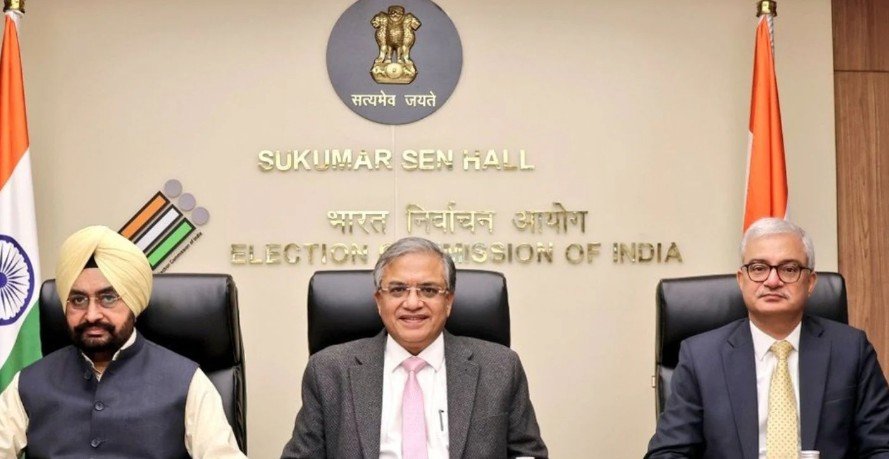
According to a report in the ‘Indian Express’, two Election Commissioners—Vivek Joshi and Sukhbir Singh Sandhu—have called these changes “illegal” and demanded their immediate withdrawal in the interest of new voters.
The controversy has escalated since the report was published. The Election Commission implemented these changes in July. Following the newspaper report, Chief Election Commissioner (CEC) Gyanesh Kumar has come under fire.
This move, along with the Election Commissioners’ objections, has created a stir and brought Form 6 to the center of discussion.
To register as a voter in India, Form 6 is required. It requires personal information, a photograph, proof of age, and proof of address. This form is prescribed under the Registration of Electors Rules, 1960.
In July 2026, the online version of Form 6 on the ECI’s ECINet portal was modified to include a new declaration.
As part of this modification, questions related to the Special Intensive Revision (SIR) were added to Form 6. Applicants were asked to choose one of three questions:
First: Was their name on the voter list during the last SIR, conducted in the early 2000s?
Second: Were their parents’ or grandparents’ names on that list?
Third: Were their and their parents’ names not on that list?
Applicants cannot complete the online form without answering this question.
The last SIR in many states was conducted in the early 2000s, while some completed it last year or this year.
According to a report in The Indian Express, Sukhbir Singh Sandhu and Vivek Joshi officially stated that since Form 6 is part of the Registration of Electors Rules, 1960, it can only be changed through a government notification and amendment to the rules, not simply by changing the online form.
Under Section 28 of the Representation of the People Act, 1950, the central government makes and amends these rules after consulting the Election Commission. Any amendments must be presented to Parliament and notified in the gazette.
According to a report in The Indian Express, Sandhu and Joshi called the change “illegal” and “without authority” and suggested that the matter be referred to the government.
Despite objections from both Election Commissioners in May, the Election Commission implemented the change in July.
Responding to the report, the Election Commission on Wednesday stated that disagreements among Election Commissioners during internal discussions are a normal part of the decision-making process. The Commission also stated that all decisions taken by the entire Commission over the past year were unanimous.
A person’s eligibility to vote is determined by factors such as age, citizenship, and usual residence—not whether their parents were included in the previous voter list.
During the ongoing SIR process, approximately 130 million names have been removed from voter lists in various states and union territories. While many of these names belong to voters who have died, moved, or were registered more than once, many people are also protesting the removal of their names.
The inclusion of a question regarding the previous SIR in the form for new voters has raised concerns about its impact on young people who want to enroll for the first time.
An 18-year-old whose parents or grandparents were not included in the previous SIR list will not be able to select the first two options related to parents and grandparents. The form also does not specify what will happen if the applicant selects the third option – ‘None of these’.
Under the SIR process, which began in Bihar in June 2025, 130 million names have been removed from the draft voter lists in various states and union territories.
Many of these voters – some of whom have been on the list for years – are now being asked to fill out ‘Form 6’ to have their names added back to the revised list.
The problem is that Form 6 contains a mandatory declaration requiring the applicant to state that they are applying for inclusion in the voter list for the first time and that their name is not included in the voter list for any Assembly or Parliamentary constituency.
According to the rules, a voter whose name has been removed from the list and who wishes to be added back must already have been on the voter list. Therefore, signing a declaration on Form 6 could be considered an endorsement of something that is actually false.
Under Section 31 of the Representation of the People Act, 1950, knowingly making a false declaration regarding the voter list is a punishable offense, punishable by imprisonment of up to one year, a fine, or both.
The new question in Form 6 assumes that families can prove a documentary connection between two generations. Critics argue that this could have a huge impact on migrants, poor families and those who move from one state to another.