

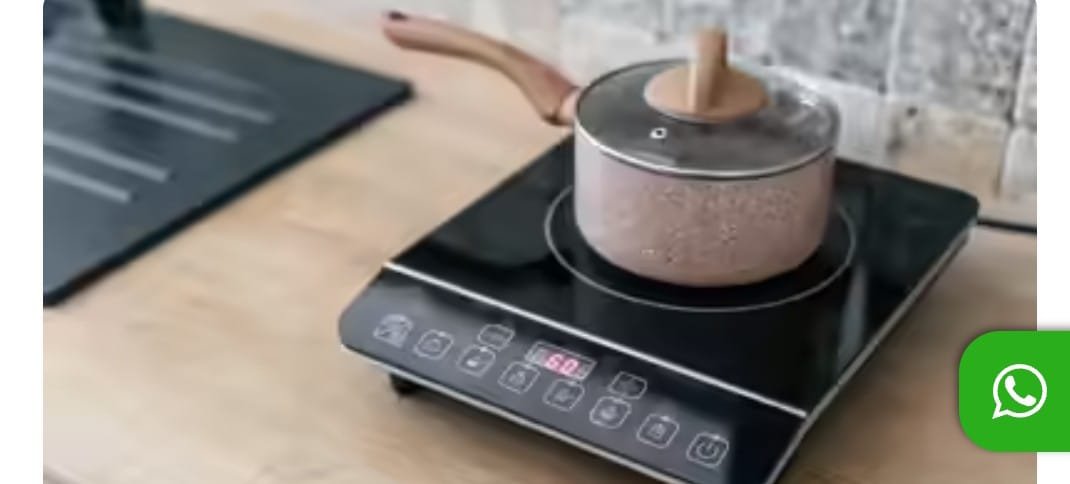
Amidst reports of cylinder shortages, the demand for induction stoves has suddenly increased. Seizing the opportunity, many induction stove manufacturers have increased the prices of their stoves by 5 to 10%. If you’re considering ordering an induction stove, it’s important to first understand the cost of cooking on an induction stove compared to a cylinder. Don’t buy an induction cooktop to avoid spending too much on a cylinder and end up getting scammed.
Induction cooktops ranging from 1000 to 2000 watts are available in the market. People typically purchase a 2000 watt induction cooktop and use it between 1000 and 1500 watts, depending on their needs. Induction cooktops can currently be purchased for between 1200 and 3000 watts. In such a situation, this is the first expense you should consider. Now, the question arises as to which of the two, LPG gas and induction, can cook food more cheaply.
If we take an average of the prices of cylinders sold in different states across the country, the cost of a cylinder can be estimated to be around ₹950. One cylinder lasts for about a month. Therefore, the cooking cost per cylinder can be estimated to be ₹950. Most induction cookers use an average power of 1000 watts. For an average Indian family of 4-5 members, it takes approximately 4 to 5 hours to cook breakfast, lunch, and dinner.
If an induction cooker is used for 4 hours a day at 1000 watts of power, then at 4000 watts, approximately 4 units of electricity will be consumed per day. Thus, an induction cooker will consume approximately 120 units of electricity per month. Now, if the unit of electricity costs ₹8, then using induction for a month could cost you up to ₹960. In this scenario, cooking on induction or a cylinder costs roughly the same. However, there are some additional reasons why an induction stove may be slightly cheaper than an LPG cylinder.
Cooking on induction may be slightly cheaper than an LPG cylinder because food heats up faster on induction than on a cylinder. This saves time and uses less electricity.
The problem with LPG gas is that when you light it, only 40-55% of its heat reaches the vessel. The remaining heat is dissipated into the air. This makes cooking on gas take longer than on an induction stove, ultimately increasing costs.
Induction stoves rely on electricity. In such a situation, if there is less electricity in your area or there are frequent power cuts, then think before buying an induction stove because induction stove cannot be used on inverters etc. due to high voltage.