

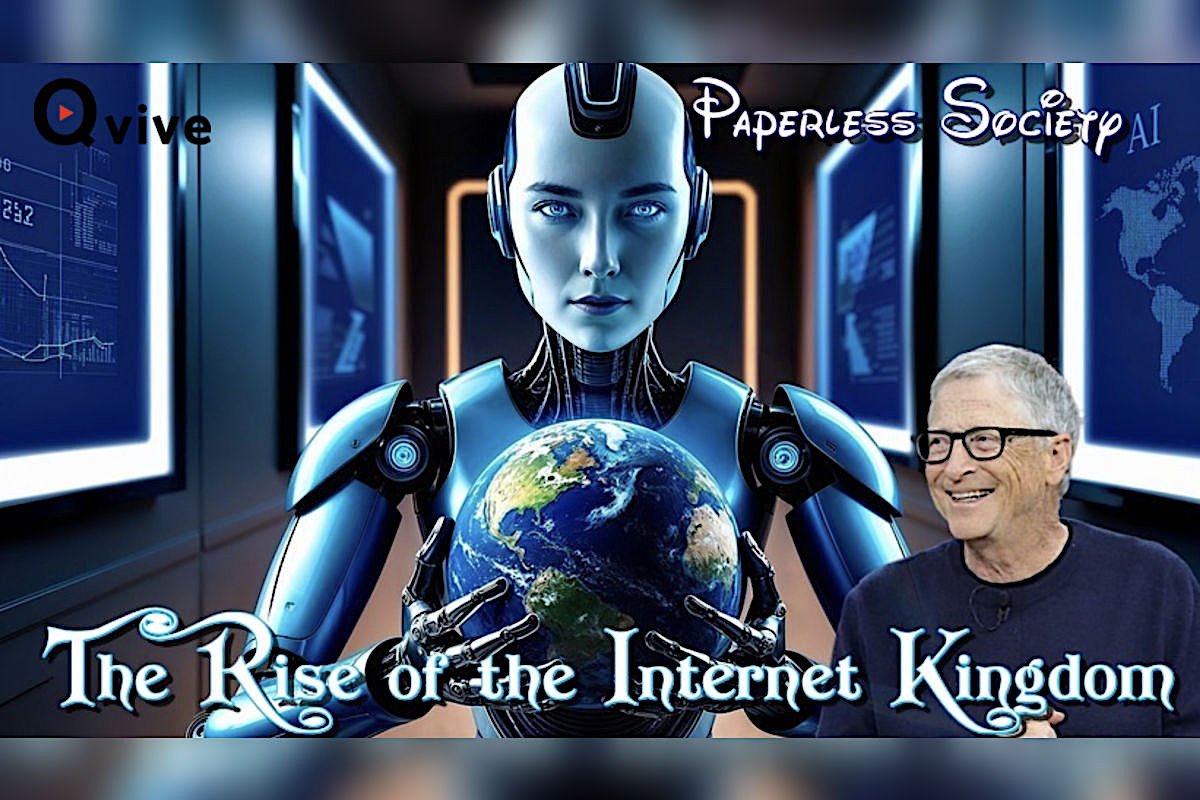
We’ve all crossed the threshold—into a new era, a new kingdom: the Internet Kingdom.
No longer a distant vision, the digital revolution has reshaped how we live, work, and connect.
A Paperless Society: Vision Made Reality?
In the early days of personal computing, Bill Gates envisioned a world where technology wasn’t just a tool, but a way of life. “A computer on every desk and in every home.”
Imagine a world where:
- Your wallet is digital. No more cash, no more clutter—your money lives securely on your PC or smartphone, accessible with a tap or a scan.
- Documents vanish from filing cabinets. Contracts, bills, medical records—everything goes paperless, stored in encrypted, cloud-based systems.
- Transactions happen at the speed of light. From grocery shopping to global banking, payments are instant, secure, and universally accepted.
The Internet Kingdom: Power to the People
The rise of the Internet Kingdom democratizes knowledge, opportunity, and financial inclusion. With digital identities, e-signatures, and blockchain-backed security, trust is redefined. Personal data stays under your control. Your finances are protected by intelligent systems designed with privacy in mind.
Gates foresaw a world where:
- Education is borderless. Anyone, anywhere, can access world-class learning.
- Healthcare goes digital. Medical records are shared instantly, enabling faster diagnosis and treatment.
- Business operates 24/7. Entrepreneurs launch ventures with a website, not a storefront.
And at the core of this transformation? A reimagined relationship with money.
Money in the Digital Age
“Money will be on your PC,” Bill Gates once said. Today, his words resonate more than ever. Digital wallets, cryptocurrencies, online banking, and contactless payments are not just convenient—they are the new normal.
November 1995: Bill Gates’ Vision in “The Road Ahead”
In his book “The Road Ahead,” Bill Gates shares his thoughts on the future of information and technology, predicting a transformation from paper-based documents to digital formats. Over the past 500 years, human knowledge has primarily been recorded on paper, but Gates argues that this is changing rapidly. Here are the key points he emphasizes:
The Decline of Paper Documents
- Shifting Perspective: While paper will always have a place, it is becoming less central to how we access and share information.
- Digital Advantages: Digital documents, accessed through computers and other devices, can be organized and searched in ways that paper cannot. For example, instead of just flipping through pages like in an encyclopedia, users can quickly find specific information with a few clicks thanks to powerful databases.
The Rise of E-Books
- E-Book Development: Gates foresees the advent of lightweight electronic books that mimic paperbacks in size and usability. These e-books will allow readers to enjoy high-resolution text, images, and even videos all in one device, facilitating an interactive reading experience.
- Changing Definitions: This shift from paper to digital will redefine what we think of as a document, an author, and even the roles of classrooms and publishers. The way we engage with information will evolve significantly.
Digital Navigation and Organization
- Enhanced Accessibility: Digital documents offer a huge leap in navigability and organization. For instance, while a restaurant might keep reservations on paper, transitioning to digital databases can handle the vast, complex systems needed by airlines, which manage billions of data points daily.
- Real-World Example: Just like an air travel management system is far more complex than a simple reservation book, digital systems can reshape our everyday experiences, making information retrieval instant and intuitive.
The Concept of the Wallet PC
- All-in-One Device: Gates introduces the idea of a compact “wallet PC,” which could carry all essential tools—like digital ID, money, and schedules—in one portable device. Imagine carrying all your important documents and connections in your pocket, much like losing clutter from your wallet.
- Digital Transactions: Rather than using physical cash or cards, your wallet PC would help you make transactions seamlessly, allowing digital funds to flow easily from one person to another, thereby streamlining everyday purchases.
The Wallet PC as a Versatile Tool
- A Modern Swiss Army Knife: The wallet PC is envisioned as an indispensable tool that not only helps manage finances but also provides navigation aids, emergency services, and connectivity to various information resources. It would be equipped with features like GPS for driving directions and could even alert you to hazards.
Looking Forward
- Future Implications: Gates emphasizes that the transition to digital will not only alter the way we store and access information but will also change how we interact with each other and the world. With the right safeguards, these technologies promise to enhance convenience significantly.
“The Road Ahead” offers a forward-thinking perspective on the inevitable shift from paper to digital experiences, suggesting a future where information is more accessible, transactions are seamless, and our daily lives are enriched by technology. Gates paints a picture of a world where our documents and dollars coexist in a digital realm, a transformation we are gradually witnessing today.
Disadvantages of Going Paperless
As businesses and government agencies increasingly embrace digital transformation, the push to go paperless has been hailed as a cornerstone of modern efficiency, sustainability, and cost savings. However, experts are now urging organizations to examine the less-discussed disadvantages of this shift, warning that a full-scale transition to digital systems without proper planning can introduce serious operational, financial, and human challenges.
Imagine trying to find your keys just before rushing out the door. When you can’t find them, your plans might get disrupted. Similarly, businesses can face significant delays if something goes wrong with their technology. If a computer crashes or if internet access is lost, and all files are stored digitally without backups, operations can come to a standstill. Therefore, it’s still important for businesses to keep printed copies of essential documents, ensuring they can continue operating smoothly even if technology fails.
While often promoted for its environmental and efficiency benefits, transitioning to a paperless office presents several notable disadvantages that businesses should carefully consider. These drawbacks span technological dependencies, financial implications, potential health concerns, and even environmental considerations.
Many believe that ditching paper makes an office more environmentally friendly, But this isn’t always true! Digital devices consume a lot of energy—they need to be plugged in, which contributes to carbon emissions. Additionally, producing electronics often involves harmful materials that impact the environment. In some cases, using sustainable paper might actually be more environmentally sound than going completely digital.
1. Higher Initial Investment
| Issue | Why It Matters | Typical Cost Impact |
|---|---|---|
| Hardware & Infrastructure | Servers, cloud subscriptions, scanners, and secure networking equipment are required to store and manage digital documents. | Capital outlay can range from $15,000–$100,000 for mid‑size firms. |
| Software Licensing & Integration | Document‑management systems (DMS), e‑sign platforms, and workflow automation tools often require per‑user or per‑document pricing. | Ongoing $10‑$30 per user/month for enterprise‑grade solutions. |
| Training & Change Management | Employees need time and support to master new tools and processes. | Training programs can cost $5,000–$20,000 depending on scale. |
2. Data Security & Privacy Risks
| Risk | Description |
|---|---|
| Cyber‑attacks & Ransomware | Digital files are attractive targets for hackers; a breach can expose confidential contracts, financial data, or personal information. |
| Unauthorized Access | Poorly configured permissions may allow employees to view or edit documents they shouldn’t. |
| Data Residency & Regulation | Storing data outside of jurisdictional boundaries may violate GDPR, CCPA, or industry‑specific regulations. |
3. Reliance on Technology Infrastructure
- Network Outages – A single point of failure (e.g., ISP disruption) can halt access to essential documents.
- System Compatibility – Legacy applications may not interface smoothly with modern DMS platforms, forcing costly custom integrations.
- Vendor Lock‑in – Switching providers later can be expensive and time‑consuming if data export formats are proprietary.
4. Risk of Data Loss or Corruption
- Hardware Failure – Even with cloud backups, a localized hardware crash can corrupt files before they are replicated.
- Human Error – Accidental deletion, overwriting, or mis‑labeling of files can become irreversible if version‑control policies are weak.
- Software Bugs – Updates to DMS platforms sometimes introduce bugs that affect metadata or indexing.
5. Compliance and Legal Challenges
| Regulation | Paperless Concern | Example |
|---|---|---|
| Retention Schedules | Digital records must be retained for defined periods (e.g., 7‑years for tax documents). | Failure to archive a PDF correctly could trigger penalties. |
| Electronic Signature Validity | Some jurisdictions still require wet signatures for specific contracts. | Real‑estate closings in certain states may need a physical signature. |
| Audit Trails | Auditors expect tamper‑evident logs; inadequate tracking can be flagged as non‑compliant. | Missing change‑history logs in a procurement file may raise red flags. |
6. Environmental Trade‑offs
Going paperless reduces tree‑cutting, but it introduces new ecological considerations:
- E‑Waste – Rapid hardware turnover (servers, laptops, tablets) creates electronic waste that must be responsibly recycled.
- Energy Consumption – Data centers consume significant electricity; unless powered by renewable sources, the carbon savings may be modest.
- Lifecycle Analysis – The total environmental impact of manufacturing, shipping, and disposing of digital devices can outweigh paper reductions for short‑term projects.
7. Employee Adoption and Productivity Gaps
| Issue | Impact | Mitigation |
|---|---|---|
| Learning Curve | Time spent learning new tools can temporarily decrease output. | Structured onboarding, micro‑learning modules, and “digital champions” on each team. |
| Digital Fatigue | Continuous screen time can lead to eye strain and burnout. | Encourage regular breaks, ergonomic workstations, and optional paper backups for high‑focus tasks. |
| Resistance to Change | Some staff may prefer tangible documents for review or signing. | Involve employees early in tool selection and highlight tangible benefits (e.g., faster approvals). |
8. Limited Accessibility for Certain Stakeholders
- Clients Without Reliable Internet – Rural or international partners may struggle to access cloud‑based documents.
- Older Audiences – Users accustomed to physical paperwork may find digital portals confusing.
Striking a balance between digital and printed documents is key to keeping operations running smoothly. Companies like Busys can help organizations navigate this balance by offering a variety of printing solutions alongside digital management services, ensuring that businesses can effectively meet their needs without sacrificing productivity or security.
Ref:
- The Future According To Bill Gates — The Technowizard Envisions A Paperless Society, Where Even Your Money Will Be On A Pc. [ https://archive.seattletimes.com/archive/19951127/2154817/the-future-according-to-bill-gates—-the-technowizard-envisions-a-paperless-society-where-even-your-money-will-be-on-a-pc ]
- Bill Gates and I work in a very simillar way!. [ https://steves.seasidelife.com/2006/04/07/bill-gates-and-i-work-in-a-very-simillar-way/ ]
- Go Paperless. [ https://time.com/3672824/go-paperless/ ]
- The Yale Book of Quotations.[ https://bits.blogs.nytimes.com/2008/03/25/did-bill-gates-really-say-that/ ]
Also Read: