


Bengaluru Residents Resist Socio-Economic Survey, Technical Glitches Plague Karnataka’s Data Collection
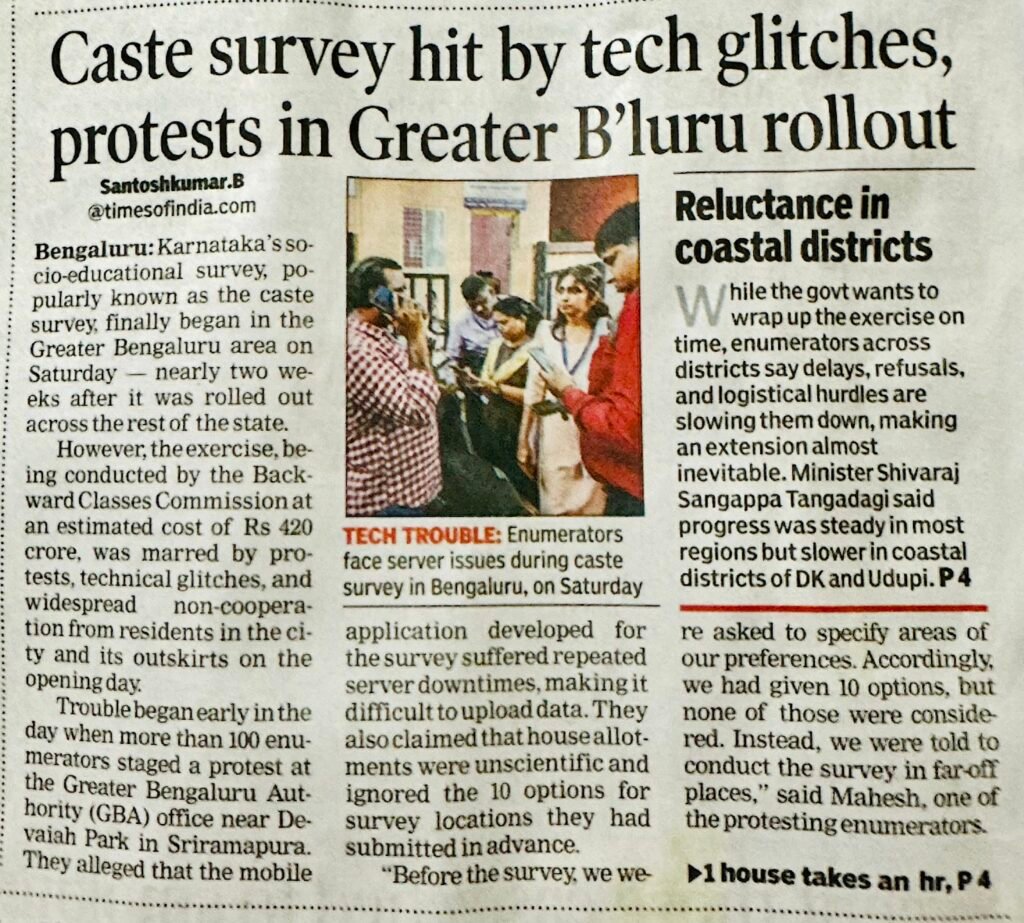
The ongoing survey in Karnataka about social, economic, and educational matters is facing challenges due to strong resistance from citizens in Bengaluru. Many people there are refusing to join in, saying they are concerned about their privacy and don’t trust the reasons for collecting the data. In other areas, the data collectors have experienced issues with the mobile app used for the survey.
BBMP staffer caught on CCTV allegedly assaulting a Bengaluru house owner, Nandeesh, during the ongoing SC community survey. Stickers pasted without consent, and when questioned, the civic worker resorted to physical violence. pic.twitter.com/BIFlp0Pvfm
— Harish Upadhya (@harishupadhya) July 4, 2025
Karnataka High Court Upholds Voluntary Social Survey: Ensures Data Privacy & Rejects Census Claims
Court’s Decision
The Karnataka High Court upheld the State Government’s decision to conduct a social and educational survey to gather data on caste and community composition, while clarifying that the exercise cannot be equated with a ‘census’ under the Census Act, 1948, which falls within the exclusive domain of the Union Government.
The Division Bench led by Chief Justice Vibhu Bakhru observed:

Accordingly, the Court permitted the continuation of the survey but imposed strict safeguards — data collection must be voluntary, anonymised, and restricted solely to welfare and policy purposes.
Facts
The petitioners, comprising individuals and civil society organisations, challenged the Government of Karnataka’s decision to carry out a socio-educational survey involving collection of caste-related data. The State had authorised the Karnataka State Backward Classes Commission (KSBCC) to conduct the exercise, describing it as a “survey” aimed at updating the socio-economic and educational conditions of communities across the State.
The petitioners contended that the State’s actions amounted to conducting a “parallel caste census”, an act falling exclusively under the Union List. The exercise, they argued, went beyond the State’s legislative competence and violated citizens’ right to privacy and equality under Articles 14, 19, and 21 of the Constitution.
The State, on the other hand, maintained that it was merely collecting data to assess social indicators and to enable equitable distribution of welfare benefits. It assured that no coercive steps would be taken against individuals who declined to participate and that the collected data would remain confidential.
Issues
- Whether the Karnataka Government has the legislative competence to conduct a caste-based survey.
- Whether the impugned exercise amounts to conducting a “census” reserved for the Union under the Census Act, 1948.
- Whether the data collection process infringes citizens’ fundamental rights under Articles 14 and 21, particularly the right to privacy.
- Whether participation in the survey can be made compulsory.
Petitioners’ Arguments
The petitioners contended that the State’s notification authorising the KSBCC to conduct a “social and educational survey” was ultra vires the Constitution, as “census” is a Union subject under Entry 69 of List I in the Seventh Schedule. They argued that the State had no authority to initiate a parallel caste enumeration process, as this would lead to duplication, inconsistencies, and misuse of data.
It was further contended that the survey intruded upon the right to privacy, as recognised in Justice K.S. Puttaswamy v. Union of India (2017). The collection of caste data, especially without informed consent or robust safeguards, could enable profiling and discrimination, contrary to the constitutional mandate of equality under Article 14.
The petitioners emphasised that even if the exercise were termed a “survey,” its design and scope mirrored that of a census, involving detailed demographic, social, and economic data collection. Thus, the nomenclature could not conceal the fact that it was a de facto census exercise.
Respondent’s Arguments
The State defended its action by asserting that the survey was not a census but a legitimate welfare measure aimed at identifying the socio-economic and educational status of various communities. It argued that Entry 45 of List III (Concurrent List) empowers both the Union and the State to legislate on matters concerning social welfare and economic planning.
The State further contended that caste and community data are essential for the effective implementation of reservation policies, welfare schemes, and resource allocation. It stressed that the data would remain confidential and anonymised, and no individual could be forced to disclose personal information.
The respondents also cited precedents such as State of Tamil Nadu v. K. Shyam Sunder (2011) to argue that States can collect data to supplement the Central Census for welfare administration. The Government assured the Court that participation would remain voluntary and that refusal to answer questions would not attract penalties.
Analysis of the Law
The Court examined the distribution of legislative powers under the Seventh Schedule, noting that “Census” appears in Entry 69 of List I, granting exclusive competence to the Union. However, the State retains concurrent power under Entries 20 and 45 of List III to collect data relevant to planning, welfare, and social justice.
Therefore, while a State cannot conduct a census, it can undertake surveys for welfare objectives, provided such surveys do not purport to assume the status, scope, or compulsive powers of a census.
The Court also examined Section 3 of the Census Act, 1948, which authorises the Central Government to appoint Census Commissioners and conduct population enumeration. The Act, being exhaustive, leaves no room for States to replicate or parallel its framework.
Further, invoking the right to privacy under Puttaswamy, the Court held that personal information such as caste, community, or economic details can be collected only with informed consent, and the State must ensure proportionality, data minimisation, and purpose limitation.
Precedent Analysis
- Justice K.S. Puttaswamy v. Union of India (2017) – Established privacy as a fundamental right; the State must show legality, necessity, and proportionality before collecting personal data. Applied to require safeguards in the survey process.
- State of Tamil Nadu v. K. Shyam Sunder (2011) 8 SCC 737 – Recognised that States may collect caste data to evaluate backwardness for welfare measures, but not as a substitute for the Union Census.
- Indra Sawhney v. Union of India (1992) Supp (3) SCC 217 – Discussed the necessity of empirical data in determining backwardness; referred to justify collection for welfare purposes.
- Romesh Thappar v. State of Madras (1950 SCR 594) and Maneka Gandhi v. Union of India (1978) – Cited for the principle that restrictions on individual liberty must satisfy reasonableness and due process.
Court’s Reasoning
Chief Justice Bakhru, writing for the Bench, observed that the State Government has not transgressed constitutional boundaries by conducting a socio-educational survey. However, the Court emphasised that the survey cannot mimic or parallel a census, as that would violate the Union’s exclusive authority.
The Court clarified that mere collection of caste-related data does not amount to conducting a census if it is done voluntarily and for limited welfare purposes. However, compelling individuals to disclose personal details or using the data for political purposes would breach constitutional safeguards.
The Bench stressed:
“The right to privacy includes the right to informational self-determination. Data collected must be used only for the purpose stated, and participation must be voluntary.”
Accordingly, the Court directed the State to:
- Ensure the survey remains non-coercive and voluntary.
- Anonymise and encrypt all collected data.
- Restrict data use to welfare and policy formulation.
- Prohibit disclosure or public dissemination of raw data.
Conclusion
The High Court upheld the validity of the survey, rejecting challenges to its constitutionality but imposing clear conditions to protect individual rights. The State’s authority to collect social and economic data was recognised as part of its welfare mandate, provided it did not encroach upon the Union’s power to conduct a census.
The Court struck a careful balance between State competence and individual privacy, reaffirming that data-driven welfare cannot come at the cost of constitutional liberties.
Implications
- Establishes a precedent that States can conduct welfare surveys but not population censuses.
- Reaffirms that data collection must comply with privacy and proportionality principles under Puttaswamy.
- Imposes strict accountability and purpose limitation on the use of caste-based data.
- Clarifies that participation in such surveys must remain voluntary, ensuring informed consent and confidentiality.
Copy & Paste the Link to download the order:
: https://rawlaw.in/wp-content/uploads/2025/10/WP_28671_2025_Caste-Census-1.pdf
Bengaluru Caste Survey Faces Hurdles On First Day, Enumerators Stage Protest Near Malleshwaram Office
Ref:
- https://www.indiacode.nic.in/bitstream/123456789/8304/1/act_%26_rules_corrected_29-5-08%281%29_doc.pdf
- https://rawlaw.in/karnataka-high-court-census-voluntary-participation/
Also Read: