

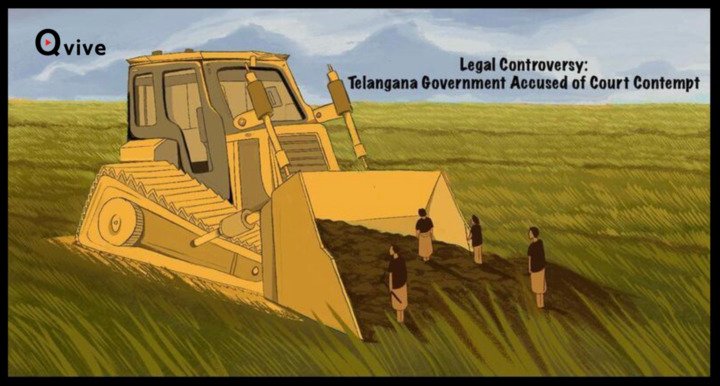
In 2013, a new law was introduced to stop land grabbing in India. However, Telangana demonstrated how simple it was to bypass this law by seizing farmland for a massive 20,000-acre pharmaceutical city.
The Hyderabad Pharma City in Telangana serves as a case study exemplifying how the state has flouted the 2013 Land Acquisition Rehabilitation and Resettlement Act (LARR) which attempts to safeguard the farmer’s interest. One of the farmers Papi Reddy finds out that his land has been indiscriminately earmarked for acquisition by the TSIIC (Telangana State Industrial Infrastructure Corporation). This “missing” consent issue affects some 1,000 farmers. Within the legal framework, the Government has resorted to fraudulent methods of land acquisition. The law’s requirement for consent, compensation, and even a basic respect for land is neglected. The law is critiqued for its intention perpetuated through myths of development. This article illustrates the enduring injustice against the farmers where state and market forces combine to silence the voices of the people. It reveals the conflict between industrialization and the farmers’ struggle for existence, showing state interventions that neglect welfare policies.
Ref: https://scroll.in/article/1037993/how-telangana-subverted-indias-land-acquisition-law
Tatiparthy Village, Yacharam Mandal, Ranga Reddy District, Telangana – Saraswati Kavula, a farmer, journalist, and social activist from Nandiwanaparthy Village in Rangareddy District, has accused government officials in Telangana of blatant contempt of court in a land acquisition case involving farmers in surrounding villages. Saraswati, who works to support fellow farmers and landless labourers, claims that state officials are defying High Court stay orders regarding the acquisition of agricultural land.
The dispute centers around land acquisition by the Telangana State Industrial Infrastructure Corporation (TGIIC) in villages like Medipally, Nanaknagar, Tatiparthy, and Kurmidda. Saraswati and her team have been assisting farmers in filing petitions with the High Court to protect their rights to life and livelihood, challenging what they believe are unconstitutional methods of land acquisition employed by the Land Acquisition Officer – RDO Ibrahimpatnam.
On April 11th, 2025, tensions escalated when TGIIC contractors began fencing off farmlands and even a lake in Tatiparthy village, despite existing stay orders from the High Court prohibiting any possession of the land or coercive actions.
“The state government is hell-bent on violating the court orders,” Saraswati stated. “Despite giving objections to the District Collector for the past week, reminding them about the Contempt of Court, they have continued the fencing with a huge police force.”
According to Saraswati, similar actions took place earlier in Medipally village, where fencing work commenced on April 3rd, 2025, again with a large police presence, despite villagers informing officials about the stay orders.
The High Court orders specifically stated, “Not to take possession of land and not to do any coercive action.” This applied to lands where farmers had obtained a stay order and to all lands where landowners had given consent for acquisition of the land by the state.
The situation reached a boiling point when Saraswati went to the field in Tatiparthy to object to the fencing and request the work be halted. She alleges that Inspector Likki Krishnam Raju from the Pharmacity police station reacted aggressively.
“He said, ‘You have no business to be here. You will be liable,'” Saraswati recounted. “I said, as a citizen, it’s my right. He was shouting, ‘Why are you here, do you belong to this mandal, do you have adhaar from here, how dare you question me while I am doing my official duty?'”
When Saraswati pointed out that the fencing was a violation of the court orders, she claims Raju dismissed her concerns, saying, “Go file the contempt. We won’t stop this work.”
Saraswati sees this incident as symptomatic of a broader disregard for the law under the current state government. “This is how government officials are functioning in Revanth Reddy’s government,” she asserted.
Saraswati and her team have already submitted letters to the District Collector, SDM, DCP, and ACP, outlining their concerns about the contempt of court. They argue that the fencing and other actions taken by TGIIC officials are a direct violation of High Court orders and an infringement upon the rights of the affected farmers.
Saraswati maintains that she was performing her constitutional duty under Article 51A, which obligates citizens to protect the natural environment, including lakes, and to stop the commission of offences. She claims to have been intimidated and threatened by Inspector Raju for simply trying to uphold the law and protect the rights of the affected farmers. The incident highlights the ongoing struggles between landowners and state authorities in Telangana, with allegations of government overreach and disregard for legal processes.
Addtional Information:
In India, when officials ignore High Court stay orders, several legal actions can be initiated to address such non-compliance. Here’s a detailed breakdown of the steps and potential actions that can be taken:
1. Contempt of Court Proceedings
The primary legal action that can be taken against officials who disregard High Court orders is initiating contempt of court proceedings. Under the Contempt of Courts Act, 1971, contempt can be classified into two categories: civil contempt and criminal contempt.
- Civil Contempt: This occurs when there is willful disobedience to any judgment, decree, direction, order, writ, or other processes of a court. If an official fails to comply with a stay order issued by the High Court, they may be held in civil contempt.
- Criminal Contempt: This involves actions that scandalize or lower the authority of the court or interfere with the administration of justice. If an official’s actions are deemed to undermine the court’s authority due to their disregard for a stay order, they may face criminal contempt charges.
2. Filing a Petition for Contempt
A party aggrieved by the non-compliance can file a petition for contempt before the same High Court that issued the stay order. The petition must demonstrate how the official has failed to comply with the court’s directive.
- The petitioner must provide evidence showing that:
- A clear and specific order was issued by the court.
- The official had knowledge of this order.
- There was willful disobedience or neglect in complying with it.
3. Possible Consequences for Contempt
If found guilty of contempt, officials may face various consequences:
- Imprisonment: They could be sentenced to simple imprisonment for up to six months.
- Fines: The court may impose fines as a penalty for non-compliance.
- Compensation: The contemnor might also be ordered to compensate any party affected by their non-compliance.
4. Suo Moto Action by the Court
The High Court has the power to take suo moto (on its own motion) action against officials who ignore its orders. This means that even if no petition is filed by an aggrieved party, the court can initiate contempt proceedings if it becomes aware of non-compliance.
5. Administrative Actions
In addition to legal proceedings, administrative actions may also be pursued against officials ignoring High Court orders:
- Disciplinary Action: Government departments may initiate disciplinary proceedings against officials for dereliction of duty or misconduct.
- Suspension or Dismissal: Depending on the severity of their actions and departmental rules, officials may face suspension or dismissal from service.
6. Contact Information
Complaints Against Officials Disobeying High Court Judgments in India
While specific contact numbers may vary by region and agency, here are some general contacts:
- Central Vigilance Commission (CVC)
- Website: cvc.gov.in
- Phone: +91-11-24651113 / +91-11-24651114
- State Vigilance Commissions
- Each state has its own commission; you would need to visit your respective state’s official website for contact details.
- High Courts
- You can find contact information for various High Courts in India on their respective websites, where they often provide helplines or email addresses for filing grievances.
Legal actions that can be taken against officials ignoring High Court stay orders include initiating contempt of court proceedings (civil or criminal), filing petitions for contempt before the High Court, potential imprisonment or fines upon finding guilt in contempt cases, suo moto action by courts against non-compliant officials, and administrative disciplinary measures such as suspension or dismissal from service.
For further reading on these topics and specific case laws related to contempt proceedings and enforcement of court orders in India, you may refer to these links:
- Contempt Proceedings Overview [https://www.linkedin.com/pulse/contempt-proceedings-exploring-consequences-non-compliance-yy8vf ]
- Legal Framework on Interim Orders [ https://www.lawbeat.in/top-stories/contempt-court-disregard-courts-order-subordinate-cannot-fasten-liability-higher]
There specific agencies or bodies where complaints can be lodged against officials disobeying High Court judgments in India.
- Understanding the Judiciary’s Independence: The judiciary in India operates independently under the Constitution, meaning that the government does not interfere in judicial matters. This independence is crucial for maintaining the rule of law and ensuring that judicial decisions are respected and enforced.
- Role of High Courts: If there are allegations of disobedience or contempt regarding a High Court judgment, the appropriate course of action is to approach the same High Court that issued the judgment. High Courts have inherent powers to punish for contempt of court under Article 215 of the Constitution of India.
- Filing a Contempt Petition: Individuals aggrieved by non-compliance with a High Court order can file a contempt petition directly in that High Court. This petition should outline how the official has failed to comply with the court’s ruling.
- In-House Procedures: Each High Court has its own procedures for handling such grievances, which may include an inquiry into the alleged disobedience. The petitioner must provide verifiable facts and evidence supporting their claims.
- No Government Intervention: It is important to note that once a grievance related to judicial orders is forwarded to the concerned High Court, there is no further follow-up or correspondence from the government, as it does not play a role in these matters.
- Additional Mechanisms: For grievances against judicial officers themselves (not just other officials), these can also be addressed through internal mechanisms established by each High Court or through complaints directed to the Supreme Court if applicable.
- Online Grievance Redressal: Citizens can also utilize online platforms like CPGRAMS (Centralized Public Grievance Redress and Monitoring System) for lodging grievances related to judicial appointments or legal aid issues, but this system does not handle complaints about disobedience of court orders directly.
Ref:
- Guidelines on grievances received in Department of Justice [ https://doj.gov.in/guidelines-of-grievances/ ]
- Redressal mechanisms outlined by Department of Justice [ https://doj.gov.in/redressal-of-public-grievances/ ]
- Information on CPGRAMS usage [ https://doj.gov.in/redressal-of-public-grievances/ ]
Source: Scroll-Image Design | Divya Ribeiro
Also Read: