

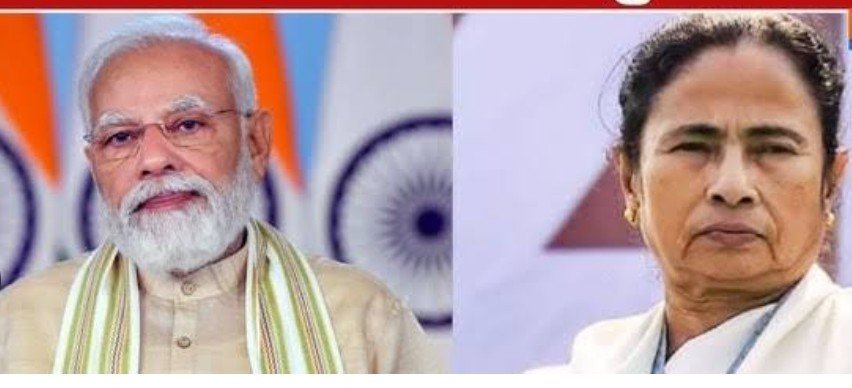
Voting is underway today for the second and final phase of West Bengal Assembly elections. The first phase saw a strong turnout of 92%. The second phase of voting today also saw a 90% voter turnout by 5 p.m. After voting in today’s election, the fate of all candidates will be sealed in EVMs. When these EVMs are counted for the vote count on May 4th, their fate will be decided. Some will win, some will lose. The victory or defeat of individual candidates will determine who will hold the key to power in West Bengal. Will Mamata Banerjee win this election and become Chief Minister of West Bengal for the fourth time, tying former Communist Party Chief Minister Jyoti Basu’s record of becoming Chief Minister five times, or will the BJP win this Assembly election and form its own government in West Bengal for the first time?
On May 4th, the election results will be announced for West Bengal, Assam, Kerala, Tamil Nadu, and the Union Territory of Puducherry. The BJP has previously held power in Assam and Puducherry. In the southern Indian state of Kerala, the Bharatiya Janata Party has yet to secure a single victory for its candidate in the Kerala Assembly elections. Even if the BJP pulls off a major election here, it could at best secure a few of its candidates’ victories, leaving power out of the question. In Tamil Nadu, another major southern state, the BJP may win a few seats in the 2021 Assembly elections in alliance with the AIADMK. However, in the current election, it cannot muster the necessary momentum to form a government with a BJP Chief Minister in this southern state. At best, it could become part of an AIADMK-led coalition government. In this context, the BJP is focusing its maximum efforts in the current assembly elections in West Bengal, hoping to form a government for the first time in at least one new state, where it has rapidly emerged as the leading opposition party in recent years. This will give it the status of a pan-India party. The BJP could also benefit significantly from this in winning the general elections in 2029.
Winning the West Bengal elections is even more important for Mamata Banerjee than it is for the BJP’s strategist duo PM Modi and Amit Shah. Winning the West Bengal elections would not only set a new record for itself by breaking Jyoti Basu’s record for longest-serving West Bengal ruler, but also secure a prominent position in national politics. In the absence of a universally recognized leader, the India Alliance, which has relied on Congress’s Rahul Gandhi as a mere figurehead, would gain a prominent leader in Mamata Banerjee before 2029. It is then highly likely that Mamata Banerjee, given her fighting spirit and her consistent leadership in West Bengal, will become the choice of a large segment of the country’s population in the 2019 general elections. In such a scenario, India Airlines could emerge as a strong alternative to the NDA, posing a political challenge to the PM Modi-led NDA alliance and potentially even overthrow the Narendra Modi-led government in the 2029 elections. While promising her voters victory in the current elections, Mamata Banerjee has also announced that the countdown to PM Modi’s departure from power at the Centre has begun and he will not be able to occupy the Prime Minister’s chair for long.
Whether the election results will go in favour of the BJP or the TMC will be known only after the results are declared on May 4th. However, there are several parameters that already indicate that after the election results are declared on May 4th, Mamata Banerjee will once again occupy the chair of Chief Minister of West Bengal or the BJP will succeed in pushing her out and installing one of its leaders on the chair of Chief Minister of West Bengal this time.
Increased Voting Percentage: This time, West Bengal witnessed a bumper voter turnout. In the first phase, over 93% of voters cast their ballots. In areas like Cooch Behar, the voter turnout was over 97%. The second phase also followed a similar pattern. Voting percentages in West Bengal are often quite high. A look at the voting percentages from 2011 to 2021 shows that this percentage has always been over 85%. For the current 2026 Assembly elections, the names of over 9 million voters have been deleted due to SIR. Adding these deleted voters, which amount to approximately 12%, to the previous voter turnout of 85%, results in a turnout of approximately 94-95%. In such a situation, the talk of bumper voter turnout, which both the Bharatiya Janata Party and the Trinamool Congress are claiming as evidence of their victory, is not true, and on this basis, the chances of victory for both are 50%-50%.
The SIR Issue: Despite the Special Intensive Revision (SIR), the Bharatiya Janata Party, its allies, the JDU, and other parties, achieved significant success in the Bihar Assembly elections. Consequently, the BJP is claiming victory in the West Bengal elections despite the SIR. However, for West Bengal, SIR is a major electoral issue that could play a significant role in the TMC’s victory. By raising the SIR issue from the streets to the Supreme Court, Mamata Banerjee has succeeded in winning public confidence on this issue. In particular, this SIR issue has further rallied a large section of Muslims to the TMC and against the BJP, which will benefit the TMC and harm the BJP.
Consistency: In 2011, when Mamata Banerjee’s TMC came to power for the first time in alliance with the Congress, the alliance won 227 seats and received a vote share of 39%. In the 2016 assembly elections, the TMC won 211 seats and received a vote share of 44.91%. In the 2021 assembly elections, the Mamata Banerjee-led TMC won 215 seats and its vote share increased to 48.02%. This occurred despite the BJP vigorously raising the issues of anti-incumbency and corruption in West Bengal. All of its key leaders, including PM Modi, Amit Shah, JP Nadda, Uttar Pradesh CM Yogi Adityanath, etc., held large-scale rallies in West Bengal. This measure of consistency points to a major victory for Mamata Banerjee’s TMC.
The BJP does not meet this standard of consistency. In 2011, it did not have a single MLA in West Bengal and only 4% of the electorate voted for it. In 2016, despite the arrival of PM Modi, the BJP failed to achieve any significant success in West Bengal, winning only three MLAs and a voter turnout of 10%. However, it made a significant jump in the 2021 assembly elections, winning 77 MLAs and its vote share also jumped significantly to 37.97%. However, this gift from the BJP came at the expense of the Congress and the Left parties, not because it made any significant dent in the sphere of influence of Mamata Banerjee’s TMC. And all this happened despite the BJP having won several prominent TMC leaders, including Suvendu Adhikari and Mukul Roy, in the 2021 elections. However, many of them, like Mukul Roy, later returned to the TMC. Moreover, voters who left Congress and the Left parties did not all join the BJP, but a significant number of them joined Mamata Banerjee’s TMC. Based on this, the TMC appears poised to win power in the West Bengal election results due on May 4th.
It’s slightly above 0%. Currently, the Muslim population may have increased significantly, as their fertility rate is much higher than that of Hindus. Consequently, the number of voters may have also increased. This Muslim community is even more upset with the BJP than before due to TMC leader Mamata Banerjee’s strong hold on this Muslim community, and the subsequent removal of their names from the SIR. Taking the Bihar election as an example, despite the resounding success of the PM Modi-led NDA, the BJP suffered a major defeat in the Seemanchal region, where the Muslim population is high.
Based on this metric, the Mamata Banerjee-led TMC appears poised to win in the election results due on May 4th compared to the PM Modi-led BJP.
Manifesto: In its manifesto, the BJP has promised to implement several programs, including free rations and permanent housing under the PM Kalyan Yojana, the Ayushman Yojana, and financial benefits under the Lakhpati Didi, Ujjwala Gas Scheme, the PM Kisan Yojana, and the Shramik Yojana. These schemes may attract voters to the BJP, but Mamata Banerjee’s government already provides ₹1,000 to general category women and ₹1,500 to SC/ST women under the Lakkhi Yojana. Additionally, several other schemes are underway, including scholarships for girl students under the Kanyashree Yojana, ₹25,000 for the marriage of girls under the Rupashree Yojana, ₹1,500 per month for unemployed youth under the Bangla Yuva Sathi, and medical facilities for the entire family under the Swasthya Sathi. The BJP’s welfare schemes are a promise, while the TMC’s Mamata Banerjee government’s schemes are a reality. Consider the example of Bihar, where the NDA government provided women with ₹5,000 bank loans, and women ignored the opposition political party’s promise of even higher amounts and voted for the NDA. Therefore, in this respect, the Mamata Banerjee-led TMC appears to have an edge over the Narendra Modi-led BJP.
Hindutva Issue: The BJP is assuming victory by polarizing West Bengal voters on the Hindutva issue. Meanwhile, the Mamata Banerjee-led TMC government provided financial support to all puja pandals during Durga Puja to woo Hindu voters. Furthermore, the BJP’s polarization on the Hindu issue has polarized Muslims in favor of the TMC. Therefore, if Mamata Banerjee succeeds in preventing the polarization of Hindu votes in favor of the BJP, as in the 2021 elections, the BJP will face difficulty in achieving its objectives.