

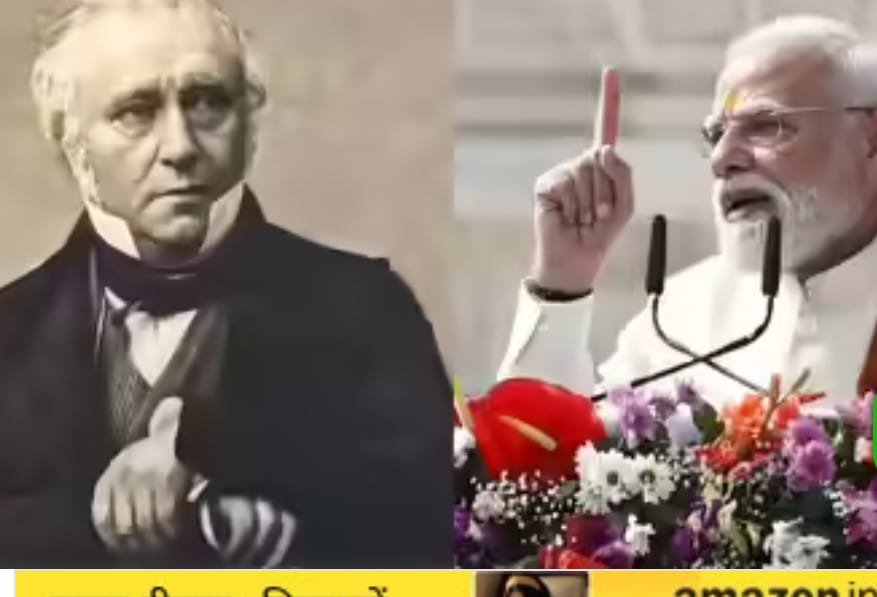
Prime Minister Narendra Modi recently stated at an event that in a few years, in 2035, India will complete 200 years since the English language was imposed in education. He stated that British historian and politician Thomas Babington Macaulay launched a colonial campaign to eradicate Indian culture 200 years ago. PM Modi emphasized that the coming decade is crucial for the people of India. We must undo the damage caused by Macaulay’s decisions before 2035.
He also said that countries like Japan, China, and South Korea adopted many Western concepts, but never compromised on their mother tongues. This is why the new National Education Policy (NEP) places special emphasis on education in local languages. PM Modi clarified that the government is not against the English language, but strongly supports Indian languages.
Explaining the rationale behind this appeal, Prime Minister Narendra Modi said that it all began in 1835, when Macaulay decided to introduce the English language into India’s education system. He advocated for the study of Western science and literature. At that time, the British colonial powers viewed the Indian education system as inferior to that of their own country, Britain. They considered their “Western” education model superior.
Macaulay’s primary goal was to create a new class in India that would grow up in an environment of Western education and the English language. Simply put, he wanted to create an English-speaking elite in India. This change in the education system in colonial India, which promoted Western education and opened avenues for progress, led to a decline in India’s traditional education system and local languages.
Historians believe that Macaulay believed that a new class of Indians, knowledgeable in English and familiar with Western thinking, would serve as a bridge between British rule and the general public. A statement made in his “Minute on Indian Education,” published in 1835, has become quite controversial. It has been widely discussed and misrepresented on social media in recent years.
Macaulay’s controversial speech in “Macaulay’s Minute on Education, February 2, 1835,” states:
All parties seem to agree that the dialects commonly spoken by the natives of India contain neither literary nor scientific information, and are so underdeveloped that it will be difficult to translate any valuable work into them unless they are enriched from other sources. It is universally acknowledged that the intellectual improvement of those pursuing higher studies can currently be effected only through a language that is not their mother tongue.
So what should that language be? Half of the committee says it should be English. The other half strongly supports Arabic and Sanskrit. For me, the whole question is: which language is worth knowing?
I know neither Sanskrit nor Arabic. But I have done all I could to assess their value accurately. I have read translations of the most famous Arabic and Sanskrit works. I have conversed with people, both here and at home, distinguished for their proficiency in Eastern languages. I am quite prepared to take Eastern knowledge at face value with Eastern scholars. I have found none of them who would deny that a shelf in a good European library is worth the entire native literature of India and Arabia. The intrinsic superiority of Western literature is, in fact, fully acknowledged by those members of the Committee who support the Eastern scheme of education…
The immediate effect of Macaulay’s imposition of the Western educational system and the English language on India’s traditional systems was a sudden decline in public interest in the Indian educational system. The cultural and long-term damage this caused included creating divisions in society and sowing seeds of doubt about Indian knowledge. PM Modi described the current consequences of Macaulay’s policy, instituted nearly 200 years ago, as “psychological slavery,” which needs to be permanently eradicated.
Macaulay wanted Indian youth to adopt Western knowledge and ideas. He believed this would make them more loyal to British rule and help run the administration. He described Indian languages as underdeveloped and poor, lacking any significant literary or scientific value. He stated that translating any significant work into these languages would be difficult.
Macaulay argued that higher education should be conducted in a language that was not the mother tongue of Indians. He considered English the best option. He stated that a shelf of European literature was equivalent to the entire literature of India and Arabia. This statement was highly controversial at the time and remains so today.
The effect of this policy was that traditional education in India, such as gurukuls and madrasas, gradually began to weaken. Those who learned English received better opportunities in government jobs and society. This created a new class that spoke English and was influenced by Western culture. This class was often called “Macaulay’s children.”
This policy influenced India.This policy created a cultural divide within India. On one side were those who embraced Western education and culture, and on the other were those who remained connected to their traditional roots. It also questioned Indian knowledge and traditions.