

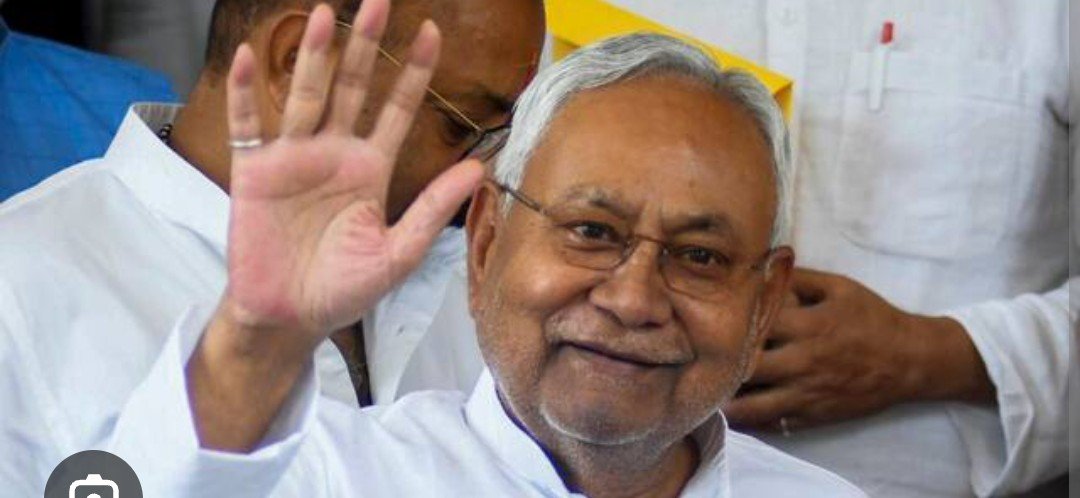
Nitish Kumar may make a big move with the BJP after the election results in five states.
Voters are turning out in large numbers in the recent assembly elections. The voter turnout in Tamil Nadu and Assam was 85%, while the first phase of voting in West Bengal saw a voter turnout of over 92%, breaking all previous election record highs. This bumper voter turnout has enthused the major political parties contesting in these states: the Congress, Communist Party, DMK, AIADMK, BJP, and TMC. Now, the leaders of these political parties are eagerly awaiting the election results on May 4th, as these results could catapult them to the pinnacle of power. However, there is another political party whose leader is closely watching the election results, even though none of its candidates is contesting any of these states. This political party is the JDU, and its leader is Nitish Kumar.
You might be surprised to learn that when no candidate from this political party is contesting elections in any of these states, why is the leader of this political party so keenly watching the election results? While this may seem surprising at first glance, when you examine the activities of Nitish Kumar, the leader of this political party, the JDU, you’ll realize that this isn’t surprising, but rather a reality.
Ever since the Bihar Assembly elections were being held in 2025, the BJP had been seeking to replace Nitish Kumar, the JDU Chief Minister, with the BJP’s Chief Minister. To this end, it began pressuring Kumar during the election campaign by having elected NDA MLAs claim he would be the next Chief Minister of Bihar. However, by the time the election results were announced, JDU leader Nitish Kumar had completely eliminated this pressure from the BJP and taken over the Chief Minister’s post. However, the BJP remained undeterred and continued its campaign. This time, it employed a new tactic to remove Nitish Kumar from the Chief Minister’s post. This time, citing Nitish Kumar’s ill health, they began pressuring him to resign as Chief Minister. This BJP ploy proved successful. First, they persuaded Nitish Kumar to appeal to his conscience and join the Rajya Sabha. Then, after his election to the Rajya Sabha, they forced him to resign as Chief Minister of Bihar on April 14th. On April 15th, they succeeded in establishing Samrat Chaudhary as the BJP’s first Chief Minister of Bihar.
Until now, Nitish Kumar had been submissive to the BJP’s pressure. But now, they have begun exerting similar pressure on the BJP. First, during the process of appointing a Chief Minister from the BJP camp, they exerted tremendous pressure on the BJP, forcing BJP strategists PM Modi and Amit Shah to appoint their favorite, Samrat Chaudhary, as Chief Minister of Bihar. And gradually, they are exerting pressure on the BJP to form a cabinet for a BJP government with Samrat Chaudhary as Chief Minister. To this end, they are carefully maneuvering each move.
Until the results of the assembly elections in these states are announced, Nitish Kumar does not want to exert any pressure on BJP strategists PM Modi and Amit Shah, fearing that his gamble may backfire. To this end, he cast a mild psychological pressure on the BJP by voting in favor of the vote of confidence brought by Bihar Chief Minister Samrat Chaudhary in the House today.
Currently, assembly elections are being held in Kerala, Tamil Nadu, Assam, West Bengal, and the Union Territory of Puducherry, with the results due on May 4th. While the election results in these states may not be significant from the perspective of gaining power, the BJP’s victory or defeat in these states holds significant significance for Nitish Kumar in terms of pressuring BJP strategists PM Modi and Amit Shah. If the BJP performs well in the assembly elections in these four states and one Union Territory, Nitish Kumar’s approach to pressuring BJP strategists PM Modi and Amit Shah may be somewhat compromising. And as part of this, he could reverse the agreement reached with the BJP during his tenure as Chief Minister, under which he sworn in two Deputy Chief Ministers from his party, Vijay Chaudhary and Vijendra Yadav, along with BJP Chief Minister Samrat Chaudhary.
But if the BJP does not achieve the desired results in the assembly elections of these states and Union Territories, Nitish Kumar could try to force BJP strategists PM Modi and Amit Shah to such an extent that, if not immediately after losing, Nitish Kumar would be forced to become the Chief Minister of Bihar again. Under this, Nitish Kumar could force BJP strategists PM Modi and Amit Shah to not only demand a relatively higher number of seats during Samrat Chaudhary’s cabinet expansion, but also to demand a lucrative seat in it.
If the results of the ongoing assembly elections in four states and one union territory do not favor the BJP, it will be better for Nitish Kumar to put pressure on PM Modi and Amit Shah, because earlier BJP strategists had also severely criticized the BJP in the matter of repeal of the Nari Shakti Vandan Amendment Act, which was introduced in the House by PM Modi and Amit Shah. Therefore, it will be interesting to see to what extent Nitish Kumar can pressure BJP strategists PM Modi and Amit Shah after the assembly election results are announced on May 4th and force them to make him the Chief Minister again.