

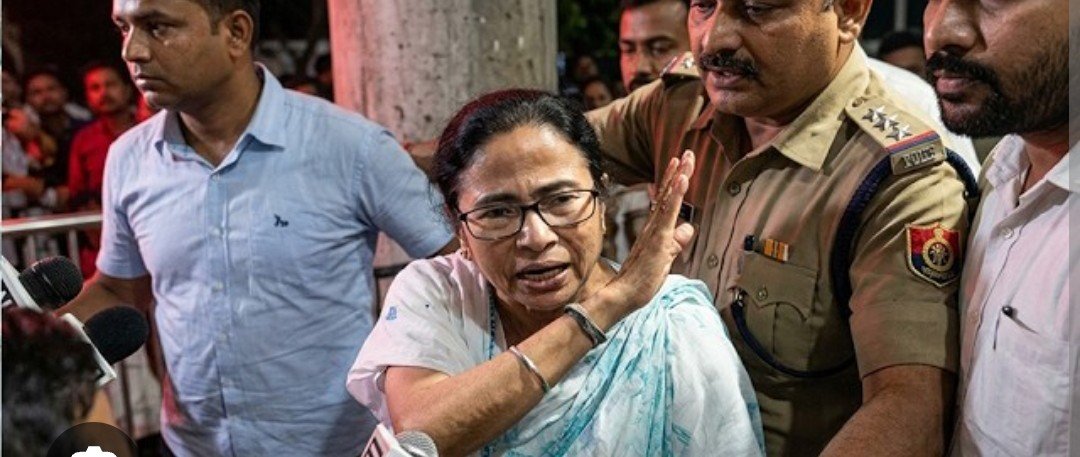
Refusing to resign from the highest positions of power has become a trend in politics these days. One such issue in West Bengal is currently the center of discussion. Despite her and her TMC party’s defeat in the assembly elections, West Bengal Chief Minister Mamata Banerjee is refusing to go to Lok Bhavan to submit her resignation. Her term as Chief Minister ends May 7th. Before delving into what might happen next in this matter, let me tell you the story of one such Chief Minister who stubbornly refused to resign. You may recall the incident in June 2024 when Delhi Chief Minister Arvind Kejriwal was accused of a liquor scam and was arrested and jailed by the Enforcement Directorate (ED). However, even after being imprisoned, Arvind Kejriwal refused to resign as Chief Minister and continued to administer Delhi from jail. You all saw the way the administration was functioning through the media, but he did not resign.
Now, let’s talk about Mamata Banerjee’s refusal to resign at Lok Bhavan, stating that she and her party, the TMC, did not lose the assembly elections, but rather that the Election Commission, working in favor of the BJP, forced their defeat. Following her insistence, the Election Commission swung into action and sent a notification to the Governor of West Bengal, stating that the completion of the West Bengal assembly elections had been completed, allowing him to initiate the process of forming a new government.
With the receipt of the Election Commission’s notification, the Governor will begin the process of forming a new government after May 7th, while Mamata Banerjee, on the other hand, is unwilling to relinquish her position as Chief Minister. This has raised the question in many minds: will the Governor have Mamata Banerjee arrested and imprisoned for refusing to resign as Chief Minister?
After losing the elections in West Bengal, Mamata Banerjee has lost her majority. Mamata Banerjee’s stubborn refusal to resign as Chief Minister despite losing her majority has created a constitutional crisis in West Bengal. Although the Constitution provides a process for resolving such a constitutional crisis, it does not mention imprisonment for the person who initiated it. Therefore, in this case, Mamata Banerjee cannot be imprisoned simply for not resigning from the post of Chief Minister. Yes! In this case, she can certainly be dismissed by the Governor for not resigning from the post of Chief Minister. Under Article 164 of the Indian Constitution, the Chief Minister holds office during the pleasure of the Governor and can be removed if the majority is not present.
Continuing to hold office despite losing the election creates a constitutional crisis, which the Governor can report to the President under Article 356 (President’s Rule). However, in this situation, President’s Rule would be imposed, depriving the BJP of its chance for a few days despite winning a landslide election victory.
The Governor can appoint the leader of the majority party as the new Chief Minister, automatically ending the term of the previous government.
That is, the overall situation is that whether Mamata Banerjee goes to Lok Bhavan and resigns from the post of Chief Minister or not, she can no longer remain the Chief Minister because the mandate has gone in favor of BJP and the Governor has sufficient powers to hand over the power to the leader of the BJP Legislative Party by swearing him in as the Chief Minister. But the Governor cannot put Mamata Banerjee in jail while doing so. However, if Mamata Banerjee does not vacate the Chief Minister’s residence even after the new Chief Minister comes to power in West Bengal or tries to create any other kind of obstacle, then the government with the BJP Chief Minister can definitely put her in jail.