

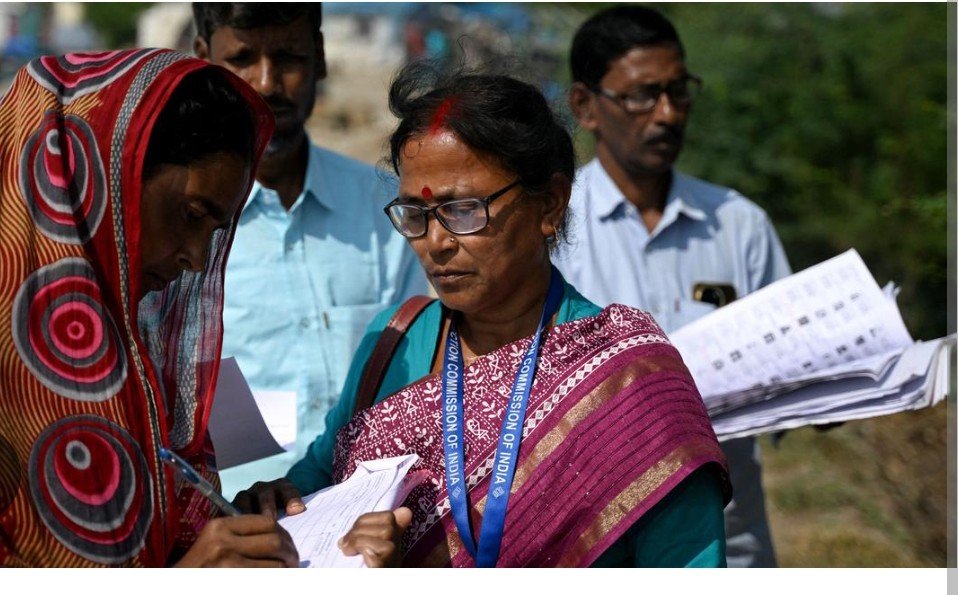
The issue of citizenship is currently hotly contested in our country. First, Aadhaar was delinked from citizenship, and for obtaining a PAN card, Aadhaar was used to provide one’s address, requiring other documents to be submitted instead. Now, passports, which were used to identify themselves as Indian citizens abroad, have been banned from being used as a basis for citizenship. During the ongoing nationwide voter revision, even with Aadhaar cards, the names of millions of people were deleted, citing their non-Indian citizenship status and requiring them to submit other documents in place of Aadhaar. Although the Supreme Court ruled that Aadhaar cards are inalienable in this case, officials associated with the Election Commission at the grassroots level continued to remove people’s names from the voter list despite their Aadhaar cards. This raises a significant question: who is a citizen of the country? What will happen to the large number of people whose names were deleted from the voter list on the grounds that they are not citizens? First, let’s understand who are Indian citizens?
Citizenship in India is primarily determined by the Citizenship Act, 1955 and the provisions of the Indian Constitution. Under this, there are five legal ways for a person to acquire Indian citizenship—by birth, by descent, by registration, by naturalization, and by accession of a new territory to India. 1. By Birth: Any person born in India between 26 January 1950 and 1 July 1987 is an Indian citizen by birth. A child born in India on or after 1 July 1987 acquires citizenship only if at least one of his/her parents was an Indian citizen at the time of birth. For children born on or after 3 December 2004, it is mandatory that one of the parents is an Indian citizen and the other is not an illegal immigrant. 2. By Descent: If you were born outside India after 26 January 1950 but before 10 December 1992 and your father was an Indian at the time of birth, you will be considered a citizen of India. For children born abroad after 10 December 1992, either the parents must be an Indian citizen at the time of birth. 3. By Registration: Persons of Indian origin who have been residing in India for seven years (period of first residence). Foreign citizens married to an Indian citizen. 4. By Naturalization: Any foreign national who has been residing in India continuously for the last 12 months and has been a normal resident of India for at least 11 out of the last 14 years can apply for citizenship. This period of 11 years has been reduced to 6 years for people belonging to Hindu, Sikh, Buddhist, Jain, Parsi and Christian religions coming from Afghanistan, Bangladesh and Pakistan.5. By accession of territory: If a new territory or area becomes part of India (like Sikkim did earlier), the Government of India can declare the people of that territory as Indian citizens. Proof of Citizenship: Legally, citizenship is not a single card or document, but the main documents used to prove it include the Indian passport, voter ID card, Aadhaar card, and birth certificate.
Articles Related to Citizenship in the Constitution (Articles 5-11) Article 5: Citizenship is granted to every person who was domiciled in India at the time of the Constitution’s commencement (January 26, 1950). Article 6: Citizenship rules for persons who migrated to India from Pakistan. Article 7: Citizenship for persons who migrated to Pakistan from India but later returned. Article 8: Citizenship rights of Persons of Indian Origin (PIOs) living outside India. Article 9: If a person voluntarily acquires citizenship of another country, His Indian citizenship will be terminated (the law of single citizenship). Article 10: Continuance of citizenship rights (subject to laws made by Parliament). Article 11: Parliament will have full power to make laws for the acquisition and termination of citizenship.
Now let’s discuss the people whose names were deleted from the voter list. Are these large numbers of people not Indian citizens, or are they all infiltrators, as the Bharatiya Janata Party claims?
In fact, all this confusion is happening because, until now, in our country, the responsibility of verifying their Indian citizenship has been imposed on the people themselves. There is no provision yet to punish Election Commission officials who arbitrarily delete the names of many legitimate citizens from the voter list. It is noteworthy that after deleting names from the voter list, a large number of people were later added to the voter list, believing them to be Indian citizens. Not only in cases related to citizenship, but in other cases as well, individuals are often held guilty, while government officials are considered completely innocent. Despite the truth of the case being proven, no action is taken against them.
Ideally, leaving aside other methods of citizenship and only those granted by birth and descent, the Indian government maintains complete data on the birth of any child. For this, it maintains a large army of officials, from senior officials to Anganwadi workers and assistants.
For whose salaries and honorariums, a huge amount of money is spent from the government treasury. In such a situation, if any child born in India is deprived of Indian citizenship, then isn’t it the responsibility of the Indian government and all its officials and employees to issue timely citizenship certificates to those born in India and keep track of it? And shouldn’t there be a provision for punishment for them if this is violated? If these officials and employees are held responsible for this and a provision for punishment is made, then surely not only the problems currently surfacing regarding citizenship, but all other irregularities will automatically end. Indian citizens must enjoy every right granted by the Constitution or law, whether it’s citizenship, enrollment in the voter list, a ration card, or any other government benefit. These rights are theirs. If a government official or employee’s negligence deprives them of these benefits, Parliament should hold them accountable and enact a stringent law to punish them. As for the issue of illegally obtaining such benefits through manipulation, government officials and employees are also responsible for this; corruption cannot occur without their involvement. In such cases, there should be stringent punishments for both government officials and employees and the perpetrators.