

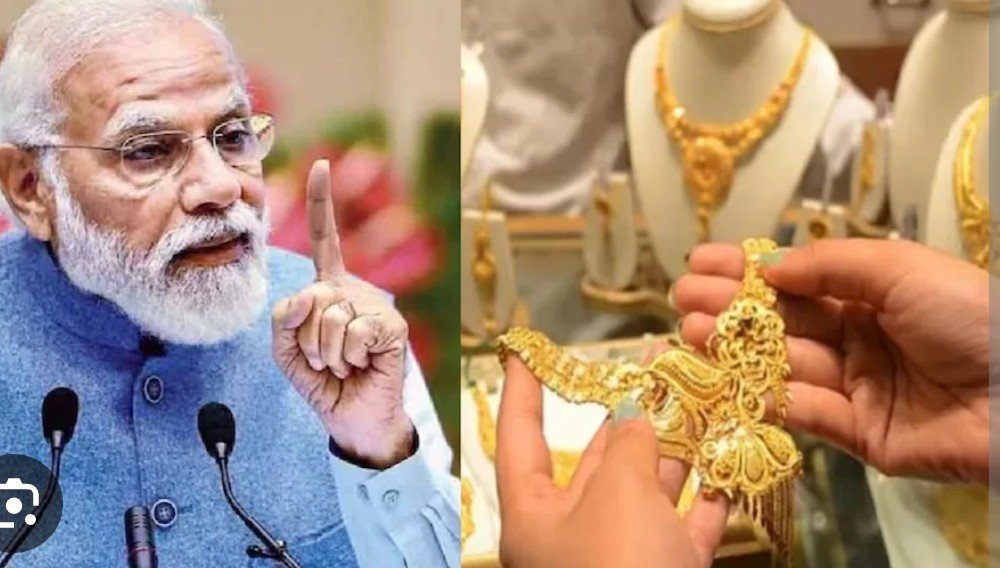
On May 10, 2026, while addressing a public rally in Secunderabad (Hyderabad), Telangana, Prime Minister Narendra Modi appealed to citizens to abstain from buying gold for the next one year. This sparked a flurry of discussions across the country regarding gold purchases. Most people focused on the apparent reasons cited by the Prime Minister or the opposition’s claim that Prime Minister Narendra Modi was also instrumental in assessing the outcome of Iran’s war with the United States and Israel. Prime Minister Narendra Modi’s working style is such that it’s difficult for people to easily discern what’s going on in his mind.
Prime Minister Narendra Modi’s appeal to citizens to abstain from buying gold for the next one year during the Middle East war is also similar. Prime Minister Narendra Modi has apparently revealed many things, but there’s something else going on in his mind that remains to be revealed. Otherwise, just as he abruptly announced demonetization in India in his address to the nation at 8:00 pm on November 8, 2016, he would have announced a ban on gold. However, he didn’t do so; he didn’t enact any law banning the purchase of gold, nor did he issue any such circular. He merely made a moral appeal to the public, asking them not to buy gold for the next year, given the consequences of the Middle East war. This appeal also holds many secrets hidden within. Today’s news will reveal some of these secrets hidden in the Prime Minister’s mind. But before that, let’s reiterate the points he made when appealing to the public not to buy gold for the next year.
Saving Foreign Exchange: India is a major importer of gold. To purchase gold from abroad, the country has to spend its foreign exchange reserves (dollars).
Global Crisis: Tensions in West Asia and rising crude oil prices are putting pressure on India’s economy and foreign exchange reserves.
Economic Self-Reliance: PM Modi appealed to the public to demonstrate “economic patriotism” during this global crisis and avoid unnecessary expenses, foreign trips, and wedding purchases, so that the foreign exchange reserves saved by avoiding such expenses can be used to purchase essential petroleum products and gas, despite the high prices.
While the above-mentioned obvious reasons are important, Prime Minister Narendra Modi’s concern about gold in India is even more significant. However, PM Modi will have to do considerable homework to take action on this crucial issue, as corrupt businessmen, bureaucrats, and politicians are behind these crucial issues.
Unregulated Gold Trade in India: The RBI has granted permission to 17 banks, including SBI, PNB, ICICI, Axis Bank, and HDFC, to purchase gold from the international market. While the common man can buy gold from these banks, several factors, including the banks’ refusal to buy back gold and their own profit policies, result in the banks selling most of their gold to approximately 20-25 trading houses, which profit by arbitrarily determining the price of gold in the country.
A major scam involving Rajesh Exports, one of these 20-25 gold trading houses, has come to light, allegedly making illegal profits by manipulating the price of gold. This has strengthened PM Modi’s desire to take further action against gold.
The Securities and Exchange Board of India (SEBI) has initiated an interim investigation into alleged fraudulent revenue and fund misappropriation of ₹15.15 lakh crore against Rajesh Exports, a well-known gold refining and jewellery company, and its chairman, Rajesh Mehta. The case is considered one of the biggest financial scams in Indian corporate history. Some key points related to this scam are as follows:
Fake Revenue: Regulator SEBI alleges that the company allegedly inflated and fraudulently reported turnover of approximately ₹15.15 lakh crore between FY 2021 and FY 2025. Accounting Fraud: The SEBI report found that the company had shown trade (buying and selling) of more than ₹11,000 crore with an entity called ‘Affluence’, but the entity has categorically denied any such transactions. Fund Diversion: The investigation also revealed that company funds were allegedly diverted to promoter Rajesh Mehta’s personal accounts and used for personal derivatives trading.
Company’s Stand: After the allegations surfaced, Rajesh Exports has denied allegations of financial irregularities and fund diversion. Chairman Rajesh Mehta has clarified that SEBI had not added the revenue of their subsidiary company (Valcambi) and it is only a “communication gap”.
Along with this major gold trader, a gang of gold smugglers is also active in the country. The recent significant increase in gold import duties in India (from 6% to 15%) has led to a surge in gold smuggling. It is estimated that the amount of illegally imported gold could exceed 100 metric tons (approximately $14.35 billion), up from just 20.4 metric tons in 2025.
The following are the key figures and reasons for this alarming increase in gold smuggling:
Trend in smuggling: When the import duty on gold was reduced to 6% in 2024, illegal imports dropped to 69.2 tons in 2024 and further to 20.4 tons in 2025. However, after the duty was returned to 15% in May 2026, smuggling increased again. Huge Profit Margin: Due to the tax, smugglers (gray market) are earning huge profits of approximately ₹2.5 million (approximately $26,000) per kilogram. Smuggling Methods: Due to stricter airport surveillance, smugglers are increasingly using new methods (such as concealing gold as paste, fitting it into electronic devices) and land borders. Impact on the Legal Market: Smuggling is causing huge losses to legitimate importers and refineries, as smugglers are selling gold at a price of $200 per ounce (approximately 4% or more) less than legal gold.
A look at all these points makes it clear that Prime Minister Narendra Modi’s statement about postponing gold purchases for a year is not meant to scare ordinary citizens, but to intimidate the scamsters and smugglers involved in gold dealing in the country.