

Bengaluru: The ISRO on Sunday said it successfully reduced the orbit of the Chandrayaan-3 mission’s Lander Module (LM), further bringing it nearer to the moon.
The national space agency also said that the LM would now undergo internal checks.
The LM, comprising the lander ‘Vikram’ and rover ‘Pragyan’, is expected to touch down on the lunar surface on August 23 evening, it said.
“The second and final deboosting (slowing down) operation has successfully reduced the LM orbit to 25 km x 134 km. The module would undergo internal checks and await the sun-rise at the designated landing site. The powered descent is expected to commence on August 23, 2023, around 1745 Hrs IST,” ISRO said in a post on ‘X’ (formerly Twitter) on Sunday.
The LM of Chandrayaan-3 successfully separated from the Propulsion Module on Thursday, 35 days after the mission was launched on July 14.
ISRO sources earlier said, that after the separation, the lander is expected to undergo “deboost” (the process of slowing down) operations to place it in an orbit, where the Perilune (the orbit’s closest point to the Moon) is 30 kilometres and Apolune (farthest point from the Moon) is 100 km, from where the soft landing on the south polar region of the Moon will be attempted.
At around 30 km altitude, the lander enters the powered braking phase, and begins to use its thrusters to reach the surface of the moon, they said, adding that at an altitude of about 100 m altitude, the lander would scan the surface to check whether there are any obstacles and then start descending to make a soft landing.
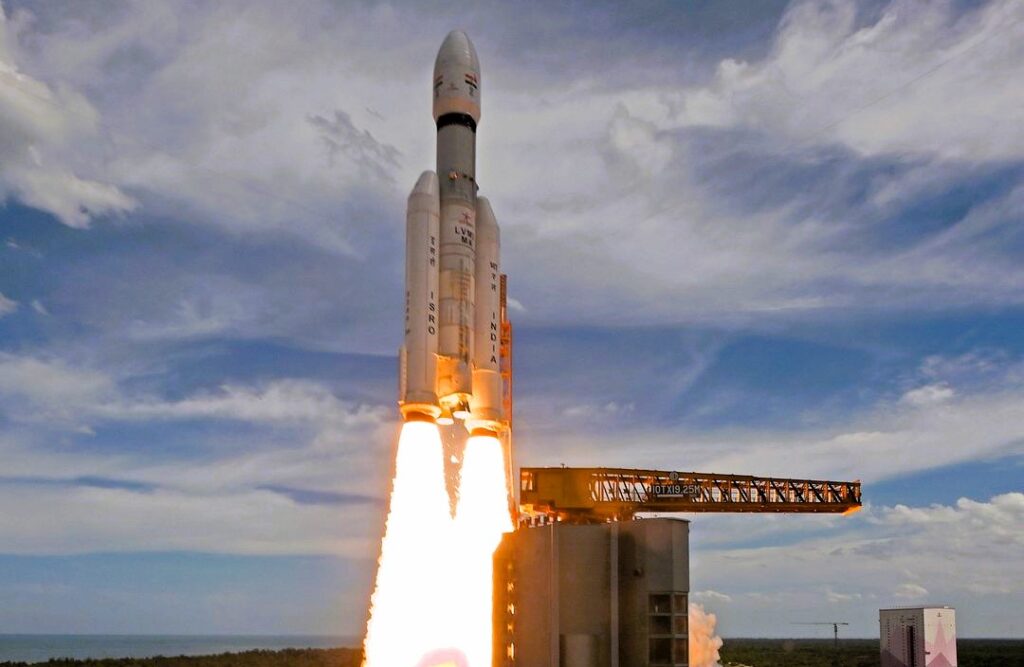
Post its launch on July 14, Chandrayaan-3 entered into the lunar orbit on August 5, following which orbit reduction manoeuvres were carried out on the satellite on August 6, 9, 14 and 16, ahead of the separation of both its modules on August 17, in the runup to the landing on August 23.

Earlier, over five moves in the three weeks since the July 14 launch, ISRO lifted the Chandrayaan-3 spacecraft into orbits farther and farther away from the Earth.
Then, on August 1 in a key manoeuvre — a slingshot move — the spacecraft was sent successfully towards the Moon from Earth’s orbit. Following this trans-lunar injection, the Chandrayaan-3 spacecraft escaped from orbiting the Earth and began following a path that would take it to the vicinity of the moon.
Chandrayaan-3 is a follow-on mission to Chandrayaan-2 to demonstrate end-to-end capability in safe landing and roving on the lunar surface.
The mission objectives of Chandrayaan-3 are to demonstrate a safe and soft landing on the lunar surface, to demonstrate rover roving on the Moon, and to conduct in-situ scientific experiments.
The lander has the capability to soft land at a specified lunar site and deploys the rover that will carry out in-situ chemical analysis of the Moon’s surface during the course of its mobility.
The lander and the rover have scientific payloads to carry out experiments on the lunar surface.
PTI