

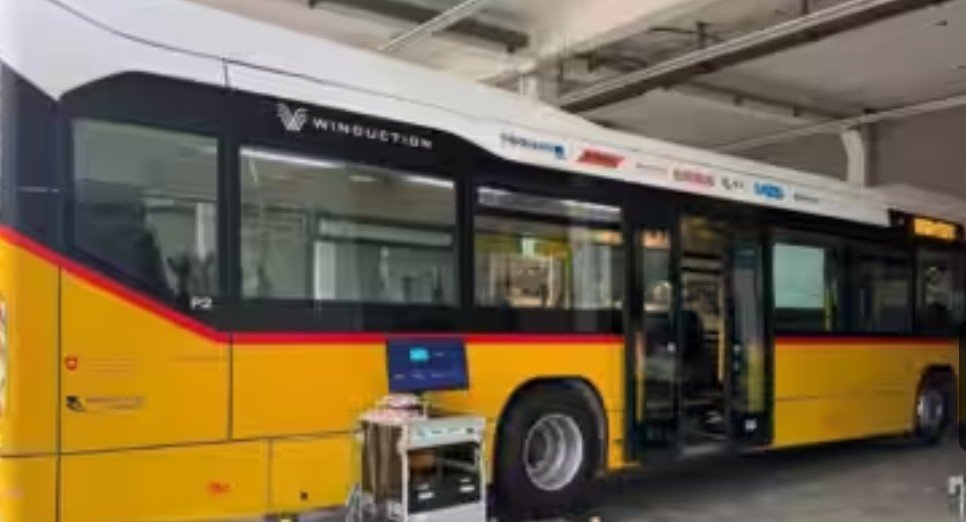
Until now, charging electric vehicles or buses required heavy and cumbersome cables, which also took hours to complete. To address this problem, Winduction, a spin-off from Switzerland’s prestigious ETH Zurich, has developed a wireless charging technology that allows the bus to be charged directly from its wheels.
This system activates when passengers board or disembark the bus and can deliver a tremendous efficiency of 90%. If this technology is adopted on a large scale, it could transform the face of electric vehicles and public transport.
Typically, a considerable distance is required between the road plate and the vehicle to wirelessly charge vehicles or buses, slowing down the speed of power transfer.
To reduce this distance, Winduction fitted the charging coil directly into the bus tires. This significantly reduced the distance between the charging plate and the coil.
This unique technology allows the charging plate, installed on the road, to connect to the grid and create a magnetic field. As soon as the bus stops on that plate, the coils inside the tire transfer the electricity directly to the battery.
The advantage of this technology is that the bus’s wheels remain in constant contact with the current-carrying plate. This results in less than 10% energy wastage.
According to reports, normal tires use steel belts for strength. These were incompatible with wireless technology. To address this challenge, the company developed a new type of steel-free tire. These tires made it possible to charge the bus wirelessly.
Furthermore, with on-the-road charging, there was no need to install heavy batteries in the buses. Furthermore, smaller batteries will reduce the purchase cost of the bus, reduce weight, and create more space for passengers.
This technology was tested on a 24-stop route between Zurich Airport and Zurich Oerlikon. The buses only needed to be charged twice along the entire route.
During a 16-hour day, these buses will be able to charge for a total of three hours in increments, eliminating the burden of five hours of simultaneous charging at the depot overnight.
This will also reduce the load on the grid. If all goes well, passenger trials of this technology could begin in 2028.