

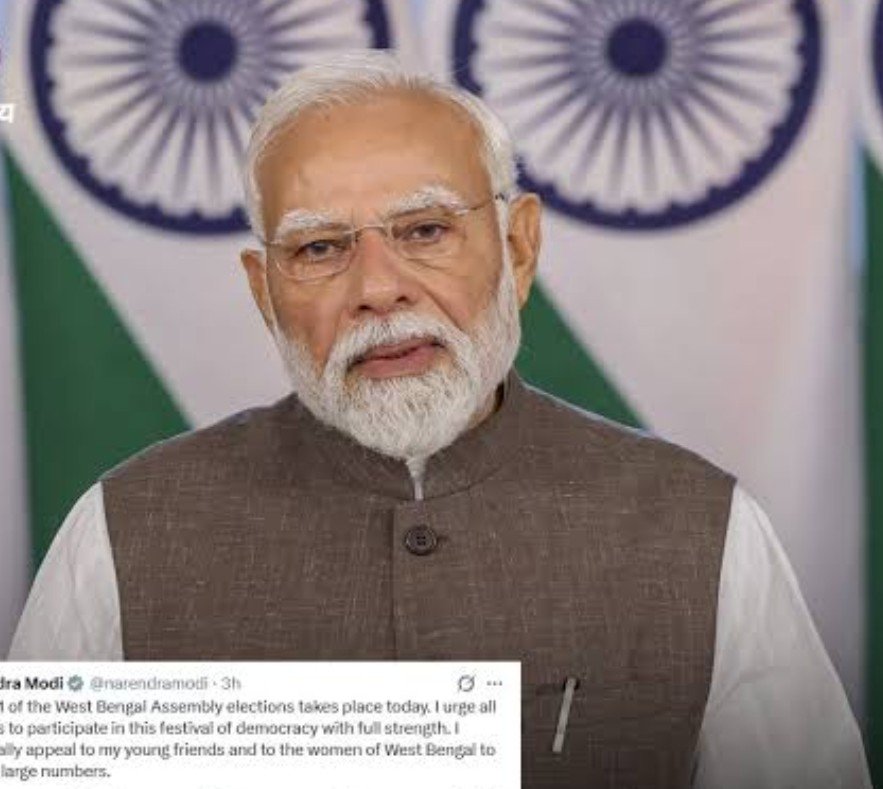
After elections in four states and one union territory, the election results have been announced. In Kerala, the Left-led LDF is set to be replaced by the Congress-led UDF. In Tamil Nadu, another southern state, film actor-turned-politician Vijay Thalapathy is set to become the Chief Minister of the coalition. In Assam, Himanta Biswa Sarma is poised to take the Chief Minister’s chair for the second consecutive term. In Puducherry, N. Rangaswamy is poised to assume the Chief Minister’s chair for the fifth time as the NDA’s Chief Minister. People are watching all this casually. However, after the change of power in West Bengal, people are paying particular attention to who will take over as Chief Minister.
The selection of the Chief Minister of West Bengal is not particularly important because the Narendra Modi-led central government had to deploy a large number of central security forces through the Election Commission to defeat Mamata Banerjee’s TMC in West Bengal. It’s not me, but Mamata Banerjee, who is saying this. Furthermore, the deployment of central forces for the West Bengal elections was witnessed firsthand by the people of West Bengal, and seen elsewhere through the media. Mamata Banerjee claims her and her party, the TMC, lost 100 seats, not because of the BJP’s (Narendra Modi-led) government’s forceful capture of 100 seats. But the BJP is unconcerned, fearing that the fights that have broken out between TMC and BJP supporters in various locations after the election results were announced will plunge West Bengal into chaos. To address this, the central forces deployed in West Bengal have already been decided to remain in place for the next month. But something is causing the Narendra Modi-led Bharatiya Janata Party to prioritize the selection of a Chief Minister in West Bengal, leaving aside other states where it has won a majority.
The underlying reason for this is the promise made by prominent BJP leaders like Narendra Modi and Amit Shah to make Bengal free from fear. This fear in West Bengal is of a syndicate. The terror of syndicates has been prevalent in West Bengal since the Communist era. When Mamata Banerjee came to power by raising the Singur issue and replacing the Communists, this syndicate also changed its guise and began working for the TMC. During Mamata Banerjee’s three consecutive terms as Chief Minister of West Bengal, winning the West Bengal Assembly elections, this syndicate’s roots became even stronger in West Bengal. Their work ranged from meddling in people’s daily affairs to interfering in major matters, extorting commissions from them, and then distributing the money to TMC leaders, from the lower-level leaders to the higher-level ones, after taking their own commissions. In a way, the terror of these syndicates prevailed among the people of West Bengal. Trusting this promise made by PM Narendra Modi and other senior BJP leaders, the people of Punjab wiped out the TMC this time. Now, top BJP leaders like Narendra Modi and Amit Shastri believe that if the Syndicate leaves the TMC and joins the BJP, their promise will be nullified. Mamata Banerjee will then begin to raise this issue vigorously. While she may not be able to destabilize the BJP in West Bengal for the next five years, she can certainly trouble the BJP by highlighting its failure to fulfill this promise in the elections to be held in Uttar Pradesh, Himachal Pradesh, Goa, Gujarat, Manipur, and Uttarakhand next year.
In this context, the BJP is considering bringing a Chief Minister to West Bengal who will not only control infiltration and implement other promises as per the BJP manifesto, but will also first eliminate the terror of the Syndicate, which the Prime Minister calls a fear-free Bengal.
The BJP is in a state of great confusion on this issue. On the one hand, a loyal BJP leader, through his first government as Chief Minister of West Bengal, can send a message about the BJP’s dedicated work for the party. On the other hand, it is believed that a dedicated BJP leader may fail to control this syndicate due to lack of contact with it. Therefore, a leader like Shivendu Adhikari, who joined the BJP from the TMC, should be made the Chief Minister of Bengal.
To overcome this dilemma, the BJP, the very next day after the 2026 Assembly election results were announced in West Bengal, began preparing for the formation of a new government and the selection of a Chief Minister. Therefore, important meetings are underway with the top leadership of the Bharatiya Janata Party in Delhi. Key leaders involved in these meetings include Prime Minister Narendra Modi, Union Home Minister Amit Shah, BJP National President Nitin Navin, and other members of the BJP Parliamentary Board. The meeting is being held in Delhi to finalize the name of the Chief Minister. Sunil Bansal, who is being called the ‘architect’ of BJP’s victory in Bengal, as well as Suvendu Adhikari, who defeated Mamata Banerjee from Bhawanipur, have also been called to Delhi for discussions.
According to sources, the BJP’s Chief Minister will take the oath of office and secrecy on May 9th. The BJP is considering the following key leaders for this position:
Suvendu Adhikari: Considered the frontrunner for the Chief Minister’s post. He is currently the Leader of the Opposition in the Legislative Assembly and won significant victories in Nandigram/Bhawanipur. Dilip Ghosh: Former state president and a leader with a strong grassroots presence. He is also among the top contenders. Samik Bhattacharya: Current state president, considered a strong contender due to his ability to build consensus within the party and his RSS background. Agnimitra Paul: MLA from Asansol South and a female candidate the party may consider. Swapan Dasgupta: Former Rajya Sabha MP, also seen as the party’s “bhadralok” (intellectual) face.