

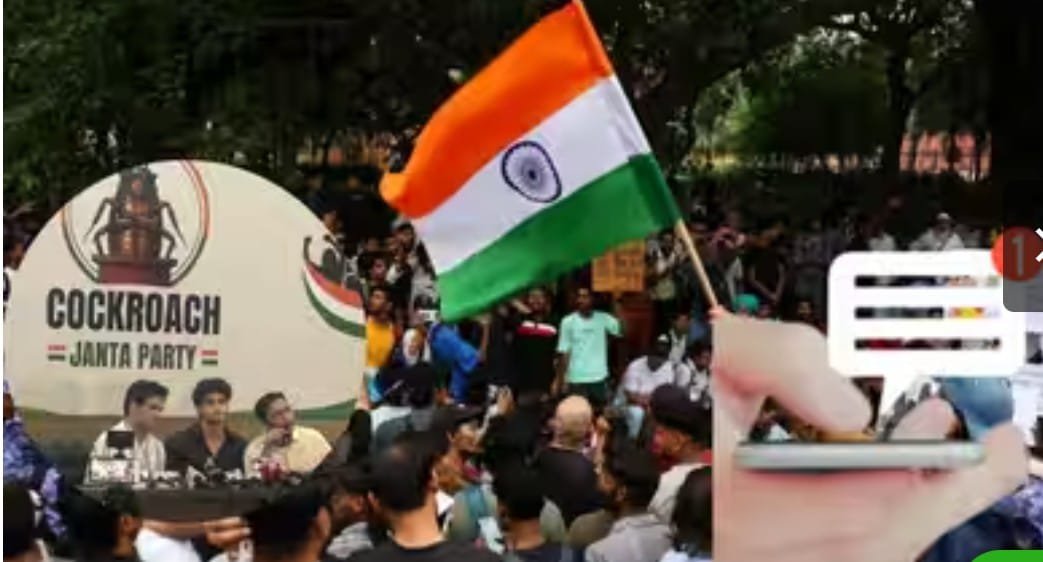
Can messages be sent despite internet shutdowns and mobile network outages? Delhi Police is investigating whether protesters gathered in areas like Connaught Place and Jantar Mantar in Delhi used offline messaging apps. Reports suggest that these protesters, who call themselves “Cockroaches,” participating in the Cockroach Janata Party (CJP) protest, are using specific apps to circumvent the internet blockade and mobile network ban. These apps create a local network via Bluetooth. Using this local network, messages can be sent even in areas without 4G, 5G, or Wi-Fi.
According to media reports, police suspect that protesters were using Bluetooth-based communication apps to stay in touch with each other even after mobile internet services were shut down in some parts of Delhi.
Although the police have not confirmed that such apps were used, they have brought to public attention a technology that was little known. These apps allow smartphones to send and receive messages without relying on mobile data, Wi-Fi, or cellular networks.
Notably, while apps like WhatsApp, Signal, and Telegram run on mobile data or Wi-Fi, offline messaging apps use Bluetooth Low Energy (BLE), a wireless technology already built into almost every modern smartphone. There are many such apps, some locally available and some widely available.
One of the popular offline messaging apps is Bitchat. It was launched in July 2025 by Jack Dorsey, the founder of X (formerly Twitter). The app has over one million downloads on the Google Play Store and allows users to send and receive messages via Bluetooth without creating an account, using a phone number, or connecting to a central server. There are other similar offline messaging apps available on Android.
Bitchat and similar apps use Bluetooth. Bluetooth is found not only in phones but also in earbuds and other smart devices, enabling offline conversations between nearby phones.
When a user sends a message using an app like Bitchat, it doesn’t go through a mobile tower, Wi-Fi router, or central server. Instead, that phone sends the encrypted message via Bluetooth to nearby devices running the same app.
Those devices automatically forward the message to other nearby phones, creating a mesh network. In this setup, each smartphone acts as a relay, allowing messages to travel from one device to another until they reach the right person.
When more people use the app in the same area, the network becomes larger, increasing the range of the conversation. Messages travel directly between devices instead of going through the internet, so these apps remain functional even when the internet is down or there’s no cellular coverage. However, they work best over short distances and in areas where many users are connected to the same mesh network. These apps are also sometimes used to communicate during natural disasters, when wired or cellular networks are disrupted.