

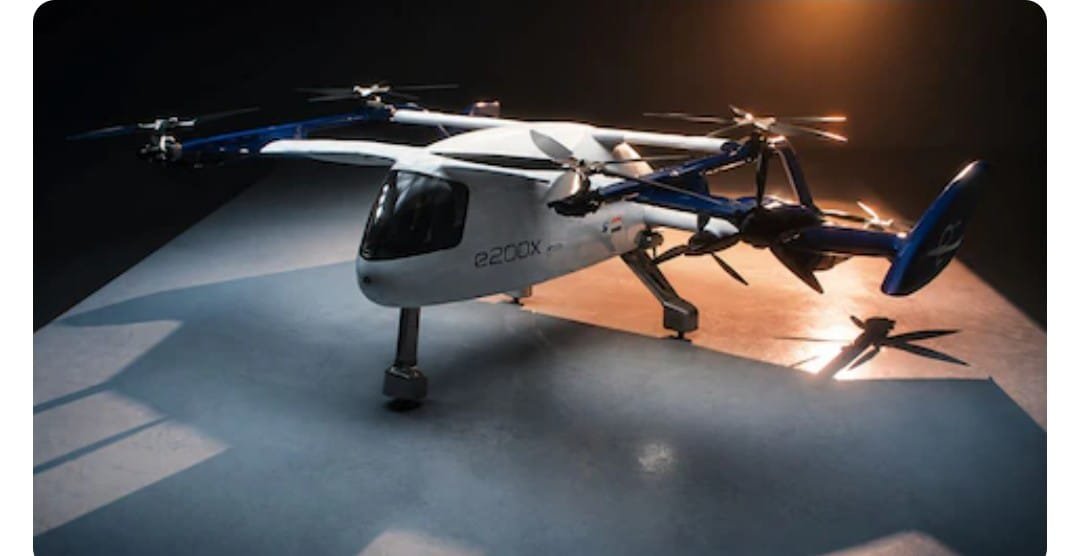
Indian cities may soon find relief from heavy traffic on the roads. People will now have access to the skies to avoid traffic jams. The ePlane Company, a startup based in IIT Madras, Chennai, unveiled a full-scale prototype of India’s first electric air taxi, the e200X – PT01. It will not only reduce intercity travel to minutes but also has the potential to transform the entire landscape of Indian aviation.
The aircraft was unveiled at a new 60,000-square-foot manufacturing unit located at IIT Madras’s Discovery Campus.
The unique features of this flying taxi include its ability to lift off vertically like a helicopter and take off like an airplane. It requires a space half the size of a basketball court, i.e., 8 x 11 meters, for landing and takeoff. This means it can easily land on hospital rooftops and existing helipads without building new vertiports in cities.
This 2.2-ton aircraft can cover a distance of approximately 110 kilometers on a single charge. This means that distances like Mumbai to Pune or Chennai to Puducherry can be covered in minutes.
It has six lift rotors and four forward propellers. Even if one motor or fan fails during flight, the remaining fans will safely handle the aircraft.
According to Satya Chakravarthy, the company’s founder and a professor at IIT Madras, this air taxi will initially be used as an air ambulance. It will help transport critical patients from one hospital to another within minutes amid heavy traffic. After this, it will be launched for general passengers. It can carry a pilot and a payload of up to 200 kg.
In keeping with strict safety standards, the aircraft’s initial test flights will be without a pilot. According to Professor Chakraborty, advanced fly-by-wire technology makes test flights without a pilot completely safe. Until the aircraft meets all safety standards, no human will be flown in it.
Aditya Ghosh, former president of IndiGo and a board member of ePlane, is also part of this project. He stated that ground testing of the aircraft will begin early next year, while flight testing is expected to begin by the second quarter of 2027. After receiving all regulatory approvals from the DGCA, it could be commercially launched within the next three to five years. The company has so far received orders for more than 800 aircraft and has raised $21.5 million in funding from investors.