

Old smartphones often lie in a drawer or cupboard in our homes for years, or some people recycle them after purchasing a new phone. But now Google has come up with a completely new and interesting idea for these old phones. According to new research by the tech company, old smartphones are not just useless. They can be repurposed by converting them into small computing clusters. This means that these phones can power cloud applications, research projects, and education platforms. The biggest benefit of this will be reducing electronic waste and significantly reducing the impact of computing on the environment.
This research, conducted in collaboration with the University of California San Diego, is exploring an interesting concept called ‘phone cluster computing.’ This idea aims to repurpose old smartphones instead of throwing them away. This means giving new life to the powerful hardware inside phones that are no longer in use.
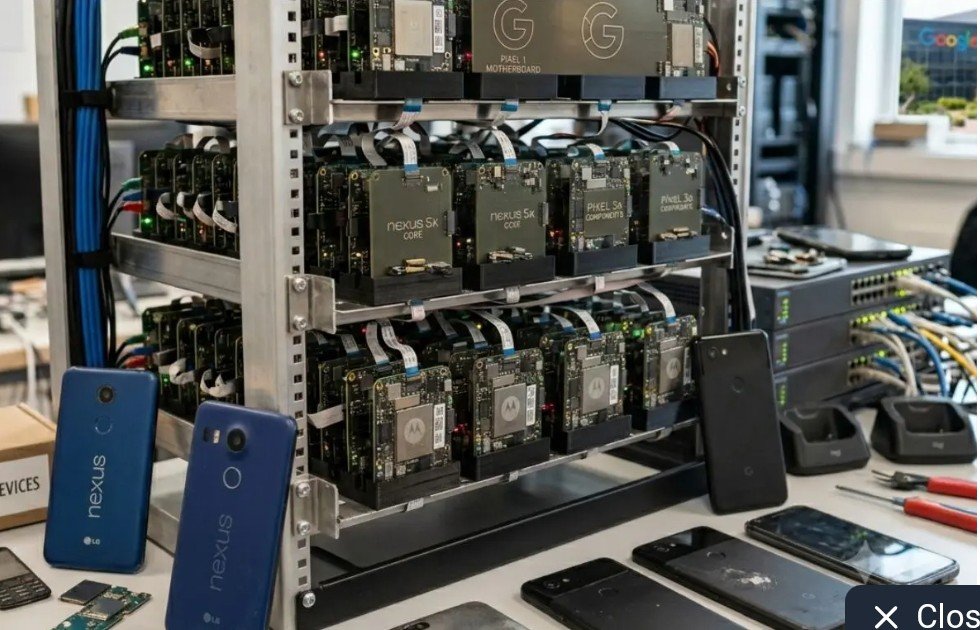
In this process, the phone’s display, battery, camera, and other external components are first removed. The remaining part is the motherboard, which houses key components like the processor, memory, and storage. These remaining motherboards are connected to form a network and run on a Linux-based system. Importantly, all these connected devices can be managed using Kubernetes, a technology commonly used to control and organize cloud infrastructure.
According to research by Google, just 25 to 50 old smartphones together can provide the performance of a small server for certain tasks. This means that the phones we discard after use can act as a mini data center. Researchers say that if thousands of old mobile phones are connected together, a powerful computing system can be created that can handle heavy tasks like cloud services and research.
To this end, researchers at the University of California, San Diego, are developing a large project to create a cluster of approximately 2,000 old Pixel smartphones. This system will be used to teach courses like systems programming and parallel computing. Additionally, the project will help scientists understand how normal consumer devices perform when used in a data center-like environment.
Google isn’t suggesting that phone clusters will replace the powerful GPU clusters used to train large AI models like Gemini. This isn’t the case at all. The project’s goal is to handle small- and medium-scale cloud tasks, not heavy-duty AI training, but everyday tasks like university research, educational tasks, web services, online grading systems, cloud-based development tools, and Jupyter Notebooks.