

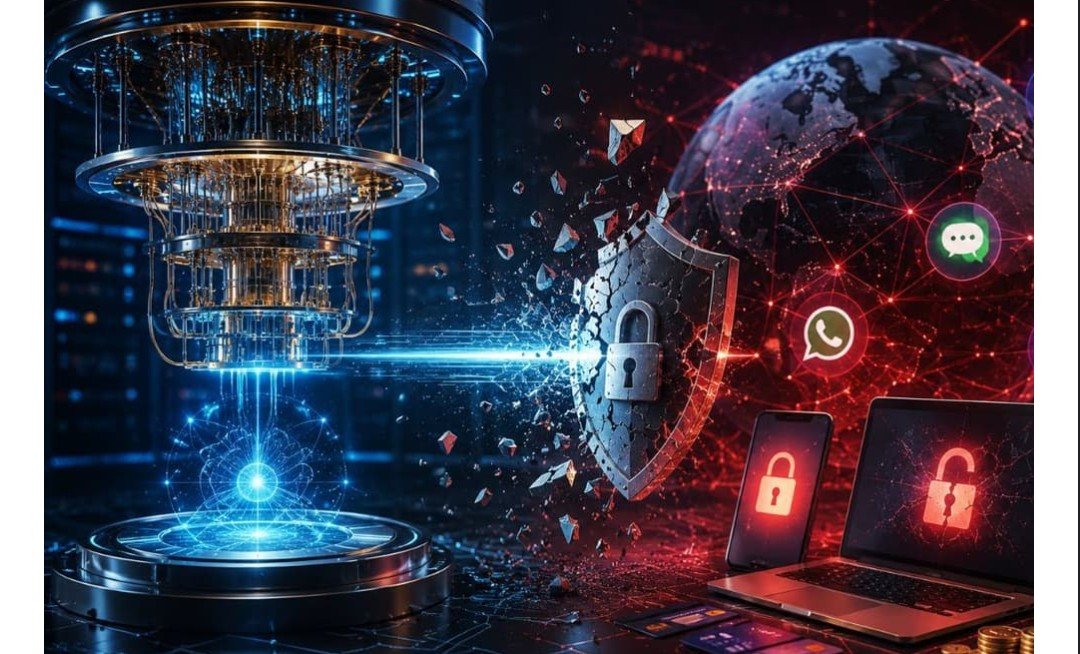
Imagine a day when the world’s strongest online security is breached in a matter of minutes. Bank accounts, UPI payments, WhatsApp chats, emails, and even government data are compromised. The passwords and encryption that protect us today become useless in a matter of minutes. In the world of technology, this potential threat is called Q-Day. This could be the time when quantum computers become so powerful that they can easily break existing internet security.
The rapid progress of quantum computing over the past few years has raised concerns among cybersecurity experts. Experts believe that in the future, quantum computers could become so powerful that they can easily break the encryption systems used today. This is why Q-Day is considered the biggest cyber turning point in internet history.
Q-Day will be the time when quantum computers will be able to break existing encryption algorithms like RSA and ECC. Today, the entire world’s digital security rests on these technologies. When you use internet banking, send payments via UPI, message on WhatsApp, or log in to a website, your data is protected by encryption. But if a quantum computer were to break this encryption, the entire digital security of the world could be at risk.
Normal computers operate in the binary system, i.e., the language of 0s and 1s, so they process each task step by step. However, quantum computers are much more advanced. They use a technology called Qubits, which allows them to process multiple tasks simultaneously. This is why quantum computers are considered extremely fast and powerful. Complex calculations that today’s supercomputers might take years to complete can be solved in a very short time.
Experts believe that this power could threaten the internet’s current security in the future, as quantum technology could become so powerful that it could even break the encryption systems currently in use.
If Q-Day truly arrives, its impact could be felt across the entire digital world.
Online banking and digital payment systems rely entirely on encryption. If this security is breached, it could become easier for cybercriminals to steal financial data.
Data in emails, chats, cloud storage, and social media accounts could become vulnerable. Even years-old encrypted files could be decrypted.
Government confidential information and military communications could also be targeted by quantum attacks. Therefore, many countries are considering this a national security issue.
Cryptocurrencies like Bitcoin also rely on public-key cryptography. Quantum computing could pose a challenge to their security in the future.
Cybersecurity agencies believe that many hackers and some countries are already stealing and storing encrypted data. Their goal is that when quantum computers become powerful enough in the future, that data can be decrypted. This is called the Harvest Now, Decrypt Later strategy. Steal today, read in the future.
When could Q-Day arrive?
There’s no definitive answer to this question. However, many experts believe that in the next 5 to 10 years, quantum technology could develop so much that current encryption could be compromised. Major tech companies like Google, IBM, and Microsoft are rapidly working on quantum computing. Cybersecurity agencies are constantly warning that the time for preparation is running out.
However, work on quantum-safe security is progressing rapidly around the world. America’s NIST (National Institute of Standards and Technology) is working on new post-quantum cryptography techniques to protect data from quantum computers in the future. Many companies have already begun working towards adopting quantum-resistant encryption.
To consider how dangerous this could be for India,
India is rapidly moving towards a digital economy. UPI, Aadhaar, net banking, digital payments, and government online services rely heavily on encryption. If the quantum threat increases in the future, India will also have to make its cybersecurity quantum-safe. Experts believe that this could pose one of the biggest challenges to the country’s digital security in the coming years.
Q-Day is still a possible future event, but it is being discussed seriously around the world. While quantum computing could revolutionize medical research, science, and technology, it could also pose the biggest challenge to internet security ever. This is why the world is already preparing for quantum-safe encryption and new cybersecurity technologies. The coming years will determine whether the internet will become more secure than before or a new era of cyber threats will begin.