

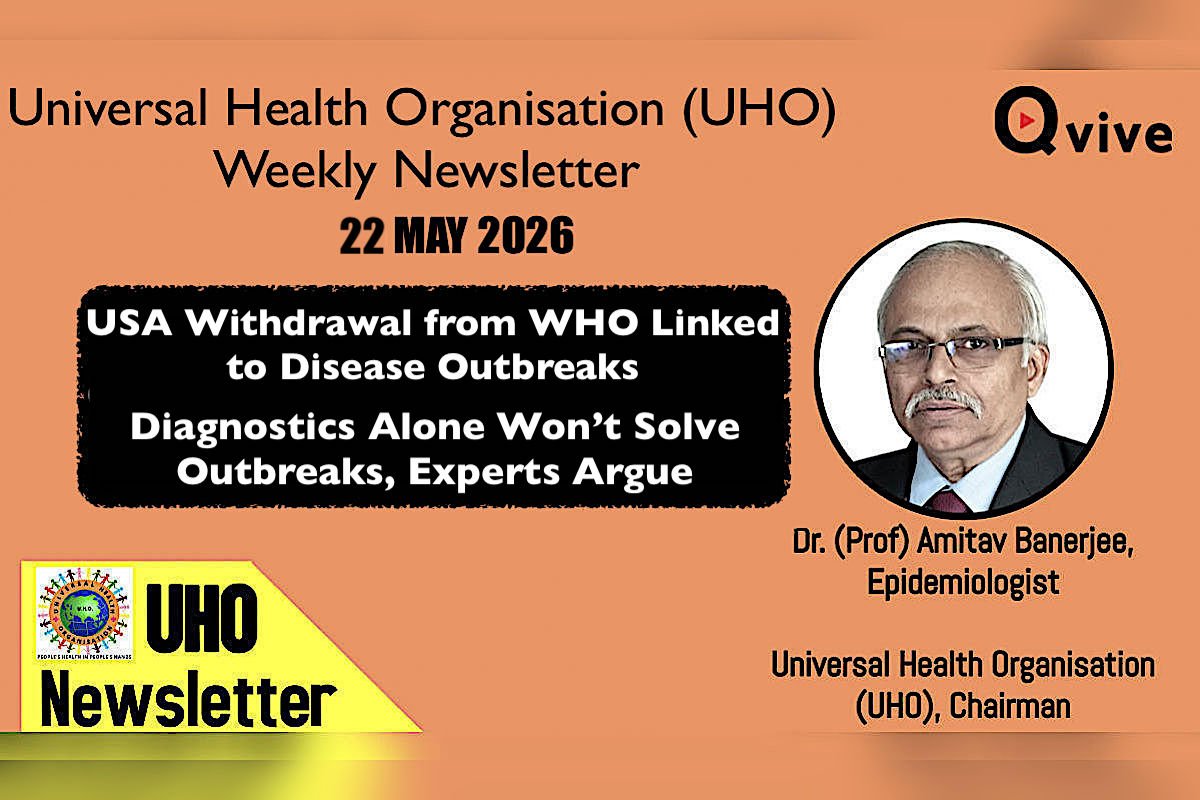
Highlights:
- Health Survey data ready but not made public: are people afraid of “shoot the messenger” phenomenon during the last survey?
- Hantavirus outbreak leveraged to blame USA withdrawing from the WHO.
- Commenting on Ebola & Hantavirus, BMJ misses the point limiting discussion to diagnostics, vaccines and pharmaceutical omitting root causes i.e. socioeconomic inequalities, extreme poverty, poor health infrastructure, and political instabilities.
Website: https://uho.org.in
By Dr. Amitav Banerjee, Chairperson of the Universal Health Organisation (UHO)
Health Survey data ready but not made public: are people afraid of “shoot the messenger” phenomenon during the last survey?
According to a report in the ET HealthWorld, the National Family Health Survey (NFHS) – 6 data is ready for over a year but not yet released publicly. In August last year, there were media reports that they are going to be released within a month but it never happened. According to the concerned officials, they can only be released after the approval of the Health Ministry. There was no response by the health ministry to queries from the media.
The National Family Health Survey (NFHS) is a large-scale, multi-round survey conducted in a representative sample of households throughout India. Five rounds of the survey have been conducted since the first survey in 1992-93. The survey provides state and national information for India on fertility, infant and child mortality, the practice of family planning, maternal and child health, reproductive health, nutrition, anaemia, utilization and quality of health and family planning services.
Each successive round of the NFHS has had two specific goals:
a) to provide essential data on health and family welfare needed by the Ministry of Health and Family Welfare and other agencies for policy and programme purposes, and
b) to provide information on important emerging health and family welfare issues.
The reports based on these data, put in the public domain, with the raw data made available to individual researchers from the Indian Institute of Population Sciences (IIPS) Mumbai, on request, facilitates research on public health and health policy issues. So one can appreciate the real time availability of such vital information.
UHO expresses concerns about this inexplicable and inordinate delay. One wonders whether the data contains some uncomfortable truths.
This is a reasonable apprehension in view of the “shoot the messenger” phenomenon which occurred when the last survey results (NFHS-5) were released. The Director of IIPS, K S James, was sacked by the government because some of the data released in the NFHS-5 were contradictory to claims made by the government including claims made that India has achieved the status of a “no open defecation free” country.
The delay in release of the NFHS-6 results is all the more intriguing because for the first time the survey was carried entirely using a digital platform with computer assisted interviews with inbuilt checks for data errors and validation to improve data quality. Given the motto of “digital India” we should expect the results in real time rather than being delayed without any explanation.
And most importantly, NFHS-6 had added 10 questions on Covid-19 and Covid-19 vaccinations. This we consider an important data which would allow independent researchers to study the impact of the virus as well as the vaccine. UHO wonders whether there are some disturbing data on the pandemic and the response to it.
Hantavirus outbreak leveraged to blame USA withdrawing from the WHO.
Keeping public panic alive at all costs seems to be the modus operandi of authortities and academicians with various conflicts of interests. No stone is being left unturned; no molehill is escaping attempts to turn it into a mountain in this endeavour.
The hantavirus outbreak which occurred on board the cruise MV Hondius has become a petridish which is being examined with a microscope to find faults with the Trump administration decision to cut ties with the WHO. The narrative is being run to project that US citizens are at risk of serious disease outbreaks which will be mismanaged by the present public health officials at the CDC, NIH and the FDA led by the Human and Health Secretary (HHS) Robert F Kennedy Jr. It will be recalled that a large number of former CDC, NIH and FDA officials who had close ties with the pharmaceutical industry and were promoting their agenda for profit was fired by the HHS. The mismanagement during the Covid-19 pandemic with lockdowns, mask and vaccine mandates which caused huge collateral harms exposed the caucus led by Anthony Fauci and his team.
Against this background, the outbreak of Hantavirus is being projected as an imminent disaster threatening the citizens of the world in the wake of USA severing ties with the WHO.
An article in JAMA, a medical journal, carries a sensational title, “Hantavirus Outbreak: First Test of US Public Health Response After WHO Withdrawal.”
To quote a paragraph from the article, “Although the CDC and the WHO may be communicating frequently, public health experts say that the US response has not been as quick and transparent as it would have been before the country’s withdrawal from the WHO and the shrinking of the CDC’s workforce under the current administration.”
It describes the outbreak in great detail making the reader believe that person to person transmission of the Andes strain of the hantavirus is more common than thought overlooking evidence that the chances are less than 0.6% as reported in peer reviewed literature. It is evident that such mis-reporting in a reputed medical journal will lead to public panic of spread of the virus.
It must be recalled that about a year ago, Gene Hackman and his wife were found dead and autopsy confirmed that his wife had died of hantavirus pulmonary syndrome while Hackman passed away due to heart related ailments. There was no transmission of the virus between the couple. Hantavirus did not hit the headlines at that time. Now the timing is crucial for the WHO as it is desperate to push the WHO Pandemic Treaty and the amendments to the International Health Regulations (IHR) which are held up due to some technicalities concerning the pathogen access and benefit sharing (PABS) clause in the amendments to the IHR.
In addition to the USA, Argentina has also withdrawn from the WHO. Tedros. UHO is of the opinion that the Director General of the WHO is using the hantavirus outbreak on the cruise ship with probable source of infection from rodents in Argentina as a bargaining point to prevail upon the USA and Argentina to reconsider their decision of severing ties with the WHO. To quote his statement which has been published at the end of the article on hantavirus in JAMA, “I think they will reconsider their position,” Tedros Ghebreyesus said of the US and Argentina, “because they can see how important universality is for health security.” The strategy being used to spread panic among the people of these countries who may prevail upon their respective governments to ally with the WHO.
Commenting on Ebola & Hantavirus, BMJ misses the point limiting discussion to diagnostics, vaccines and pharmaceutical omitting root causes i.e. socioeconomic inequalities, extreme poverty, poor health infrastructure, and political instabilities.
A report in the BMJ, warns that the Ebola and Hanta are more frequent and deadly as world “moves backwards.” It states growing distrust, attacks on science, and geopolitics are undermining pandemic preparedness at a time when infectious disease outbreaks are becoming deadlier and more frequent.
It warned that the world was also “moving backwards” in equitable access to diagnostics, vaccines, and therapeutics. UHO would like to emphasize that in this sentence the BMJ has lost the plot completely. Ironically, the BMJ article has used the term “world moves backwards.” It overlooks the important lessons from public health history from “backward times.”
In 1848, the Prussian government asked the young German pathologist, Rudolf Virchow, to investigate the typhus outbreak in Upper Silesia, presently in Poland. His observations on the epidemic brought about a paradigm shift in understanding human disease at the population level. Beyond the narrow concept of bacteria and infections, as causes of disease in populations, Virchow studied the importance of the social and economic conditions prevailing in Upper Silesia such as poverty, poor civil services, ignorance, illiteracy, and other socioeconomic predicaments. These findings made him realize that if these challenges, all of which called for political action, were addressed, such epidemics would not recur. The remedies for population health were education, employment, a functional government, and investment in agriculture. Virchow summed up famously, “Medicine is a social science and politics is nothing but medicine on a large scale.” Virchow went on to become a political advocate and a crusading social reformer. His reputation as a practitioner of “social medicine” equaled that as a pathologist.
These lessons from Virchow hold the key to the present situation in Democratic Republic of Congo (DRC), with frequent outbreaks of monkeypox, Ebola and other infectious disease all due to the exact conditions described more than 100 years ago.
The weekly newsletters bring the updates on the science, battered and bruised during the pandemic, legal updates and impact of activism for a just society, across the world. These are small steps to promote Transparency, Empowerment and Accountability – the ethos of the UHO.
Announcement: Membership & endorsements to the UHO invited: https://uho.org.in/member.php
Also Read: