


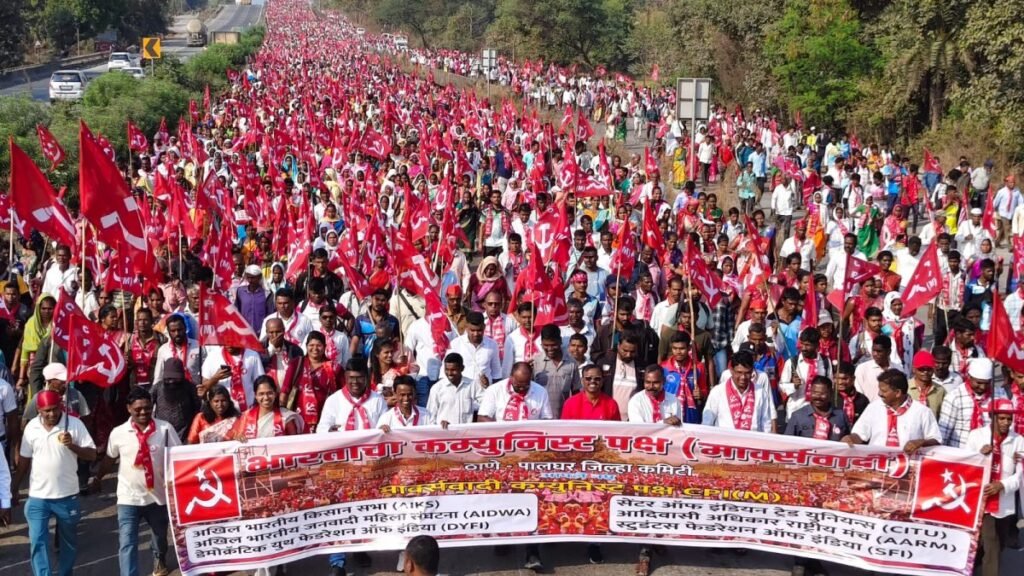
The Communist Party of India (Marxist) (CPI(M)) initiated a significant “long march” in Palghar, Maharashtra, involving thousands of participants, primarily farmers, agricultural workers, tribals, women, and students, to advocate for a range of long-standing demands. This protest, which began on January 19, 2026, from Charoti in Dahanu tehsil and culminated in an indefinite sit-in at the Palghar Collectorate, highlights growing discontent among rural and tribal communities regarding land rights, employment, and large-scale infrastructure projects.
Background of the Protest
The CPI(M)-led march is a continuation of historical agitations in the region, reflecting persistent issues faced by marginalized communities. The 2018 Nashik–Mumbai Long March, also led by the CPI(M) and the All India Kisan Sabha (AIKS), saw similar demands presented to the state government, many of which remain unfulfilled. This current protest underscores the perceived inaction of authorities despite repeated appeals and demonstrations. The mobilization reflects a deep-seated frustration with government policies and their impact on the livelihoods and rights of local populations.
सीपीआई(एम) नेतृत्व में ऐतिहासिक लॉन्ग मार्च पहुँचा चरोती से पालघर कलेक्ट्रेट
— CPI (M) (@cpimspeak) January 21, 2026
माँगें पूरी होने तक अनिश्चितकालीन धरना pic.twitter.com/O9QLZIuR0z
CPI(M) begins a massive 50,000-strong march from Charoti to Palghar in #Maharashtra on a host of people's demands, including restoration of #MGNREGA, implementation of the Forest Rights Act, cancellation of the Smart Meter Scheme, and repeal of the Labour Codes. pic.twitter.com/nvo5TAA3Mp
— CPI (M) (@cpimspeak) January 19, 2026
Key Demands of the Protestors
The protestors have articulated a comprehensive set of demands, categorized broadly into land rights, employment and social welfare, opposition to infrastructure projects, and repeal of new legislation.
Land Rights and Forest Rights Act
A central demand is the rigorous implementation of the Forest Rights Act (FRA), 2006. Many tribal communities in Palghar have been cultivating land for generations but lack formal ownership, leaving them vulnerable to displacement and unable to access government schemes or compensation for land acquisition. The protestors seek the vesting of all temple, inaam, and government land in the name of the actual tillers. Despite legal provisions allowing for the allocation of up to four hectares under the FRA, thousands of claims have been rejected, and recent amendments to forest conservation laws are seen as further weakening the act’s implementation. The Panchayats Extension to Scheduled Areas Act (PESA) is another crucial piece of legislation whose full implementation is demanded, aiming to empower tribal communities with greater self-governance and control over their natural resources.
Employment and Social Welfare
The restoration and strengthening of the Mahatma Gandhi National Rural Employment Guarantee Act (MGNREGA) is a significant demand. The protest comes in the wake of the Centre replacing MGNREGA with the Viksit Bharat-Guarantee for Rozgar and Ajeevika Mission (Gramin) (VB-G RAM G) Act, 2025. While the new act promises 125 days of employment instead of 100, critics, including CPI(M) leaders, argue that it places an increased financial burden on state governments, potentially depriving rural citizens of employment, especially in states with weak financial conditions like Maharashtra. The protestors also demand increased facilities for education, employment, ration, and health, along with the revival of the Jal Jeevan Mission scheme to provide work and benefits from the Gharkul scheme.
Opposition to Infrastructure Projects
A major point of contention is the proposed Wadhwan and Murbe Ports, along with other large infrastructure projects like the seaplane airport and the ‘Fourth Mumbai’ project. Protestors allege that these projects would displace thousands of farmers, fishermen, and Adivasi families, primarily benefiting corporate houses and industrialists. Concerns are also raised about the environmental impact and the potential destruction of ecosystems. The proposed river-linking projects are also opposed, with protestors arguing that they aim to divert water from the region to Gujarat, while local communities face water scarcity for drinking and irrigation.
Repeal of New Legislation and Other Concerns
The repeal of the four new Labour Codes, implemented by the Centre, is another key demand. These codes have faced opposition from various parties and trade unions, who argue that they weaken workers’ rights and collective bargaining power. The cancellation of the Smart Meter scheme is also demanded, with protestors alleging that the forcefully installed smart electricity meters have led to exorbitant power bills, causing financial hardship for economically weaker families.
Participating Organizations and Leadership
The march is led by prominent CPI(M) Polit Bureau members such as Ashok Dhawale (also National President of the All India Kisan Sabha) and Vijoo Krishnan (National General Secretary of AIKS), along with MLA Vinod Nikole and Kiran Gahala. Several mass organizations have joined the protest, demonstrating a broad-based coalition of support. These include:
- All India Kisan Sabha (AIKS)
- Centre of Indian Trade Unions (CITU)
- All India Democratic Women’s Association (AIDWA)
- Democratic Youth Federation of India (DYFI)
- Student’s Federation of India (SFI)
- Adivasi Adhikar Rashtriya Manch (AARM)
The participation of these diverse groups underscores the widespread nature of the grievances and the collective effort to pressure the government.
Escalation and Future Actions
The protestors have declared an indefinite sit-in at the Palghar Collectorate, vowing to continue until their demands are accepted in writing with a definite time-bound assurance for their implementation. Leaders have warned of escalating the agitation, including a potential march to Mantralaya in Mumbai and even a “rail roko” (train blockade) if their demands are not met. This demonstrates the resolve of the protestors to achieve their objectives and highlights the potential for broader unrest if the issues remain unaddressed.
Broader Implications
The Palghar protest is indicative of larger socio-economic and political tensions in India, particularly concerning land rights, tribal welfare, and the impact of economic development policies on marginalized communities. The opposition to the new Labour Codes and the replacement of MGNREGA reflects a broader debate about labor rights and social safety nets in the country. The concerns raised about large infrastructure projects also echo similar movements across India where local communities resist development initiatives that threaten their livelihoods and environment. The CPI(M)’s leadership in this movement positions it as a significant voice for these communities, challenging the policies of the ruling government.
Ref:
- https://cpim.org/cpim-begins-massive-50000-strong-march-from-charoti-to-palghar-in-maharashtra/
Also Read: