


In a bold move that has stirred the legal community in Mumbai, the Indian Bar Association (IBA) has taken a stand against the Bombay High Court’s handling of a suo motu contempt case. The IBA, led by its Head of National Coordination Committee, Adv. Ishwarlal Agarwal, has filed a formal representation calling for the recusal of Chief Justice Alok Aradhe. The association alleges violations of constitutional, procedural, and judicial discipline and raises critical concerns about the Chief Justice’s dual role as both initiator and adjudicator in the same contempt proceedings.
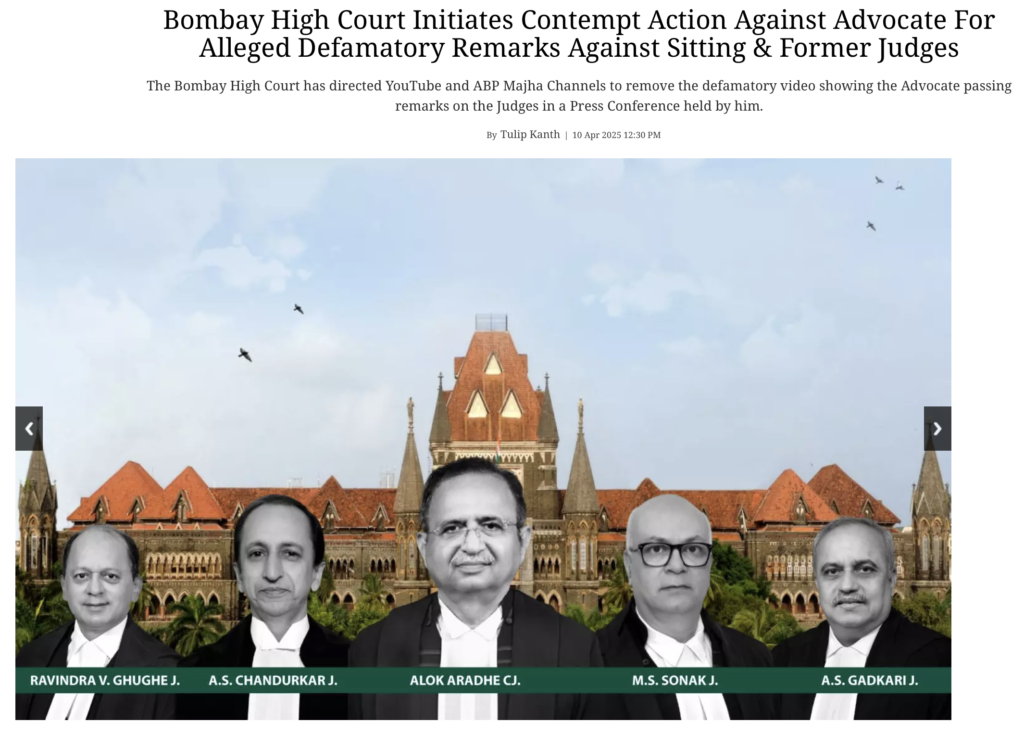
Recent events occurring at the Bombay High Court have sparked a lot of discussions about the faults in India’s justice system. The public has to be aware of these flaws and ask for the responsible parties to be held accountable for the state of the country’s justice system.
The Indian judiciary has been in the limelight due to the occurrence of some events and situations of malpractices and corruption have been reported. The participation of influential people such as Mumbai Police, doctors, politicians, and Bollywood stars in severe criminal offenses has questioned the neutrality and fairness of the justice system.
One of the justice system’s most disturbing aspects is apparently a high level of disrespect for the common man’s problems. Even Disha’s father, a man who can barely walk does all the exertion to go to the court to ask for justice but is answered by complete lack of interest from the Supreme Judges. From the above it is obvious that judges consider justice less important than their own reputation.
Nilesh Ojha, a lawyer, is recognized as a leading advocate of justice, particularly in the Sushant and Disha cases. His never-going-back approach to unraveling the truth and naming the guilty has attracted significant support from the public. Nevertheless, the dangers he is likely to be exposed to while fighting for justice just highlight the systemic difficulties that restrain transparency and fairness in the legal system.
Unprecedented Legal Concerns Raised by the Indian Bar Association
The Indian Bar Association has formally addressed a representation to the Chief Justice of the Bombay High Court, requesting appropriate corrections regarding the suo motu contempt proceedings initiated against Advocate Nilesh Ojha. The representation raises concerns about fundamental legal violations, including the Chief Justice’s dual role as both initiator of the proceedings and a member of the constituting Five-Judge Bench, which breaches the legal principle of “Nemo Judex in Causa Sua” (no one can be a judge in their own cause). The document outlines other procedural improprieties, stresses the importance of the involvement of state authorities in initiating contempt actions, and highlights previous judgments that support these assertions. Advocating for institutional integrity, the representation requests that the Chief Justice recuse himself from the case, seek the formation of a new Bench, and modify the title of the proceedings to reflect appropriate legal standards.
Highlights
- Concerns over Judicial Neutrality: The Chief Justice’s role as both initiator and judge presents a serious legal conflict.
- Principle of Bias: The established legal doctrine mandates recusal when judges are involved in initiating proceedings.
- Procedural Safeguards: The necessity for state involvement in contempt proceedings is emphasized to ensure impartiality.
- Institutional Integrity: Bypassing established processes raises alarm over the impartiality of the judicial system.
- Role of Precedents: Binding Supreme Court rulings reinforce that deviations from procedure must be corrected.
- Public Perception: There is a growing concern about judicial bias affecting public trust in legal institutions.
- Call for Action: Request for the Chief Justice’s recusal and for a new Bench to be formed to ensure fair proceedings.
Request for correction of legal errors in contempt proceedings (SMCP No. 1 of 2025)
- Understanding “Nemo Judex in Causa Sua”: This principle underpins the legal system. The Chief Justice, by participating in both the initiation and the adjudication of the contempt proceedings, violates the very essence of this doctrine. Legal systems worldwide take this concept seriously, prioritizing impartiality to preserve public confidence in judicial decisions.
- Call for Judicial Accountability and Recusal: Given that the Chief Justice has personally initiated contempt proceedings, his continuing involvement threatens the neutrality of the proceedings. Legal precedent establishes that a judge who initiates a case cannot fairly judge it, as their interests are biased by involvement.
- Procedural Error and Legal Risks: The representation indicates a fundamental oversight—the initiation of contempt prohibits direct action without involving state authorities, such as the Advocate General. This is to prevent the judiciary from overstepping its boundaries and ensures fair trials under criminal jurisprudence.
- Existence of Judicial Safeguards: Historical benchmarks set by case law have established criteria for the launch of contempt actions. Failure to comply with these guidelines, as observed in this instance, illustrates the grave potential for miscarriages of justice. The representation underscores these precedents as essential checks to uphold the integrity of judicial engagement.
- The Erosion of Trust in the Judiciary: There is an implied risk that the perception of bias stemming from these proceedings may erode public trust in the courts, particularly because the involved parties are critical figures like Advocate Nilesh Ojha, who has previously engaged in high-profile cases against powerful individuals. This highlights a need for transparency and adherence to established protocols.
- The Necessity of Prior Legal Consultation: Previous Supreme Court cases bolster the necessity of engaging the Attorney General or equivalent state representatives before initiating contempt actions. This is to maintain a division between prosecutorial and adjudicative roles, supporting a fairer judicial process by mitigating risks of bias.
- Continued Importance of Judicial Precedence: Reinforcing adherence to the Supreme Court’s decisions shapes not only ongoing legal practices but also guides judges in their conduct. The presented case typifies challenges when procedural errors are allowed to persist, ultimately necessitating rectification to maintain judicial integrity and public confidence.
Date: 7th April 2025
- It is hereby informed that a Suo Motu Contempt Case has been registered as SMCP No. 1 of 2025.
- The case is titled: High Court on its Own Motion vs. Nilesh Ojha and State of Maharashtra.
- The matter is shown as listed tomorrow, 8th April 2025, before the Historic Five-Judge Bench. The order taking suo motu cognizance has not yet been uploaded on the official website, and therefore the exact reasons for the initiation are currently unknown. However, it is presumably related to the allegations concerning Justice Revati Mohite Dere and Justice Devendra Upadhyay.
- It is important to note that the Hon’ble Court has not issued any notice in the matter. As and when an official notice is received, an appropriate response will be filed, and the matter will be defended in accordance with the law.
- Notably, this is the second instance in the history of the High Court where a Five-Judge Bench has been constituted in a matter involving Adv. Nilesh Ojha. The first such case was in the year 2017, titled “BBA vs. Adv. Nilesh Ojha and Ors.”, which involved ten other respondents and is still pending adjudication.
Adv. Ishwarlal Agarwal,
Head,
National Coordination Committee
Indian Bar Association
Document Ref: https://t.me/awakenindiamovement/9773
Mumbai, April 8
Echoing Supreme Court Judgments: “High Court Cannot Directly Take Suo Motu Cognizance of Contempt”
At the heart of the IBA’s challenge lies its contention that the High Court lacks the authority to directly initiate suo motu contempt proceedings without first allowing the State Law Officers, primarily the Advocate General, the opportunity to investigate and prosecute the alleged contempt.
The IBA anchors its argument in established legal precedent from across jurisdictions, including the UK (Balogh v. St. Albans Crown Court, 1975), the United States Supreme Court (Young v. U.S. ex rel. Vuitton), and several rulings from the Indian Supreme Court. These precedents emphasize that the responsibility for prosecuting criminal contempt rests primarily with the executive branch, with judicial intervention reserved as a last resort.
Citing Hari Dass v. State (AIR 1964 SC 1773), the IBA highlights the Supreme Court’s classification of criminal contempt as an offense under the Indian Penal Code (IPC), further solidifying the need for prosecutorial safeguards. Moreover, in Vinay Chandra Mishra (1995), the Supreme Court reiterated the fundamental principle that judges should not assume the dual role of prosecutor and judge, except in cases of utmost urgency.
“Violation of Federal and Legal Norms”: IBA Accuses High Court of Bypassing State Authority
The IBA’s representation accuses the High Court of completely bypassing the state machinery, thereby undermining the constitutional separation of powers and circumventing legal safeguards designed to protect individuals from arbitrary prosecution.
“The court’s suo motu intervention without first seeking action from the State gives rise to a perception of procedural impropriety and bias,” the IBA asserts. “When the executive has not even been asked, where is the urgency that justifies bypassing due process?”
The association further points to the Subramanian Swamy v. Arun Shourie case (2014), where the Supreme Court first sought written opinion from the Attorney General before even issuing notice – a practice that lends credibility and objectivity to the process.
Three-Pronged Objection: IBA’s Demands for Rectification
The Indian Bar Association has outlined a clear three-pronged objection to the current handling of the contempt case:
- Chief Justice’s Conflict of Interest: The IBA argues that the Chief Justice cannot preside over a Bench hearing a case he administratively initiated, creating a conflict of interest.
- Failure to Involve State Authorities: The association insists that the High Court should have referred the matter to the Advocate General, deeming direct suo motu cognizance a legal overreach.
- Incorrect Case Title: The IBA calls for the case title to be changed to “In Re: Advocate Nilesh Ojha” instead of “High Court vs. Nilesh Ojha” to maintain impartiality.
Stressing Equality: “Bench and Bar Are Co-Wheels of Justice”
The representation also reminds the judiciary that Advocates are Officers of the Court and deserve the same institutional dignity as Judges. Citing Latief Ahmad Rather v. Shafeeqa Bhat (2022) and Ghanshyam Upadhyay v. State of Maharashtra (2017), the Bar asserts that the judiciary must not prematurely label any advocate as a “contemnor” before guilt is proven.
“To Correct It Is the Compulsion of Judicial Conscience”: IBA Invokes Supreme Court Wisdom
Drawing upon the Supreme Court’s wisdom in Distributors (Baroda) Ltd. v. Union of India (1986), the IBA reminds the Chief Justice: “A Judge ought to be wise enough to know that he is fallible, and courageous enough to acknowledge his errors. To perpetuate an error is no heroism — to correct it is the compulsion of judicial conscience.”
Addressing Concerns of Public Perception: The Shadow of Retaliation
The IBA highlights the potentially damaging public perception surrounding the case, particularly given that Adv. Nilesh Ojha has been actively involved in legal actions against influential individuals and alleged judicial corruption. The abrupt prosecution under contempt laws, without prior State intervention, raises concerns about potential bias and retaliation.
The representation underscores that even the appearance of bias is sufficient to invalidate judicial proceedings, citing precedent in State of Punjab v. Davinder Pal Singh Bhullar (2011) and Manak Lal v. Dr. Prem Chand Singhvi (1957).
IBA’s Specific Requests:
The Indian Bar Association formally requests:
- Recusal of the Hon’ble Chief Justice from the Five-Judge Bench.
- Reconstitution of the Bench to ensure impartiality.
- Correction of the case title to In Re: Advocate Nilesh Ojha.
- Referral of the matter to the Advocate General for independent legal review.
A Legal Fraternity on Edge: Implications for Judicial Restraint and Public Trust
The IBA’s strong intervention has ignited intense debate within the legal community and civil society. Many believe the case could serve as a crucial test for judicial restraint, a critical examination of the boundaries of contempt jurisdiction, and a reaffirmation of the importance of maintaining public confidence in the judicial system. The coming weeks will be crucial in determining the trajectory of this landmark legal challenge.
Watch : High Court vs. Advocate Nilesh Ojha and Maharashtra
Also Read: