

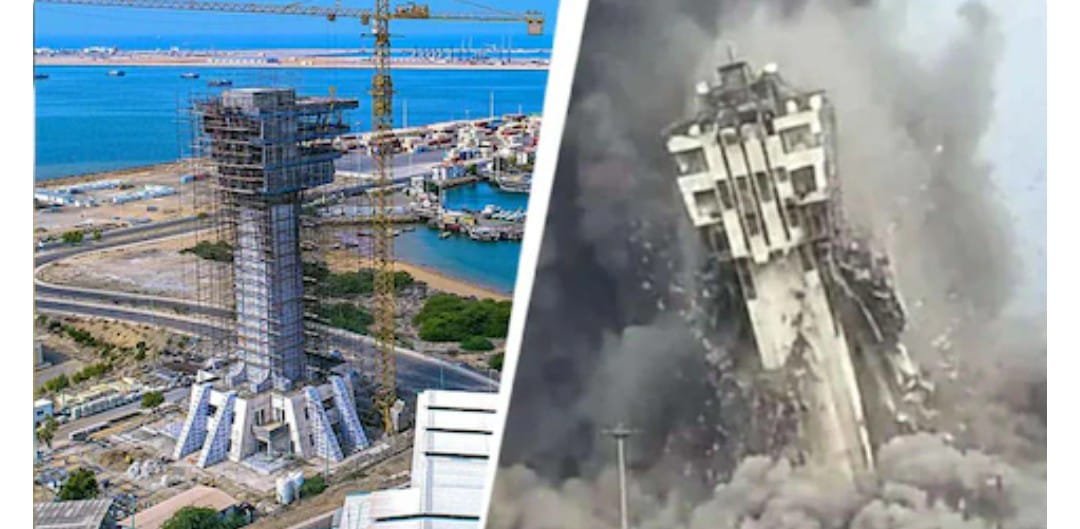
Amid US-Iran tensions, news of the attack on Chabahar Port has raised concerns in India. However, India has clarified that the Shahid Beheshti Terminal, operated by India, is safe. Chabahar is crucial for India because it provides trade and strategic access to Afghanistan and Central Asia, bypassing Pakistan.
The war between the US and Iran has flared up again. Trump has ordered the US military to destroy Iran after Iran refused to agree to a deal he desired. The US military has been carrying out heavy bombing raids on various Iranian cities every night for the past seven days. Iran’s ports, power plants, bridges, and roads are among its targets. By doing this, it aims to completely paralyze Iran. The US military also destroyed the watchtower at Chabahar Port with a missile. This incident has also raised concerns in India. This is because this port is being developed with Indian cooperation, and India has already spent $40 billion on its construction.
According to reports, a traffic-control and surveillance tower at Chabahar Port, located on Iran’s southern coast, collapsed in a US attack on Friday. However, India’s Ministry of External Affairs has clarified that the Indian-operated Shahid Beheshti Terminal is safe and undamaged. Despite this, the attack is being considered a major strategic wake-up call for New Delhi. This unrest in West Asia has now reached directly to India’s economic and diplomatic interests.
India has developed Chabahar Port in response to Pakistan’s Gwadar Port in the Gulf of Oman. China is developing Gwadar Port. By building Chabahar Port next to it, India aims to gain direct access to Central Asia. Through this route, it is creating direct trade access to Afghanistan, Central Asia, and Russia without using Pakistani territory. India has named this the International North-South Transport Corridor (INSTC). This route has been considered the shortest and safest route connecting India to the vast markets of Central Asia.
The most important point on this trade route is the Chabahar Port, located in southern Iran. Goods are unloaded at this port and then shipped via Iran’s road and rail routes to various countries in Central Asia and Europe. India is actively developing this port as it seeks new markets for its finished goods. It recently committed an investment of $120 million for the development of Chabahar. India considers this project a major pillar of its foreign policy. However, due to the shadow of US sanctions and recent tensions, India did not release new funding for it in this year’s budget.
The attack on Chabahar Port is being considered a “strategic alert” for India. Because the port is located outside the Strait of Hormuz, it was previously believed that it would be protected from any direct conflict or tension in the Gulf. However, this illusion has been completely shattered after the US Central Command targeted the tower of Chabahar’s Shahid Kalantari Terminal. This proves that in the event of war, India’s dream project will also be directly exposed to the war.
According to defense experts, if a full-scale war breaks out between the US and Iran, it will be extremely difficult for India to operate the port smoothly, insure its ships, and continue its banking transactions. Consequently, India’s dream of connecting with Central Asia and Eurasia will be put on hold. The disruption of this route will cause huge losses to Indian exporters and completely disrupt the supply chain.
India’s biggest concern is that if it slows down or completely ceases its operations in Iran due to security reasons or US pressure, China is ready to immediately fill the void. China already manages Pakistan’s Gwadar Port and has a 25-year strategic partnership with Iran. India’s withdrawal from Chabahar would directly mean handing over control of the entire region to China, which could pose a major threat to India’s national security.
On the other hand, India has deep strategic, technical, and trade ties with the US. India and the US are together on platforms like the Quad. Consequently, India can neither anger the US nor abandon its strategic interests in Iran. This situation is like walking a double-edged sword for Indian diplomacy.
The dilemma facing India now is how to extricate itself from this predicament. Indian strategists are also realizing that they should not rely solely on a single option for connectivity. To achieve this, they will need to accelerate work on alternative routes to the International North-South Transport Corridor (INSTC). Additionally, they will need to work with Gulf countries to explore new routes through Oman or the UAE. However, these are long-term projects that could take considerable time and cost. Therefore, for now, they should focus on negotiating with the US to stop the bombing of Chabahar, thereby safeguarding their interests there.
Overall, in today’s global politics, no investment is completely safe unless it has strong strategic backup. India’s terminal in Chabahar may be safe, but it may be very difficult for India to protect investment and trade in any project standing on the threshold of a war zone in the future. In such a situation, this conflict is going to prove to be a diplomatic challenge like a litmus test for India.