

Nikola Tesla is today famous for his work on electricity and energy. He developed the alternating current system, making it possible to transmit electricity over large distances, and worked also on wireless communication and energy transfer. He was a brilliant thinker, but also very eccentric. Maybe the more enigmatic parts of his personality make him such an interesting subject for conspiracists. Tesla is credited to have worked on unknown energy-sources, to be contacted by UFOs, caused the Tunguska explosion by a death-ray, and even worked on an earthquake-generator.
In 1896 Tesla was working on oscillations to be used for energy transfer. The idea was to create a steam-powered oscillator, able to create various frequencies. If the frequency-matched the resonance frequency, a receiving device should transform the mechanical oscillations back into an electric current.
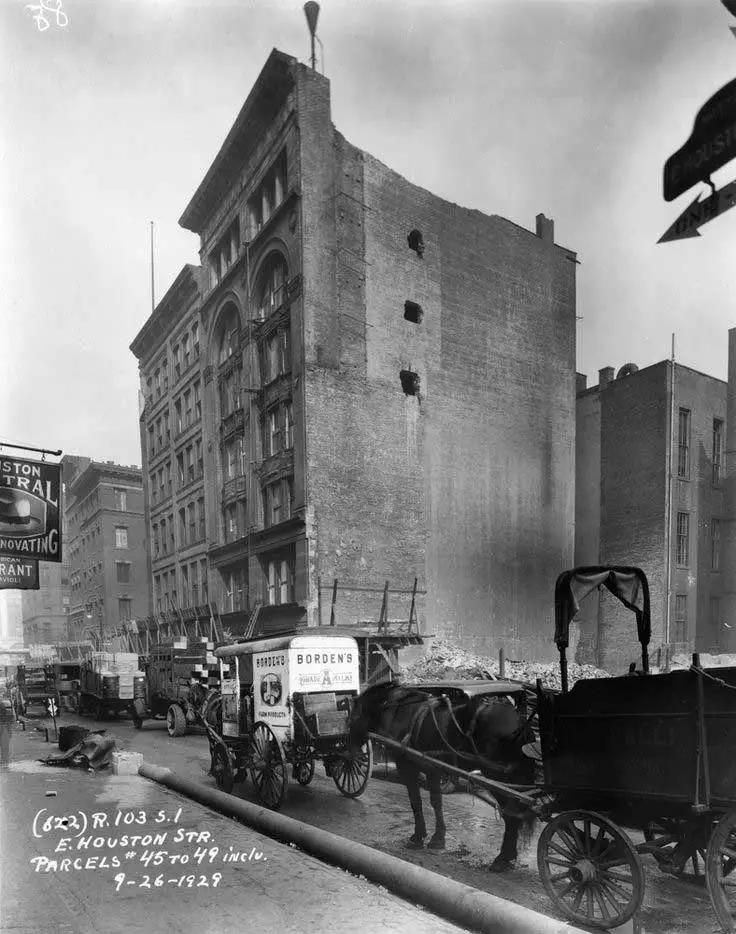
Nikola Tesla revealed that an earthquake which drew police and ambulances to the region of his laboratory at 48 E. Houston St., New York, in 1898, was the result of a little machine he was experimenting with at the time which “you could put in your overcoat pocket”:
“I was experimenting with vibrations. I had one of my machines going and I wanted to see if I could get it in tune with the vibration of the building. I put it up notch after notch. There was a peculiar cracking sound. I asked my assistants where did the sound come from. They did not know. I put the machine up a few more notches. There was a louder cracking sound. I knew I was approaching the vibration of the steel building. I pushed the machine a little higher. “Suddenly all the heavy machinery in the place was flying around. I grabbed a hammer and broke the machine. The building would have been about our ears in another few minutes. Outside in the street there was pandemonium. The police and ambulances arrived. I told my assistants to say nothing. We told the police it must have been an earthquake. That’s all they ever knew about it.”
Some shrewd reporter asked Dr. Tesla at this point what he would need to destroy the Empire State Building and the doctor replied:
“Vibration will do anything. It would only be necessary to step up the vibrations of the machine to fit the natural vibration of the building and the building would come crashing down. That’s why soldiers break step crossing a bridge.
On the occasion of his annual birthday celebration interview by the press on July 10, 1935 in his suite at the Hotel New Yorker, Tesla announced a method of transmitting mechanical energy accurately with minimal loss over any terrestrial distance, including a related new means of communication and a method, he claimed, which would facilitate the unerring location of underground mineral deposits. At that time he recalled the earth-trembling “quake” that brought police and ambulances rushing to the scene of his Houston Street laboratory while an experiment was in progress with one of his mechanical oscillators.
The earthquake machine of Nikola Tesla!

It was a quiet day in 1898 when the residents of several blocks of buildings in the crowded Chinese and Italian neighbourhoods of Manhattan began to experience a tremor that soon began to shake all buildings and shatter glass, causing people to run scared on the streets of New York.
The police were forced to rush in to assess the situation. After checking that the quake was confined to that small part of the city and suspects who could be the cause, the police sent two of their agents to 46 East Houston Street. Just before entering the building, they noticed that the tremor stopped, and when they passed through the door of a laboratory, they were received by a tall and thin man, with a moustache, elegantly dressed, and armed with a hammer. The man calmly told them,
Of course, that man was Tesla and his Earthquake Machine!

The cause of that incident had been a small electromechanical oscillator(Earthquake Machine) with which Tesla was experimenting that day for his research into mechanical resonance. After placing it on a pillar of his laboratory, the vibration caused by the instrument began to spread through the underground of the building to neighbouring buildings creating chaos among its neighbours.
So absorbed and fascinated was Tesla that did not decide to end the experiment until he noticed that his entire laboratory was shaking vigorously.
Another of his experiments he would tell a few years later to a journalist. This time Tesla decided to experiment outside his laboratory and after locating a building under construction in the Wall Street neighbourhood, which was still a metal skeleton, he placed the oscillator on one of the beams and activated it.
In a few minutes, the entire structure of ten floors of the building began to vibrate, frightening the workers and causing the police to make an appearance again. Before anyone could realize what was happening, Tesla deactivated the device, put it in his pocket and continued on his way. In the same interview the inventor said that in less than an hour he could knock down the Brooklyn Bridge, and he even claimed that with a suitable machine and dynamite, he would be able to split the Earth in two
Tesla’s mechanical power transmission system, he dubbed it the “art of telegeodynamics,” was based primarily upon his reciprocating engine invention, patent US514,169 – Reciprocating Engine – February 6, 1894. While the fundamental operating principles of Tesla’s mechanical oscillator are well understood, little has been said about how the machine would have been used for underground prospecting.
The electromechanical oscillator was originally designed as a source of isochronous (that is to say, frequency stable), alternating electric current used with both wireless transmitting and receiving apparatus. In dynamical system theory an oscillator is called isochronous if the frequency is independent of its amplitude. An electromechanical device runs at the same rate regardless of changes in its drive force, so it maintains a constant frequency (hz).

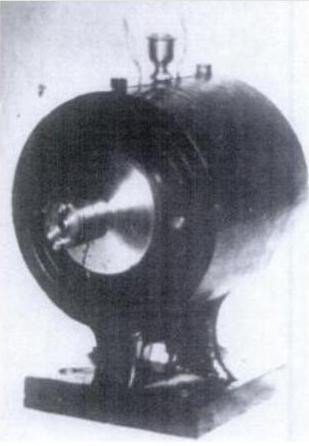
Article written by Paul Eitson
I will have to give credit to Dr. Tesla for the design of the oscillator. I will however submit a crude representation of his his work. Keep in mind the diagram is not to scale, the actual piston in the oscillator moved a distance of [ 1/ ” up to 3/8″]. You may notice the lower part of the fraction under the one is missing. I have not seen a book with the actual number printed so this is somewhat of a mystery to be solved. It could be as little as 1/ 1000 and the printer could not print the number.
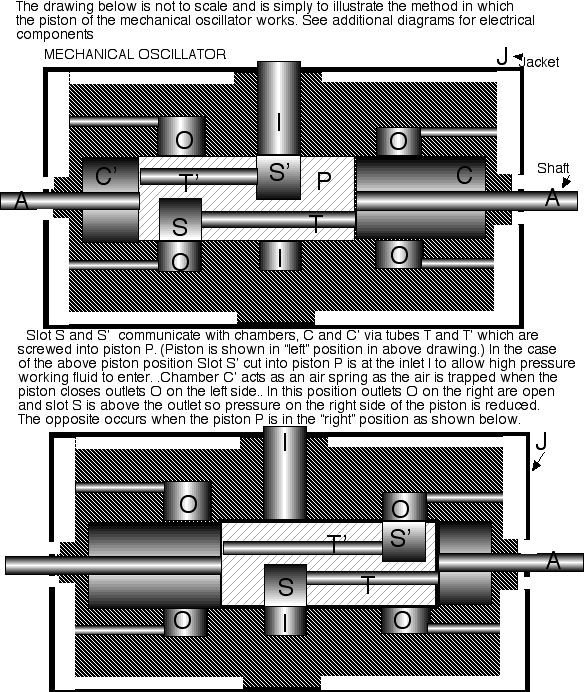
One of the major features of the oscillator is that it could move massive weights (coils) with little energy input. This was due to the small movement of the piston combined with the spring effect produced by the piston slamming into a closed chamber. The air inside the chamber compressed and acted as a spring, forcing the piston to travel the opposite direction. At the same time this occurs the slot on the piston aligns with the inlet to allow high pressure working to propel the piston like a rocket toward the other end where it once again slams into an “air spring”.
The diagram does not show the electromagnetic coil system that also controls the frequency of the piston. I will submit an additional diagram soon as I can.
Two electromagnets positioned on either side of the shaft. In the drawing the coils appear to be about one foot in diameter. The shaft has two coil pairs attached to either end which are on either side of the electromagnet fields when the shaft is at rest. When the shaft is given a slight tap, the coils are forced into the electromagnetic field. When one coil enters the field, it energizes a coil on the opposite side of the shaft producing an oscillation in the coils, somewhat similar to the oscillation produced in (oddly enough) a Tesla coil. Also similar to the Tesla coil, a capacitor arrangement is mentioned that provides electricity for the field coils.
The Inventions, Researches and Writings of Nikola Tesla – Chapter XVIII: The tesla mechanical and electrical oscillators:
On the evening of Friday, August 25, 1893, Mr. Tesla delivered a lecture on his mechanical and electrical oscillators, before the members of the Electrical Congress, in the hall adjoining the Agricultural Building, at the World’s Fair, Chicago. Besides the apparatus in the room, he employed an air compressor, which was driven by an electric motor.
Mr. Tesla was introduced by Dr. Elisha Gray, and began by stating that the problem he had set out to solve was to construct, first, a mechanism which would produce oscillations of a perfectly constant period independent of the pressure of steam or air applied, within the widest limits, and also independent of frictional losses and load. Secondly, to produce electric currents of a perfectly constant period independently of the working conditions, and to produce these currents with mechanism which should be reliable and positive in its action without resorting to spark gaps and breaks. This he successfully accomplished in his apparatus, and with this apparatus, now, scientific men will be provided with the necessaries for carrying on investigations with alternating currents with great precision. These two inventions Mr. Tesla called, quite appropriately, a mechanical and an electrical oscillator, respectively.
The former is substantially constructed in the following way. There is a piston in a cylinder made to reciprocate automatically by proper dispositions of parts, similar to a reciprocating tool. Mr. Tesla pointed out that he had done a great deal of work in perfecting his apparatus so that it would work efficiently at such high frequency of reciprocation as he contemplated, but he did not dwell on the many difficulties encountered. He exhibited, however, the pieces of a steel arbor which had been actually torn apart while vibrating against a minute air cushion.
With the piston above referred to there is associated in one of his models in an independent chamber an air spring, or dash pot,
[Pg 487]or else he obtains the spring within the chambers of the oscillator itself. To appreciate the beauty of this it is only necessary to say that in that disposition, as he showed it, no matter what the rigidity of the spring and no matter what the weight of the moving parts, in other words, no matter what the period of vibrations, the vibrations of the spring are always isochronous with the applied pressure. Owing to this, the results obtained with these vibrations are truly wonderful. Mr. Tesla provides for an air spring of tremendous rigidity, and he is enabled to vibrate big weights at an enormous rate, considering the inertia, owing to the recoil of the spring. Thus, for instance, in one of these experiments, he vibrates a weight of approximately 20 pounds at the rate of about 80 per second and with a stroke of about 7/8 inch, but by shortening the stroke the weight could be vibrated many hundred times, and has been, in other experiments.
To start the vibrations, a powerful blow is struck, but the adjustment can be so made that only a minute effort is required to start, and, even without any special provision it will start by merely turning on the pressure suddenly. The vibration being, of course, isochronous, any change of pressure merely produces a shortening or lengthening of the stroke. Mr. Tesla showed a number of very clear drawings, illustrating the construction of the apparatus from which its working was plainly discernible. Special provisions are made so as to equalize the pressure within the dash pot and the outer atmosphere. For this purpose the inside chambers of the dash pot are arranged to communicate with the outer atmosphere so that no matter how the temperature of the enclosed air might vary, it still retains the same mean density as the outer atmosphere, and by this means a spring of constant rigidity is obtained. Now, of course, the pressure of the atmosphere may vary, and this would vary the rigidity of the spring, and consequently the period of vibration, and this feature constitutes one of the great beauties of the apparatus; for, as Mr. Tesla pointed out, this mechanical system acts exactly like a string tightly stretched between two points, and with fixed nodes, so that slight changes of the tension do not in the least alter the period of oscillation.
The applications of such an apparatus are, of course, numerous and obvious. The first is, of course, to produce electric currents, and by a number of models and apparatus on the lecture platform, Mr. Tesla showed how this could be carried out in
[Pg 488]practice by combining an electric generator with his oscillator. He pointed out what conditions must be observed in order that the period of vibration of the electrical system might not disturb the mechanical oscillation in such a way as to alter the periodicity, but merely to shorten the stroke. He combines a condenser with a self-induction, and gives to the electrical system the same period as that at which the machine itself oscillates, so that both together then fall in step and electrical and mechanical resonance is obtained, and maintained absolutely unvaried.
Next he showed a model of a motor with delicate wheelwork, which was driven by these currents at a constant speed, no matter what the air pressure applied was, so that this motor could be employed as a clock. He also showed a clock so constructed that it could be attached to one of the oscillators, and would keep absolutely correct time. Another curious and interesting feature which Mr. Tesla pointed out was that, instead of controlling the motion of the reciprocating piston by means of a spring, so as to obtain isochronous vibration, he was actually able to control the mechanical motion by the natural vibration of the electro-magnetic system, and he said that the case was a very simple one, and was quite analogous to that of a pendulum. Thus, supposing we had a pendulum of great weight, preferably, which would be maintained in vibration by force, periodically applied; now that force, no matter how it might vary, although it would oscillate the pendulum, would have no control over its period.
Mr. Tesla also described a very interesting phenomenon which he illustrated by an experiment. By means of this new apparatus, he is able to produce an alternating current in which the e. m. f. of the impulses in one direction preponderates over that of those in the other, so that there is produced the effect of a direct current. In fact he expressed the hope that these currents would be capable of application in many instances, serving as direct currents. The principle involved in this preponderating e. m. f. he explains in this way: Suppose a conductor is moved into the magnetic field and then suddenly withdrawn. If the current is not retarded, then the work performed will be a mere fractional one; but if the current is retarded, then the magnetic field acts as a spring. Imagine that the motion of the conductor is arrested by the current generated, and that at the instant when it stops to move into the field, there is still the
[Pg 489]maximum current flowing in the conductor; then this current will, according to Lenz’s law, drive the conductor out of the field again, and if the conductor has no resistance, then it would leave the field with the velocity it entered it. Now it is clear that if, instead of simply depending on the current to drive the conductor out of the field, the mechanically applied force is so timed that it helps the conductor to get out of the field, then it might leave the field with higher velocity than it entered it, and thus one impulse is made to preponderate in e. m. f. over the other.
With a current of this nature, Mr. Tesla energized magnets strongly, and performed many interesting experiments bearing out the fact that one of the current impulses preponderates. Among them was one in which he attached to his oscillator a ring magnet with a small air gap between the poles. This magnet was oscillated up and down 80 times a second. A copper disc, when inserted within the air gap of the ring magnet, was brought into rapid rotation. Mr. Tesla remarked that this experiment also seemed to demonstrate that the lines of flow of current through a metallic mass are disturbed by the presence of a magnet in a manner quite independently of the so-called Hall effect. He showed also a very interesting method of making a connection with the oscillating magnet. This was accomplished by attaching to the magnet small insulated steel rods, and connecting to these rods the ends of the energizing coil. As the magnet was vibrated, stationary nodes were produced in the steel rods, and at these points the terminals of a direct current source were attached. Mr. Tesla also pointed out that one of the uses of currents, such as those produced in his apparatus, would be to select any given one of a number of devices connected to the same circuit by picking out the vibration by resonance. There is indeed little doubt that with Mr. Tesla’s devices, harmonic and synchronous telegraphy will receive a fresh impetus, and vast possibilities are again opened up.
Mr. Tesla was very much elated over his latest achievements, and said that he hoped that in the hands of practical, as well as scientific men, the devices described by him would yield important results. He laid special stress on the facility now afforded for investigating the effect of mechanical vibration in all directions, and also showed that he had observed a number of facts in connection with iron cores.
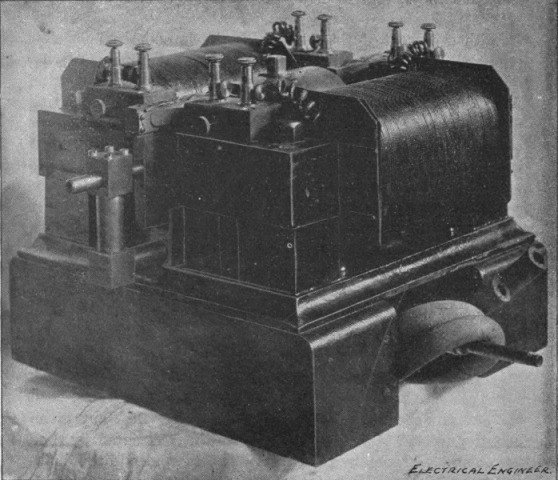
Large electromagnetically controlled mechanical oscillator for generating isochronous oscillations, used in demonstration before the Electrical Congress at the Chicago World’s Fair, August 25, 1893. Illustrated in Martin book, Fig 312, p.490.
Here is an actual picture of the electro-mechanical oscillator. Note the size of the field magnets. They were constructed of numerous flat sheets of iron. Using flat sheets of iron, as opposed to a single piece of iron, increases the magnetic field. Recent research with permanent magnets and permanent magnet, electromagnetic combinations could greatly increase the work done by the oscillator. In Dr. Tesla’s machine, current is provided for the field coils by the generator. By using a permanent or combination magnet arrangement current for the field coils could be reduced, resulting in a greater output.
Motion of the piston was controlled in three different methods. Connecting the coil pairs on either end of the shaft, forces the coil on the opposite end into the field when it is at full charge, resulting in the coil being repelled from the field at the same speed it enters the field. The motion of the shaft is also reversed mechanically by both the air spring and pressure from the working fluid. Either steam or air can be used to drive the piston. If steam is used, a vacuum is created when the steam enters the jacket and condenses. The vacuum created at the outlet pulls the piston in addition to the steam push on the other end. The most important part of the picture cannot be illustrated but can demonstrated. The resonant frequency of the machine could be adjusted to match the resonant frequency of any object.
Dr. Tesla was able to match the resonant frequency of objects in the room by adjusting either the electrical or mechanical movement of the piston. He was able to identify different objects in a circuit by matching their resonant frequency. The mechanical oscillator had to be mounted on wooden blocks to help damp vibration. Dr. Tesla also showed parts of a steel arbor that had been torn apart with one of his oscillators.
The Inventions, Researches and Writings of Nikola Tesla – Chapter XVIII: The tesla mechanical and electrical oscillators:
The engraving, Fig. 312, shows, in perspective, one of the forms of apparatus used by Mr. Tesla in his earlier investigations in this field of work, and its interior construction is made plain by the sectional view shown in Fig. 313. It will be noted that the piston P is fitted into the hollow of a cylinder C which is provided with channel ports O O, and I, extending all around the inside surface. In this particular apparatus there are two channels O O for the outlet of the working fluid and one, I, for the inlet. The piston P is provided with two slots S S’ at a carefully determined distance, one from the other. The tubes T T which are screwed into the holes drilled into the piston, establish communication between the slots S S’ and chambers on each side of the piston, each of these chambers connecting with the slot which is remote from it. The piston P is screwed tightly on a shaft A
[Pg 491]which passes through fitting boxes at the end of the cylinder C. The boxes project to a carefully determined distance into the hollow of the cylinder C, thus determining the length of the stroke.
Surrounding the whole is a jacket J. This jacket acts chiefly to diminish the sound produced by the oscillator and as a jacket when the oscillator is driven by steam, in which case a somewhat different arrangement of the magnets is employed. The apparatus here illustrated was intended for demonstration purposes, air being used as most convenient for this purpose.
A magnetic frame M M is fastened so as to closely surround the oscillator and is provided with energizing coils which establish two strong magnetic fields on opposite sides. The magnetic frame is made up of thin sheet iron. In the intensely concentrated field thus produced, there are arranged two pairs of coils H H supported in metallic frames which are screwed on the shaft A of the piston and have additional bearings in the boxes B B on each side. The whole is mounted on a metallic base resting on two wooden blocks.

Continue Reading: https://teslaresearch.jimdofree.com/oscilators/mechanical-oscilator/
Source: Teslaresearch, Matrixdisclosure, Al Jazeera, Mysteriesrunsolved