

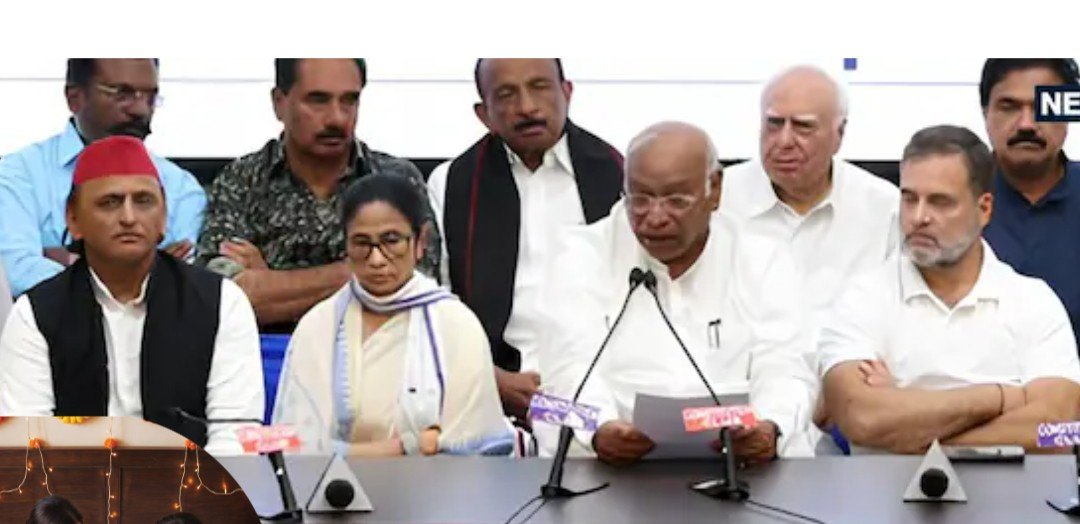
Following the setbacks in the recent assembly elections, the opposition India Alliance held a crucial meeting on Monday. The meeting began with a strong defense of Mamata Banerjee. Opposition leaders, supporting the Trinamool Congress chief, turned the discussion into a full-blown attack on the electoral process.
According to sources familiar with the discussions at the India Alliance meeting, Mamata Banerjee told alliance partners that the results of nearly 60 percent of the West Bengal elections were “rigged.” This allowed the Bharatiya Janata Party to create history by winning a landslide victory in the state.
According to sources, Congress leader Rahul Gandhi immediately responded to Mamata Banerjee’s comment, saying, “Not 60 percent, but 100 percent.” Several leaders in the room agreed with the Congress MP. The discussion then focused on issues related to electoral transparency, voter lists, and election management.
During this meeting, Congress Parliamentary Party chief Sonia Gandhi described Mamata Banerjee as a “lioness.” This was seen as a major sign of opposition unity and a message that the opposition alliance stands firmly behind the TMC chief.
Sources said Mamata Banerjee received full support from opposition allies. India Bloc leaders argued that the issues she raised regarding electoral processes should be made part of the opposition’s collective campaign, rather than a state-specific complaint.
Jammu and Kashmir Chief Minister Omar Abdullah also made a significant suggestion at this meeting. Sources told CNN-News18 that the Jammu and Kashmir Chief Minister argued that opposition parties need to focus more on the issues being raised by the “Cockroach Janata Party” (CJP) and turn them into sustained political campaigns.
Omar Abdullah told fellow leaders that they should learn from the issues they raise and not let the CJP take advantage of them.
The meeting displayed unity on electoral issues, but it also served as a platform for allies to air long-standing grievances against the Congress. Left parties complained that during the Kerala election campaign, Congress leaders attacked them using language that often sounded indistinguishable from criticism of the BJP.
According to sources, Rahul Gandhi acknowledged these concerns but defended some of his statements, saying that the Congress also has to consider the views and political compulsions of its state units. Rahul told the leaders, “I have to listen to my state unit as well.”
The conversation reflected concerns that several India Bloc allies had publicly expressed before the meeting. Regional party leaders urged the Congress to exercise more restraint in dealing with allies and avoid unnecessary confrontation in states where opposition parties are contesting against each other. Several allies urged the Congress to adopt a “large-hearted” approach so that the India Bloc remains effective until 2029.
From Grievances to Consensus
The meeting took place amid apparent tensions within the alliance. The DMK did not participate. Tensions between the Congress and the Left parties in Kerala remain unresolved, and several regional parties have privately complained about the Congress’s tendency to dominate the opposition’s strategy. Nevertheless, by the end of the discussion, the leaders appeared determined to demonstrate unity.
According to media reports, Rahul Gandhi responded to allies’ concerns with a conciliatory message, emphasizing the need for “love” and cooperation within the alliance. Congress leaders also assured allies that better coordination mechanisms would be established in the future. This reflects growing concern within the opposition that, while there is public discontent on many issues, the alliance has often struggled to create a unified national narrative around them.
What united everyone was the belief that electoral issues could become the alliance’s biggest political base. Discussions surrounding Mamata Banerjee’s claims, Rahul Gandhi’s response, and Omar Abdullah’s intervention led to a broad consensus that the opposition should campaign more aggressively on issues of voter lists, election management, and electoral transparency.
This was also reflected in the formal decisions made by the INDIA bloc after the meeting, which included a coordinated campaign on electoral issues, improved parliamentary coordination, and more frequent meetings among alliance partners. Clearly, the meeting’s significance lay not in the five-point action plan announced later but in the message conveyed during the meeting.
Facing turmoil and with many alliance partners unhappy with the Congress, top opposition leaders decided to publicly unite. They resolved that the next political battle would be fought less on leadership issues and more on the credibility of the electoral process.