

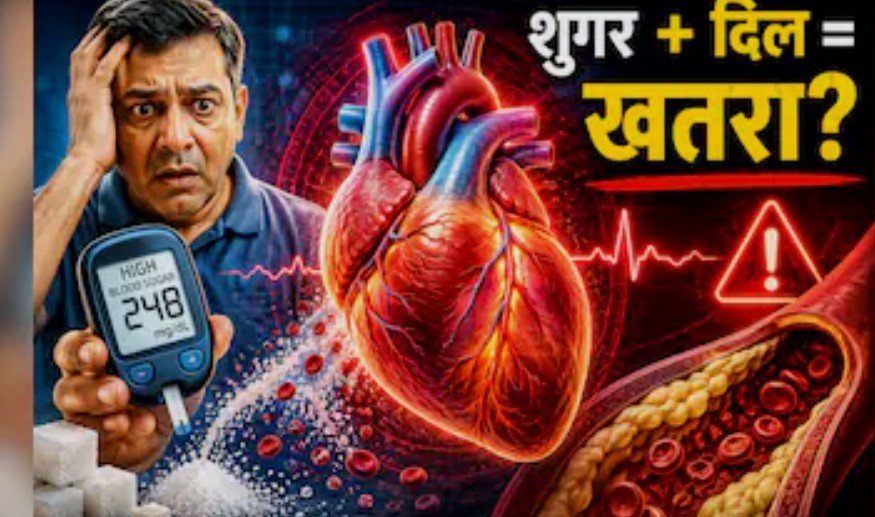
Nowadays, in every second house around us, we find someone who is suffering from diabetes. Often people think that diabetes just means giving up sweets in tea or staying away from rasgullas. More and more people think that if sugar increases, eyesight will become weak or kidneys will be affected. But very few people understand that high blood sugar attacks your heart first and foremost.
Doctors clearly say that if your blood sugar keeps increasing continuously, it directly starts making your nerves and heart sick. There is a very close relationship between type 2 diabetes and heart health. If you are taking sugar lightly, then understand that you are putting your heart at great risk.
The blood vessels in our body are like pipelines, through which blood and oxygen reach the entire body. When the amount of glucose in the blood increases too much, it starts making the inner walls of the tubes rough and weak.
Swelling starts inside the blood vessels.
Fat and waste i.e. plaque starts accumulating rapidly in the veins.
The arteries become hard and thin, causing the heart to work harder to pump blood.
For this reason, the risk of heart attack or stroke increases manifold.
The risk of silent heart attack increases.
The biggest problem with diabetic patients is that they do not get diagnosed with heart disease easily. When a common person gets a heart attack, he sees symptoms like severe pain in the chest, strain or pain in the arm. But people who are suffering from diabetes for a long time, their nerves become weak. In medical language it is called Neuropathy. Due to this, the ability to feel pain in the body decreases. The result is that the patient does not feel severe chest pain and suffers a heart attack. This is called silent heart attack.
If you have diabetes and suddenly see these symptoms, then be alert immediately:
Excessive sweating without any effort.
Feeling of slight heaviness or strange restlessness in the chest.
Sudden breathlessness or nervousness.
Unexplained weakness or dizziness.
Often patients measure their blood sugar on an empty stomach in the morning and are happy with its results, but doctors say that just one day’s fasting reading does not give a clear picture.
For this, HbA1c test is most important. This test tells what has been the average sugar level in your blood in the last two to three months. Its target may be different for every person. It depends on your age and chronic diseases. Therefore, never increase or decrease the medicine according to your own will. Some people, in order to reduce sugar, stop eating, due to which the sugar suddenly becomes very low, which is even more dangerous.
Keeping diabetes under control and keeping your heart healthy is not a very difficult task. For this you just have to make the following changes in some of your daily habits:
1. Make changes in your diet: Include more green vegetables, salads and whole grains in your diet so that the body gets enough fiber. Eat pulses and sprouted grains. Avoid items made from refined flour, bakery biscuits, cold drinks and excessively fried foods.
2. Sweat a little every day: Walk at a brisk pace for at least 30 minutes every day. If you already have any heart problem, then definitely ask the doctor before starting heavy exercise. Light aerobics or yoga also helps insulin to work properly in the body.
3. Not just sugar, keep an eye on these also: If you want to save your heart, then just looking at the glucose meter reading will not help. Along with this, always try to keep your blood pressure close to 120/80.
Get regular testing of bad cholesterol i.e. LDL.
If you consume beedi, cigarette or tobacco, then leave it today, because it clogs the veins very fast.
Control belly fat and weight.
The last thing is that diabetes is not such a disease that one should stop living life out of fear. But ignoring it can prove fatal. By eating right, doing some exercise and taking medicines on time, you can keep your heart completely healthy. When your blood sugar remains under control, your heart will also keep beating without any interruption for years.