

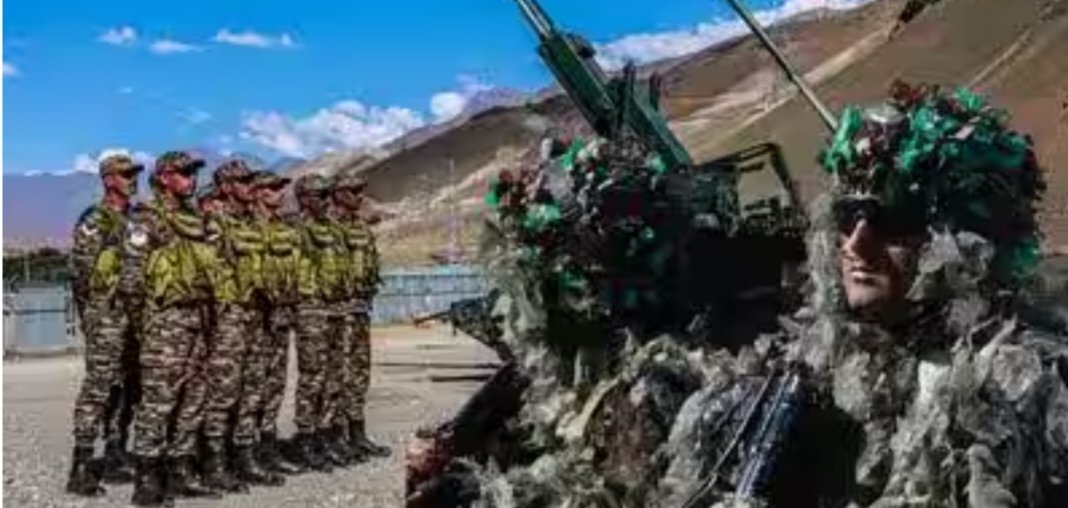
China is currently harassing India through its aggressive activities along the Line of Actual Control (LAC), rapid infrastructure development, and diplomatic pressure. According to official reports and statements by security officials in October 2026, China is primarily posing challenges to India from both the eastern sector (Arunachal Pradesh) and western sector (Ladakh).
The main ways in which China is harassing India are as follows:
Face-offs on the Arunachal Pradesh border: Recently (in October 2026), the Director General of the Indo-Tibetan Border Police (ITBP) confirmed that face-offs with Chinese troops (PLA) continue at several locations in Arunachal Pradesh. Particularly in the Upper Subansiri (Taksing area) of Arunachal Pradesh, Chinese troops have attempted to block Indian troops’ traditional patrols and set up tents there, renewing tensions along the border.
Construction of Model Villages and Military Infrastructure: China is rapidly constructing modern model villages, called “Xiaokang,” very close to the LAC. Under the guise of settling civilians in these villages, China is building permanent outposts, bunkers, helipads, and underground shelters for its army (PLA). Through this, it seeks to strengthen its claim to disputed areas.
New Tactics to Block Indian Infrastructure: India is also building a network of roads and tunnels (such as the Sela Tunnel) along the border to counter China. To slow this down, China has imposed strict restrictions on the export of tunnel boring machines (TBMs) and related equipment in October 2026. Since India has relied to some extent on this Chinese technology for cutting mountains, China is using this technological advantage to block India’s strategic border projects.
Diplomatic and Psychological Pressure: China continues to harass India diplomatically. It has been making illegal attempts to rename Indian areas in Arunachal Pradesh and give them Chinese names, which India has consistently rejected. Furthermore, China deliberately withholds clarity on the LAC demarcation at the negotiating table, so that ambiguity persists along the border and it can attempt incursions at will.
Use of Modern Warfare Technologies: China is extensively using drones, surveillance cameras, and electronic warfare (e-warfare) equipment instead of conventional weapons along the border. It is installing large-scale radars and reconnaissance equipment along the LAC to monitor the movements of Indian troops 24/7.
India is responding to this Chinese stance by the following:The Indian Army and ITBP are fully prepared to counter these Chinese actions. India has also accelerated the construction of the Arunachal Frontier Highway along the border, increased troop deployments at forward posts, and is working to resolve these disputes through ongoing military and diplomatic dialogue with China (such as Corps Commander Meetings) to prevent any major conflict.
Vibrant Village Program: This is a highly ambitious initiative of the Indian government, specifically launched to counter China’s “Model Village” (Xiaokang) policy. Its objective is to comprehensively develop India’s northern border villages, to stop migration and strengthen national security.
This special campaign, being run to empower India’s border youth and villages, is strengthening the country’s first line of defense:
Key points of the Vibrant Village Program:The country’s “first village”: As envisioned by Prime Minister Narendra Modi, these border villages are no longer considered “economically or geographically the last village,” but rather the country’s “first village.” The program was officially launched in April 2023 by Home Minister Amit Shah from the remote border village of Kibithu in Arunachal Pradesh.
Strategic Coverage: The scheme covers 46 border blocks in 19 districts across four Indian states and one union territory (Arunachal Pradesh, Himachal Pradesh, Sikkim, Uttarakhand, and Ladakh). In the first phase, 662 border villages have been identified for infrastructure development.
Special Focus on Arunachal Pradesh: Given China’s increasing aggression, 455 of the identified villages are in Arunachal Pradesh alone. The Government of India has approved the construction of 1,022 kilometers of roads and 27 large bridges at a cost of approximately ₹2,361 crore to enhance connectivity.
India’s other major border infrastructure projects (status as of 2026):
To counter Chinese pressure, India is working on all-weather connectivity as follows:
Tunnel network: After the Sela Tunnel in Arunachal Pradesh, the strategic Zojila Tunnel, connecting Kashmir and Ladakh, was successfully completed in June 2026. Furthermore, construction of the Shinku La Tunnel at an altitude of 4,800 meters on the Zanskar Pass is progressing rapidly.
Forward airstrips: Airbases and advanced landing grounds for fighter aircraft have been upgraded in areas like Nyoma and Daulat Beg Oldie in Ladakh, enabling the army to quickly deploy heavy tanks and troops in case of an emergency.
Thus, India is not relying solely on military outposts, but also on border security by making the citizens living there self-reliant and fundamentally strong, India is giving a befitting reply to China’s actions.