

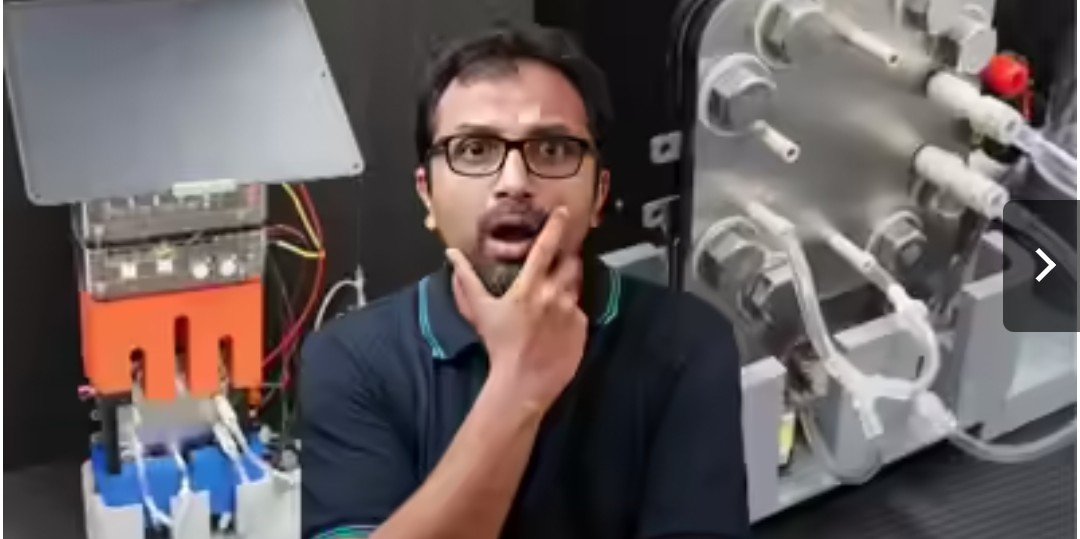
A device without batteries may sound strange. However, researchers at Osaka Metropolitan University have developed a new artificial photosynthesis system. This system can continuously produce solar fuel from sunlight without the need for a battery. This is possible because a chemical was added to the electrolyzer that automatically controls its operation. This has simplified the design and reduced manufacturing costs. In the future, this device can be used to charge household devices. This means that your devices will be able to charge from sunlight without electricity and without batteries.
Like natural photosynthesis (the process of making their own food) in plants, artificial photosynthesis is a technology that works like plants.
It uses sunlight to convert water and carbon dioxide gas into clean fuel or energy.
One such product is formic acid, a chemical that can be used as a fuel and energy storage method.
At the heart of these systems is an electrolyzer that converts electricity from solar cells into chemical energy. This energy is then stored as fuel, such as formic acid.
Sunlight is not constant throughout the day. Maintaining consistent performance under such conditions is a significant challenge. To address this, many artificial photosynthesis systems use maximum power point tracking (MPPT). This is a method that continuously adjusts voltage and current to ensure the solar cells deliver maximum power output.
However, traditional MPPT setups typically rely on batteries and additional electronic components to regulate energy flow. These are effective, but they increase both cost and system complexity. A self-regulating electrolyzer eliminates the need for batteries.
The team of Yasuo Matsubara, Associate Professor in Artificial Photosynthesis, and Professor Yutaka Amao, in collaboration with Ida Group Holdings Co., Ltd., redesigned the electrolyzer.
Their method uses a specially designed solid electrolyte. This allows the electrolyzer to perform the MPPT function automatically, eliminating the need for a battery-based control system.
This could be significantly beneficial because the electrolyzer does not rely on an external computer, converter, or battery to operate. Instead, it automatically adjusts itself to sunlight using its own heat and ability to increase and decrease power.
Professor Amao explained that as sunlight increases, the electrolyzer heats up. The system is designed so that this heat reduces electrical resistance, allowing electricity to flow more easily. This allows the system to automatically adjust its electrical behavior.
Professor Matsubara explained that it produced enough formic acid to power a small model (diorama) in the pavilion. This demonstrates that it is an effective artificial photosynthesis system, which could be used to charge devices in our homes in the future. This means that in the future, electronic items, including phones, could be charged without electricity.