

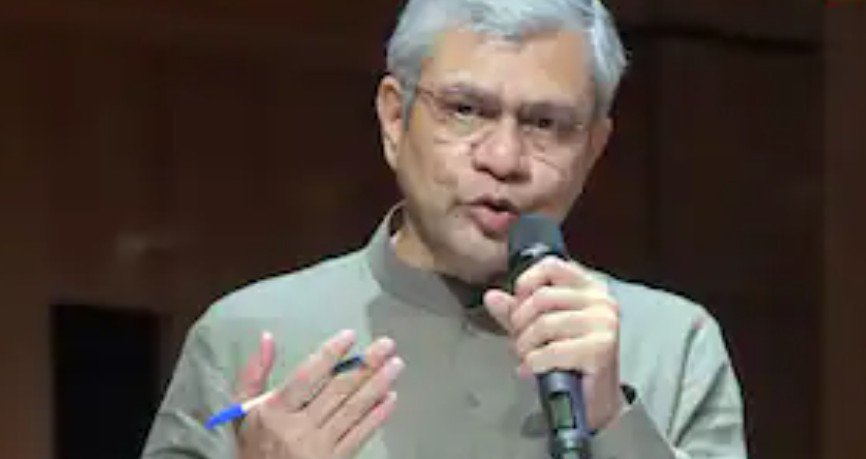
Several important decisions were taken on Wednesday (September 9, 2026) at a cabinet meeting chaired by Prime Minister Narendra Modi. Union Minister Ashwini Vaishnav announced that the government has approved the conversion of seven railway projects in the country into telecommunications lines. The Kolkata-Delhi, Chennai-Kolkata, Delhi-Mumbai, Mumbai-Chennai, and Bilaspur-Katni telecommunication lines have been approved. A fourth rail line from Kharagpur to Jharsuguda on the Mumbai-Howrah High-Density Network route has been approved. Its length is 367 km and it will cost ₹6,528 crore. The third and fourth lines from Arakunnam to Renigunta have been approved, each 77 km long and costing ₹1,936 crore.
Union Minister Ashwini Vaishnav stated that today’s Cabinet meeting discussed some very important railway modernization projects, which have been underway for the past 12 years. These projects are part of the complete overhaul and modernization of the railways under the leadership of Prime Minister Narendra Modi. They are working to expand seven high-density railway corridors to four lanes and four tracks. Work is also underway on several other corridors that are expected to see heavy traffic in the future.
The Union Minister explained that this forms the “Golden Quadrilateral”: Delhi to Mumbai, Mumbai to Chennai, Chennai to Kolkata, Kolkata to Delhi and back to Mumbai. It now has two diagonals: Delhi to Chennai and Mumbai to Kolkata. There is also a Delhi to Guwahati route. Thus, seven high-density corridors are being expanded to four lanes, and work is progressing on all projects one by one. DPRs are currently being prepared for approximately 4,000 kilometers.
Union Minister Ashwini Vaishnav stated that of the 11,000 kilometers of high-density corridors, seven corridors carry approximately 40 percent of railway traffic. He stated that approximately 2,000 kilometers of these corridors have already been completed, and four lines have been laid. Work is underway or approved on approximately 5,000 kilometers. The remaining 4,000 kilometers are in the process of receiving final approval. This gives a comprehensive picture of the entire high-density network and the seven corridors, which are crucial for the railways.
Union Minister Ashwini Vaishnav noted that in addition to Jharsuguda, Chhattisgarh also has projects facing significant congestion problems. The network there had not been developed for the past 50-60 years and had been neglected. Over the past 12 years, a series of new projects have been approved in Chhattisgarh, as it is a tribal region and the people here have many aspirations that must be fulfilled. It is also economically significant and crucial for the country’s energy security.
He stated that there are two main projects: Bilaspur to Pendra and Pendra to Katni. In some areas, three lines already exist, while in others, there are double lines. Therefore, the entire section from Bilaspur to Katni is being expanded to four lanes. The central government stated that these projects will expand the Indian Railways network by approximately 656 kilometers across 14 districts in five states: West Bengal, Jharkhand, Odisha, Madhya Pradesh, and Chhattisgarh.
The government stated that this will provide improved rail connectivity to approximately 5.6 million people in 4,790 villages, creating new local employment and self-employment opportunities. Union Minister Ashwini Vaishnav said that this project will facilitate travel to major religious and tourist places like Taratarini Temple, Jagannath Temple of Jharsuguda, Bandhavgarh Tiger Reserve, Virateshwar Temple, Amarkantak, Jwaleshwar Dham, Achanakmar Tiger Reserve, Khutaghat Dam and Ratanpur Mahamaya Temple.