

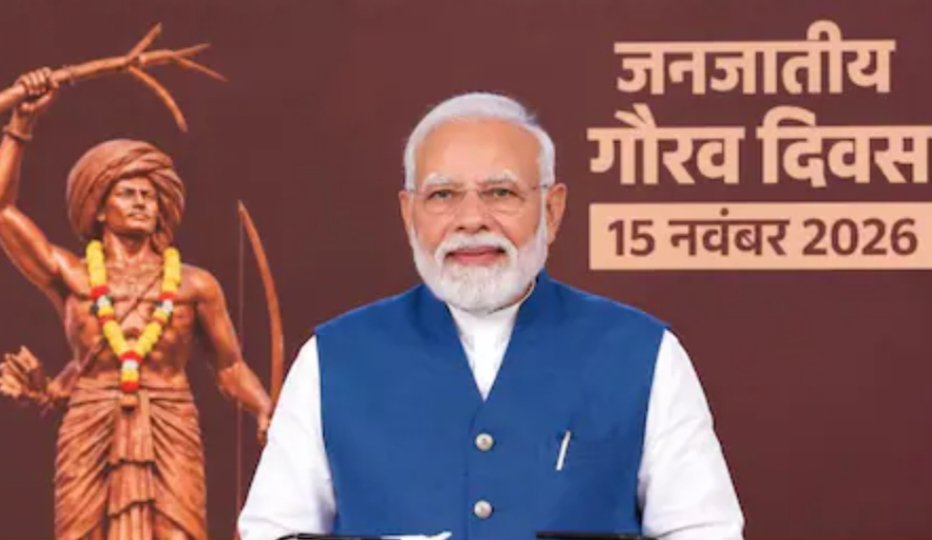
Prime Minister Narendra Modi interacted virtually with tribal communities across the country during the “Tribal Pride Day” celebrations in Gadchiroli, Maharashtra. On this special occasion, he inaugurated and launched 246 development projects worth ₹3,000 crore. This massive nationwide event commemorates the 151st birth anniversary of tribal freedom fighter Birsa Munda. The focus of such events and initiatives is on strengthening education, healthcare, housing, livelihoods, and infrastructure for tribal communities.
During the “Tribal Pride Day” event, PM Modi said, “Today, the entire nation is proudly remembering all its tribal heroes and heroines. “Tribal Pride Day” is a national celebration that is deeply rooted in the pride of the tribal community and inspired by Lord Birsa Munda.”
Addressing his tribal brothers and sisters, PM Modi also presented his government’s report card. He said that nearly 500 million people in the country have come out of extreme poverty and Naxalism has also ended. Both of these significant achievements are deeply connected to our tribal communities. According to a World Bank report, nearly 500 million people in India have come out of extreme poverty in the last 12 years. This is the country’s biggest achievement since independence. The credit for this goes to the collective strength of society and your efforts. The decisions and schemes launched by the Central Government for the tribal community in the last few years have played a major role in this.
In his address, PM Modi also said that with this same energy, ‘Tribal Pride Day’ events are being organized across the country. Gadchiroli in Maharashtra is hosting one such massive event; I see huge crowds of people as far as the eye can see. This is a new vision of a changing India, one that showcases the glorious stories of its heroes.
During the event, members of the tribal community informed the Prime Minister about the benefits they have received from central government schemes. Krishna Nagarao Teka, a resident of Yavatmal, Maharashtra, and a beneficiary of the PM-Janman Yojana, said, “Earlier, we faced a lot of difficulties. Living in our homes was very difficult during the rainy season, and we had to deal with insect infestations. Now, under the PM-Janman Yojana, we have got a permanent house, a toilet, and other amenities. We no longer face those problems.”
While speaking with Wazir from Hathkundi village in Netrang tehsil of Bharuch district, Gujarat, about the New Gujarat Pattern Scheme, the Prime Minister asked him about the challenges faced by the tribal community and the changes this initiative has brought to his life. Wazir said, “In 2004, I received training in bamboo work under the Gujarat government’s New Gujarat Pattern Scheme. I have also benefited from several other PM-Janman Yojana schemes.” Meanwhile, targeting the previous UPA government, Prime Minister Modi said, “Minister, you probably know that the British played a trick by classifying bamboo as a ‘tree,’ resulting in jailing anyone who cut bamboo. Sadly, this law should have been abolished after independence. However, some in the government neither understood nor cared about the tribal communities. When we came to power, we abolished that law and ensured that tribals have full control over the bamboo trade.”
Meanwhile, Sabavat Anvesh from Hyderabad thanked the Prime Minister for launching the ‘PM SHRI’ (Prime Minister’s School for Rising India) schools, saying that with the help of these schools, people are able to complete their higher education.