

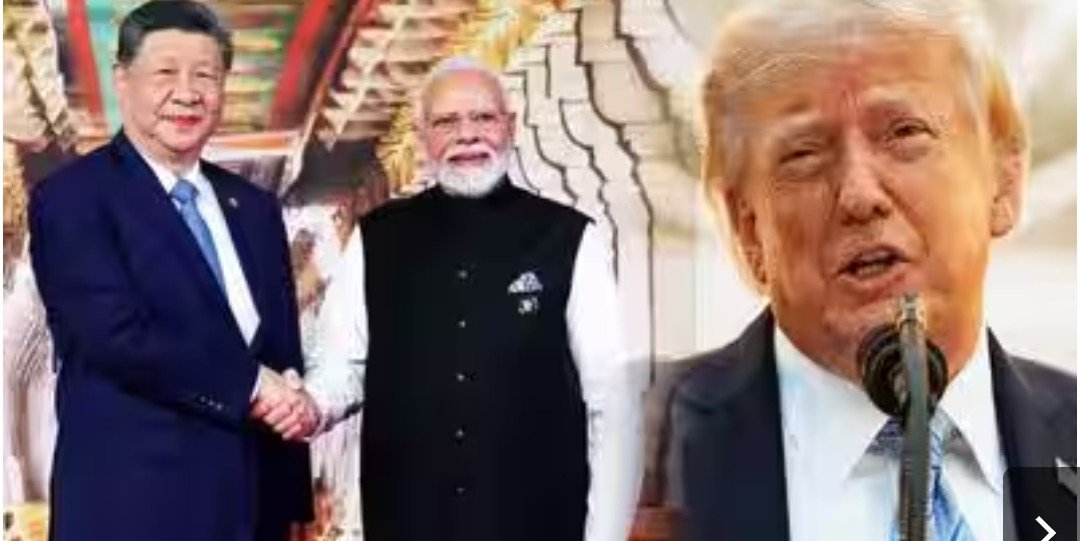
The US Congress has passed a bill imposing a 100% tariff on the purchase of Russian oil. The bill now goes to President Donald Trump for his signature. This bill targets India and China. China has now hit back at the US and expressed support for India. China’s Foreign Ministry stated that it strongly opposes unilateral sanctions that are not based on international law. Such sanctions also lack the support of the United Nations Security Council. China also stated that its normal trade and economic cooperation with any country should not be subject to third-party interference or pressure.
The US House of Representatives has passed a bill authorizing US President Donald Trump to impose sanctions on Russia and impose heavy tariffs on its oil and gas buyers, such as India and China. When asked about the bill, Chinese Foreign Ministry spokesman Guo Jiakun said at a press conference here that China opposes any action that does not have the approval of the UN Security Council. “China conducts normal economic and trade cooperation with other countries on the basis of equality and mutual benefit,” Guo said.
He added that such cooperation does not target any third party and will be free from any third-party pressure. China opposes “attempts to impose extra-judicial laws” and unilateral sanctions that have no basis in international law and have not received UN Security Council approval. Ahead of Chinese President Xi Jinping’s visit to Washington next week for a summit with Trump, China has again opposed the addition of any tariffs on oil and gas purchases from Russia.
The summit is scheduled for September 24-25. Meanwhile, China’s Commerce Ministry said Beijing and Washington are in talks to reach an agreement on a reciprocal tariff arrangement. The Lindsey O. Graham Sanctioning Russia and Iran Act of 2026 passed the US Senate last month. The House of Representatives approved it on Wednesday evening by a vote of 262 to 159. It will now be sent to Trump, where it will become law upon his signature. The bill was voted in favor by 203 Republicans, 58 Democrats, and one independent. Seven Republicans and 152 Democrats opposed it.
Democratic opposition was primarily focused on the authority given to Trump to impose tariffs. The bill is named after South Carolina Republican Senator Lindsey Graham, who passed away in July after spending more than a year building support for the measure against Russia. The bill proposes sanctions on Russia’s leadership and its energy sector, as well as a “proxy fleet” of ships that help Moscow evade oil supply sanctions.
In addition, the bill proposes authorizing Trump to impose stiff tariffs on China, India, and other countries to reduce their dependence on Russian oil and gas. It also includes provisions for imposing additional sanctions on Iran. Speaking to reporters after the bill’s passage, Democratic Senator Richard Blumenthal said, “China and India, you’re going to have to buy your oil and gas from somewhere else.”