

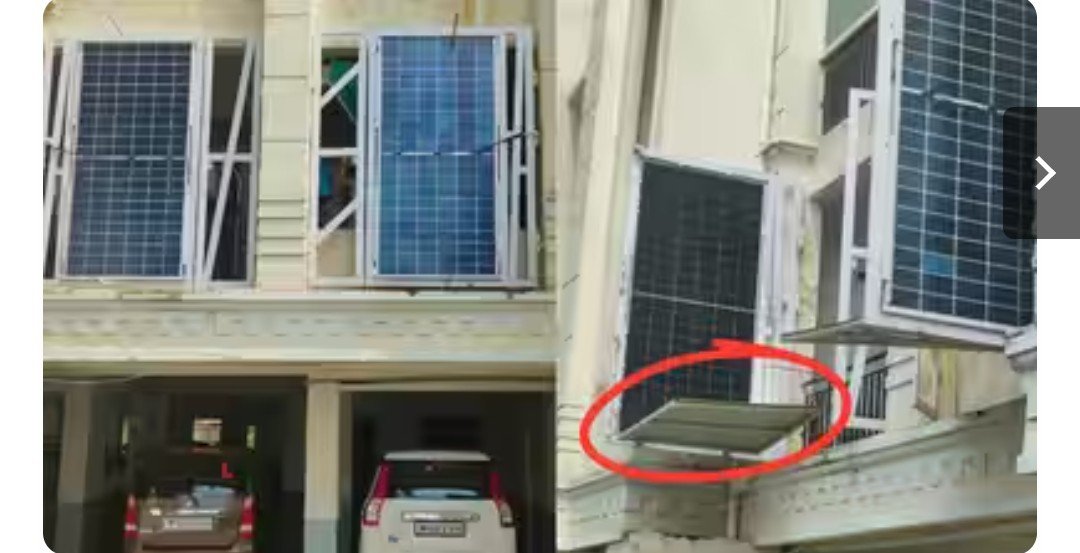
In India, people with sufficient rooftop space or space to install panels are rapidly adopting solar systems. However, there are many cities in India where not everyone has a rooftop, leaving these people deprived of the benefits of solar power. A father and son duo have found a solution to this problem. Former Bhopal mining engineer Pradeep Kumar Jain and his son have developed a foldable balcony solar system that can generate 1 to 3.5 kilowatts of electricity in a very small space.
This system utilizes 360-degree bifacial technology. Its unique feature is that it can be used by simply plugging it in without any permission from the electricity department.
Sunlight often comes from a single direction on the balcony of an apartment, which prevents ordinary solar panels from generating their full potential. To address this problem, Pradeep Kumar Jain and his team have installed modern 615-watt bifacial glass panels in their setup.
The special mounting frame hangs out from the balcony during the day, exposing the front of the panel to direct sunlight and the back to ambient light and heat. Furthermore, they have incorporated special reflectors into their system to better capture sunlight, focusing the light onto the back of the panel.
This increases the panel’s efficiency by 15%, even in limited space. At night, the same structure can be easily folded inward to form a sturdy balcony security gate.
Pradeep Kumar Jain and his son, Siddhant Jain, have used heavy-duty fasteners capable of supporting 5 tons of weight to secure their system firmly to the balcony wall.
The panel frame is also fabricated to heavy-industry standards, ensuring the panel’s balance is unaffected even by strong winds and gusts.
In an exclusive interview, Siddhant Jain explained that the recent storm in Bhopal uprooted over 100 large trees, but his system held firm without any damage.
The highlight of the solar system built by this father-son duo is its off-grid architecture. This means the setup isn’t connected to the power grid, eliminating the need for any approval from the electricity department.
Wiring is as simple as any standard inverter. For energy management, it runs on a Fujiyama off-grid system with a built-in lithium-ion battery and a solar MPPT (Maximum Power Point Tracking) controller.
According to Siddhant, the controller’s strength is that it draws maximum power based on sunlight and seamlessly resumes backup power in the event of a power outage.
The total cost of this unique solar system and battery unit is ₹55,000, which generates 1 to 3.5 kilowatts of electricity daily. 550 to 700 units of electricity can be generated from this in a year.