

Politics is all about governance, and even if we consider the policies of the ruling party, its games are unique. The cash-for-vote game has even been played on the floor of Parliament. Currently, the ruling party, the BJP, accuses the opposition of using the ED, CBI, Income Tax, and other means to destroy the opposition.
Sixty out of 80 TMC MLAs and 20 of its own MLAs have rebelled. Not only are the TMC’s allies in the party’s ranks deserting, but even members at the block and panchayat levels have rebelled against Mamata Banerjee. Even today, former minister Chandrama Bhattacharya resigned from all TMC posts.
A similar situation has been observed in Maharashtra with the Shiv Sena UBT MPs. Six of the nine Shiv Sena UBT MPs have left the Shiv Sena UBT and joined the Eknath Shinde-led Shiv Sena.
Opposition political party leaders blame PM Modi and Amit Shah for all these activities. They believe that PM Modi and Amit Shah, driven by their success in passing the Nari Shakti Vandan Act and the Delimitation Bill in Parliament, are now misusing their subordinate agencies, such as the CBI, ED, and Income Tax, to increase their MP numbers to 360.
Opposition political parties have failed to provide any evidence for their claims, but the previous government of our country has committed numerous acts that have been proven by the public, both in India and around the world through the media.
In July 1993, the minority Congress government of then-Prime Minister P.V. Narasimha Rao was facing a no-confidence motion in Parliament. To prevent the government from toppling, four JMM MPs, including Shibu Soren, allegedly accepted a hefty bribe (bags full of currency notes) from the Congress and voted in favor of the government. Subsequently, Narasimha Rao’s government was able to prove its majority in the House and survive.
This transaction was investigated by the Central Bureau of Investigation (CBI), and the investigation revealed that the MPs had received bribes.
The matter reached the Supreme Court. In 1998, a five-judge bench of the Supreme Court, by a 3:2 majority, acquitted these MPs of corruption charges, stating that under Article 105(2) of the Constitution, MPs are immune from legal action in exchange for their speeches or votes in Parliament.
Later, in March 2024, a seven-member Constitution Bench of the Supreme Court overturned this landmark decision. The court clarified that MPs or MLAs would not enjoy any legal immunity for accepting bribes in exchange for voting or speaking in the House and could be prosecuted.
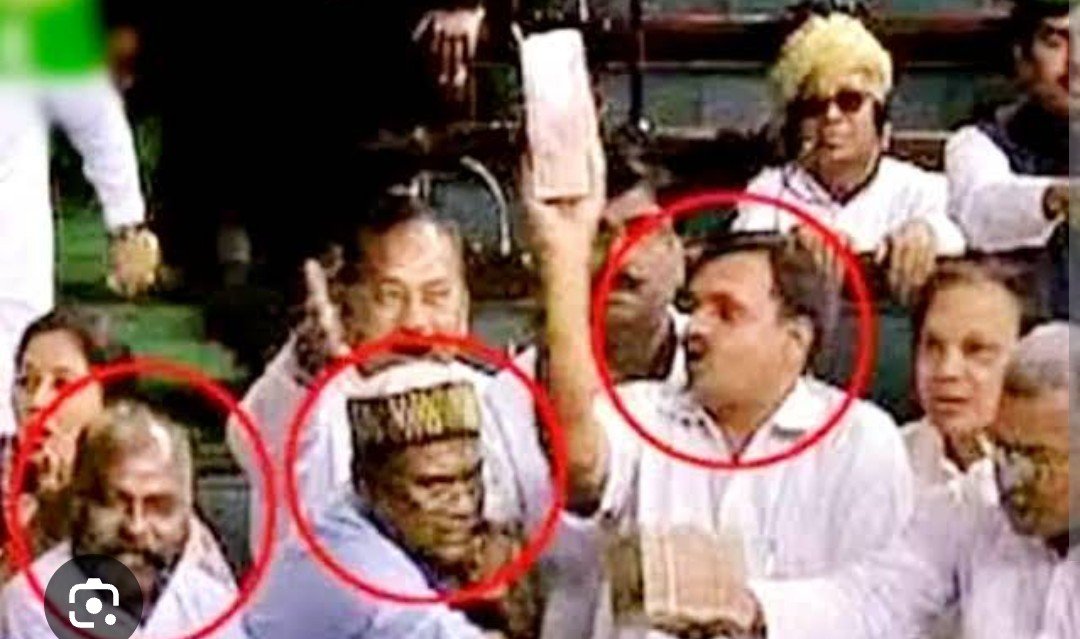
A similar incident occurred during the Manmohan Singh government. On July 22, 2008, during a vote of confidence in the Lok Sabha, three Bharatiya Janata Party (BJP) MPs—Faggan Singh Kulaste, Ashok Argal, and Mahavir Bhagora—waved bundles of currency notes. The three MPs alleged that they had been bribed with ₹1 crore (approximately $10 million) to support or abstain from the vote of confidence in Manmohan Singh’s then-UPA government. This incident is known in Indian parliamentary history as the cash-for-vote scandal.
There was widespread speculation that reporters from Bin Seven Hindi and CNN IBN English conducted a sting operation on the incident. This sting operation became quite popular at the time because evidence of this sting operation was shown to leaders of the BJP and several other political parties. BJP leader Arun Jaitley repeatedly urged the media house to broadcast the sting operation, but in the meantime, a major internal conspiracy was hatched, and the sting operation never came to light. It is said that the managing editor of that media house, Rajdeep Sir Desai, was awarded the Padma Shri as a reward for not broadcasting the sting operation. It was believed that the sting operation, which was allegedly used to distribute money to save his minority government, could have led to the fall of Manmohan Singh’s government.