

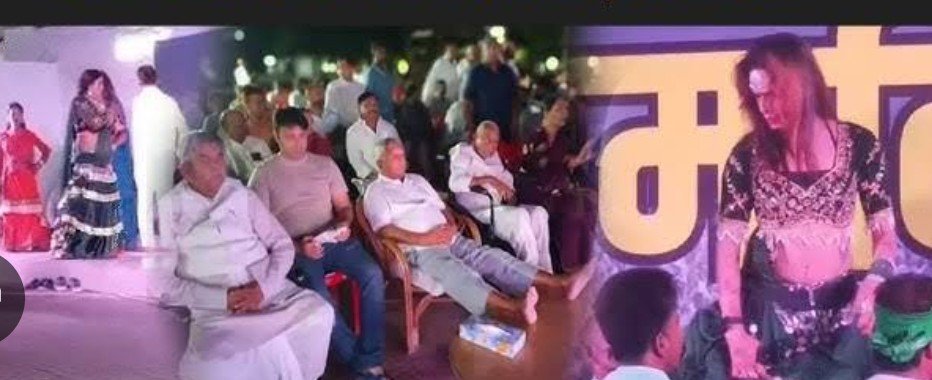
Bihar is currently the center of discussion across the country due to an incident involving former Bihar Chief Minister Lalu Prasad Yadav. On March 29th, Lalu Prasad Yadav organized a Launda Naach at his wife and former Bihar Chief Minister Rabri Devi’s residence at 10 Circular Road. He was accompanied by his wife and former Bihar Chief Minister Rabri Devi, his son and former Deputy Chief Minister of Bihar Tejashwi Yadav, and several prominent figures from his party. Everyone thoroughly enjoyed the Launda Naach. Although the event was held at the residence of Lal Yadav’s wife and former Bihar Chief Minister Rabri Devi, thanks to social media and mainstream media, people across the country saw the event. This sparked a heated debate and political reactions. Let’s discuss this debate and political reactions later. First, let’s explore the history of Lal Yadav and the Launda Naach.
According to available information, the Launda dance originated during the 11th century, when women were prohibited from dancing in public, and it was difficult for the general public to witness the dances of courtesans. The oppressed society then began the tradition of men dressing up as women for entertainment.
The 19th century was the heyday of the Launda dance, when Bhikhari Thakur transformed it into a well-organized folk theater. He transformed it not only for entertainment but also as a powerful medium for criticizing social evils like dowry and alcoholism through plays like “Videshiya.”
The Launda dance is primarily popular in the Bhojpur region of Bihar. It is performed during wedding processions, marriages, and other auspicious occasions.
At this time, the Launda dance performers had a distinct identity. Bhikhari Thakur, who brought the Launda dance to its pinnacle, may not have been awarded the Padma Award, and for whom there are now demands for the Bharat Ratna, a prestigious national award, but he did succeed in establishing a significant image as the Shakespeare of Bhojpuri. Ramchandra Manjhi, the lead dancer in Bhikhari Thakur’s troupe, was even honored with the Padma Shri, bringing this art form fame both nationally and internationally.
The primary region of Launda dance is the Bhojpuri-speaking regions of Bihar and Uttar Pradesh (e.g., Ara, Chhapra, Saran, Siwan, and Ballia). This traditional folk dance is part of Bhojpuri culture, performed by men dressed as women. It is especially popular during weddings, tonsure ceremonies, and other joyous occasions.
Earlier, Launda dance was a focal point of healthy entertainment. As part of plays like “Bidesiya,” it addressed serious social issues such as dowry, elopement, and mismatched marriages. But over time, obscenity began to dominate. Now, instead of entertainment, it has become a means of serving obscenity, where obscene songs are used.
Today’s Launda dance emphasizes double-meaning dialogue and body exposure by the dancers. This has led educated and modern society to distance itself from this Launda dance.
Lalu Yadav, adept at conducting politics in his typical rural style, often organized Launda dance during his tenure. At state events like the Rajgir Festival and the Mandar Festival, Lalu Yadav was seen enjoying the Launda dance, tapping his thighs, and calling the performers to him and paying them.
Lalu Yadav did not organize Launda dance to honor the Launda dance or its performers, but rather to attract a large number of young people to witness the obscenity and vulgarity presented through this dance. During this Launda Naach, Lalu Yadav would humorously say things like, “Clean the brown hair,” “Give oil to the stick,” etc. in his actions and speeches. This led to a large segment of this youth crowd considering him their icon and, during elections, helping to secure votes for Lalu Yadav and his party. In many places, these youth would intimidate and drive away genuine voters and cast their own votes for Lalu Yadav’s RJD party.
After being imprisoned in the fodder scam, Lalu Yadav would still organize this Launda Naach on special occasions as long as his wife, Rabri Devi, remained Chief Minister of Bihar and Lalu Yadav was released on bail. However, since Nitish Kumar assumed the position of Chief Minister of Bihar in 2005, Lalu Yadav has ceased to organize Launda Naach due to his political defeat and poor health.
In fact, Nitish Kumar had a distinct socialist vision. Instead of Lalu Yadav’s Launda Naach, Charwaha Vidyalayas, and Tel Pilavan Lathi Motawan rallies, Nitish Kumar successfully brought these communities under his influence by providing bicycles to girls for school, reservation for women in Panchayats, developing rural roads, and implementing numerous programs for the welfare of Dalits and Mahadalits.
Now that Lalu Yadav has once again organized the Launda Naach, there’s a significant political ploy behind it. By expressing his joy at this Launda Naach, Lalu Yadav wants to send a message to Nitish Kumar that even though the BJP is trying to wrest the position of Chief Minister of Bihar from him through pressure, if Nitish Kumar comes to his side, the two will not only thwart the BJP’s current efforts to oust Nitish Kumar from the Chief Minister’s post, but in the future, the combination of Nitish Kumar’s socialist-style politics and his own, testimonial, politics will completely eliminate the BJP from the political landscape in Bihar. This is perhaps a major reason why the banner Lalu Yadav put up behind the Launda Naach event at his Rowdy residence read “Hum Bihar.” Now, let’s examine the Bihar Legislative Assembly’s MLA data to understand the message Lalu Yadav’s Launda Naach is conveying to Nitish Kumar. The Grand Alliance currently has 35 MLAs in the legislative assembly. Considering the fact that the Asaduddin Owaisi-led AIMIM party had pledged support to the Grand Alliance candidate during the Rajya Sabha elections, adding five AIMIM MLAs brings the total to 40. Adding the JDU’s 85 MLAs to this total brings the total to 125, which is three more than the minimum 122 required for a majority in the 243-member Bihar Legislative Assembly. In such a situation, Nitish Kumar will succeed in remaining the Chief Minister of Bihar despite the BJP’s unwillingness by coming in favor of the Grand Alliance, and then in the upcoming elections too, Nitish Kumar’s social engineering and Lalu Yadav’s rustic style will not allow the BJP to flourish in Bihar.
Now Lalu Yadav has conveyed his message to Nitish Kumar through this launda dance, but it does not seem that Nitish Kumar will give much importance to Lalu Yadav’s message, because JDU MLC Neeraj Kumar has even called this sympathy shown by Lalu Yadav towards Nitish Kumar as the sin of launda dance. Nevertheless, politics has its own unique tricks, due to which it is difficult to say when and where someone will reach.