

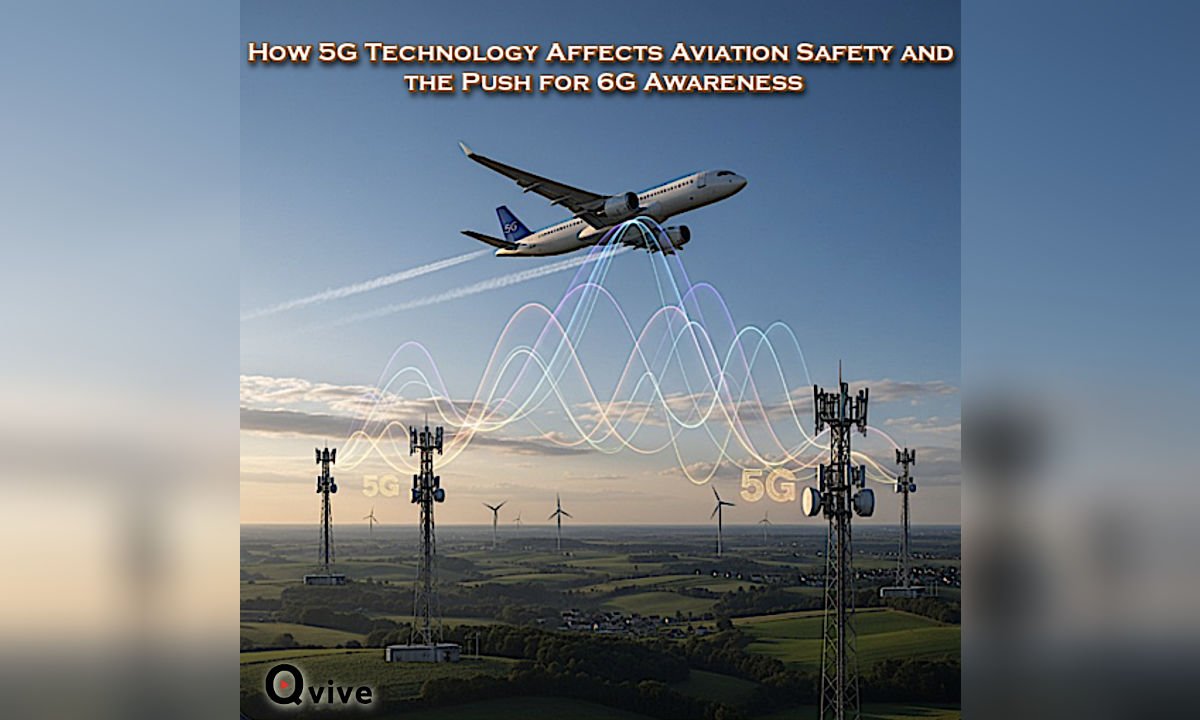
The rapid rollout of 5G technology has revolutionized telecommunications, offering ultra-fast speeds and low latency. However, concerns over potential interference with aircraft safety systems, particularly radio altimeters, have led to regulatory delays and restrictions—especially near airports. The United States has faced significant challenges, prompting airlines to cancel flights and regulators to enforce buffer zones. India, while deploying 5G more cautiously, must take lessons from these incidents before advancing to 6G.
This article explores:
- How 5G could interfere with aircraft systems
- Why the US delayed 5G near airports
- India’s regulatory response and potential risks
- Reported incidents in India related to 5G and aviation
- The implications for future 6G deployments
1. Could 5G Really Ground Planes?
The Science Behind the Risk
Radio altimeters (RADALTs) operate in the 4.2–4.4 GHz frequency range and are critical for:
- Terrain awareness (GPWS/TAWS)
- Auto-landing systems (Autoland)
- Collision avoidance (TCAS)
- Fly-by-wire altitude-dependent flight controls
5G operates in the C-Band (3.3–3.98 GHz in the US, 3.3–3.67 GHz in India). The proximity of these frequencies raises concerns about:
- Receiver desensitization (5G signals overwhelming RADALT sensitivity)
- Spurious emissions (leakage into adjacent bands)
5G Ground Planes Interfere with Radar Altimeters
Types of Interference
- Receiver Blocking: High-power 5G signals can overwhelm the RadAlt’s front-end, causing erroneous readings or complete failure.
- Spurious Emissions: Unintended 5G signals leaking into the 4.2–4.4 GHz band may trigger false altitude data.
Observed Effects in Testing
- Erroneous altitude readings (deviations of hundreds/thousands of feet).
- “No Computed Data” (NCD) errors, where the system fails to provide altitude.
- Common-mode failures (multiple RadAlts failing simultaneously due to shared antenna proximity).
Worst-Case Scenarios
- False Terrain Warnings: Erroneous TAWS alerts could force unnecessary evasive maneuvers.
- Autoland Failures: Premature flare commands or throttle reductions could lead to runway undershoots or stalls.
5G Factor in Plane and Helicopter Crashes? FAA Warning Issued in 2021
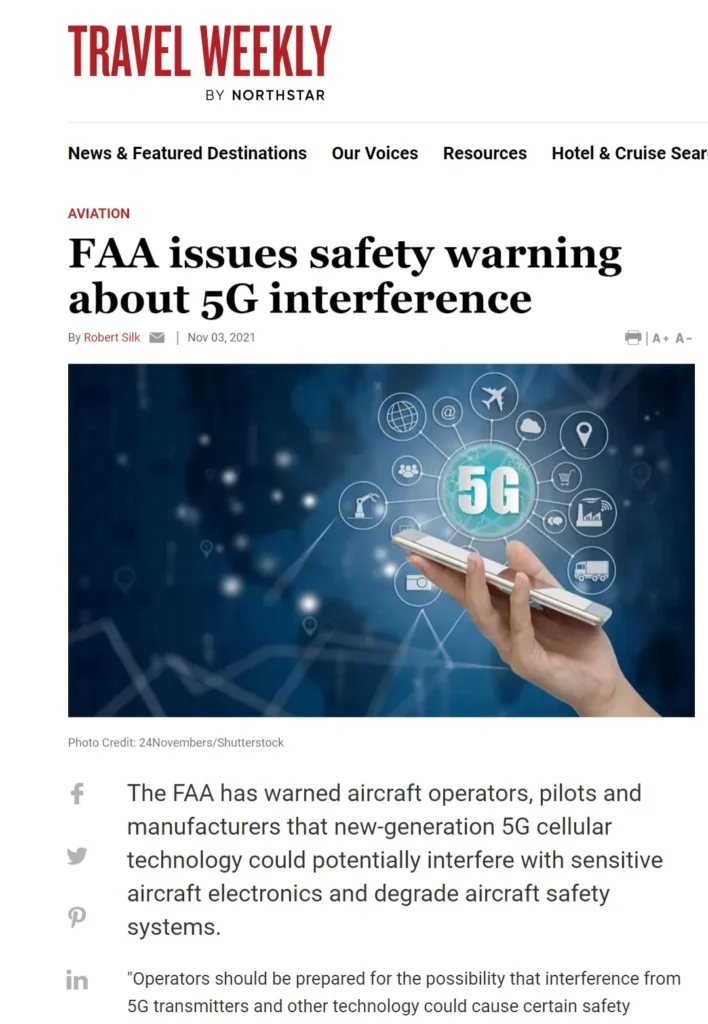
Aviation disasters in Alaska, Washington D.C., and Philadelphia

2. Why Did the US Delay 5G Near Airports?
In early 2022, the FAA warned airlines about potential 5G interference, leading to:
- Flight cancellations by major carriers (including Air India)
- Restrictions on low-visibility landings near 5G towers
- Buffer zones (no high-power 5G within 2 miles of runways)
Reasons for US Delays:
- Higher 5G frequencies (up to 3.98 GHz, closer to aviation bands)
- High-power deployments (riskier than EU’s lower-power approach)
- Legacy aircraft with unfiltered altimeters
The FCC and FAA eventually compromised with mitigations like power reductions and exclusion zones, but the dispute highlighted spectrum policy fragmentation.
3. India’s Regulatory Response and Risks
India’s DoT, DGCA, and MoCA have taken a more cautious approach than the US:
- Smaller frequency gap (3.67 GHz vs. 4.2 GHz, safer than the US but still a concern)
- Exclusion zones around airports (prohibiting high-power 5G antennae near runways)
- Power limitations (reduced 5G transmission strength near flight paths)
Why India Must Be Wary Before Deploying 6G:
- Higher frequencies (6G may extend into millimeter waves, increasing interference risks)
- Dense urban airports (Mumbai, Delhi, Bengaluru have heavy 5G/6G demand)
- Mixed fleet (older aircraft with legacy altimeters still in use)
India should:
- Mandate altimeter upgrades (5G-hardened filters)
- Enforce stricter spectrum guard bands for 6G
- Conduct real-world interference testing before nationwide rollout
4. Reported 5G-Related Incidents Near Indian Airports
Reported 5G-related incidents near Indian airports primarily involve Radar Altimeter (RADALT) interference from C-band 5G deployments (3.3-3.67 GHz), adjacent to RADALT’s 4.2-4.4 GHz band.
Delhi Airport (2023)
Multiple pilots reported temporary RADALT fluctuations during low-altitude approaches at Indira Gandhi International Airport. DGCA investigations confirmed links to nearby 5G trials by operators like Airtel and Jio; DoT mandated power reductions (e.g., 58 dBm cap within 2.1 km of runways).
- Pre-2023 restrictions barred C-band 5G base stations near ~120 airports to protect legacy altimeters, delaying services for millions.
- No widespread post-mitigation RADALT outages reported by 2026, though upgrades to 5G-tolerant altimeters continue fleet-wide.
- Recent disruptions (2025) at Delhi, Mumbai, etc., involve GPS spoofing/jamming (1,951 cases), not confirmed as 5G-related.
The following airports have been specifically cited in government reports and technical directives regarding 5G interference or related navigation disruptions:
- Indira Gandhi International Airport (DEL), Delhi: Identified as a primary site for GPS spoofing and 5G signal concerns, particularly on Runway 10.
- Chhatrapati Shivaji Maharaj International Airport (BOM), Mumbai: Included in the DoT’s restrictive orders for C-band installation and reported GNSS interference.
- Kempegowda International Airport (BLR), Bengaluru: A major hub where 5G rollout was initially curtailed near runways to protect sensitive avionics.
- Netaji Subhash Chandra Bose International Airport (CCU), Kolkata: Reported incidents of Global Navigation Satellite System (GNSS) interference.
- Rajiv Gandhi International Airport (HYD), Hyderabad: Subject to exclusion zone protocols and reported signal anomalies.
- Chennai International Airport (MAA), Chennai: Listed by the Ministry of Civil Aviation as experiencing navigation signal disruptions.
- Sri Guru Ram Dass Jee International Airport (ATQ), Amritsar: Confirmed by the Civil Aviation Minister as having recorded GNSS interference incidents.
Global Parallel
Mirrors U.S. cases (400+ FAA anomalies by 2023), resolved via telecom power limits and hardware retrofits. [iata.org/en/pressroom/2023-releases/2023-05-02-01/]
5. Lessons for 6G Deployment in India
The 5G-aviation clash serves as a warning for 6G, which may use higher frequencies (24 GHz and above).
The Intersection of 5G Technology and Artificial Intelligence in Aviation Safety
The integration of fifth-generation (5G) wireless networks and Artificial Intelligence (AI) into the global aviation ecosystem represents a paradigm shift in operational efficiency and connectivity. However, these advancements introduce significant technical and security challenges. The primary concern regarding 5G involves electromagnetic interference with critical flight instruments, while AI introduces vulnerabilities related to cybersecurity and autonomous decision-making.
Operational Risks and Flight Safety
Inaccurate altimeter readings are not merely a technical glitch; they pose a “catastrophic” risk during critical phases of flight. Modern aircraft rely on altimeter data for:
- Automatic Landing Systems (Autoland): Systems that land the plane in low visibility (Category II/III approaches) require precise altitude data to execute the “flare” maneuver before touchdown.
- Ground Proximity Warning Systems (GPWS): These systems alert pilots if they are flying too close to the ground or an obstacle.
- Traffic Collision Avoidance Systems (TCAS): Altimeter data helps coordinate maneuvers between aircraft to prevent mid-air collisions.
The Federal Aviation Administration (FAA) warned that interference could lead to flight cancellations, diversions, and delays, particularly in poor weather conditions where pilots cannot rely on visual cues.
Artificial Intelligence and Cybersecurity Vulnerabilities
While 5G presents a hardware interference risk, the implementation of AI in aviation introduces complex software and cybersecurity threats. AI is increasingly used for predictive maintenance, air traffic management, and autonomous flight operations.
Adversarial Machine Learning
One of the primary dangers of AI in aviation is “adversarial machine learning.” This involves malicious actors feeding “poisoned” data into an AI algorithm to cause it to malfunction. For example, an AI-driven security scanner or an autonomous drone could be fooled into misidentifying a threat or a navigational landmark by subtle, human-imperceptible changes to the input data.
The “Black Box” Problem and Decision Opacity
AI systems, particularly those using deep learning, often operate as “black boxes,” where the logic behind a specific decision is not transparent to human operators. In a high-stakes aviation environment, if an AI system makes an erroneous maneuver or provides a false diagnostic, pilots may find it difficult to understand the error in real-time, leading to a loss of situational awareness.[
Increased Attack Surface
The synergy between 5G and AI creates a massive “Internet of Things” (IoT) ecosystem within airports. 5G allows for the connection of thousands of sensors (from baggage trackers to fuel sensors), all managed by AI. However, this vastly increases the “attack surface” for cyber-terrorists. A breach in a low-security IoT device could serve as an entry point to disrupt an entire airport’s network or launch Distributed Denial-of-Service (DDoS) attacks.
Global Variations in 5G Deployment
The 5G danger is notably more pronounced in the United States than in Europe or Asia. This is due to several technical factors:
- Frequency Separation: In the European Union, 5G operates in the 3.4–3.8 GHz range, providing a larger buffer (400 MHz) from the altimeter band compared to the U.S. buffer.
- Power Levels: U.S. 5G base stations are authorized to operate at higher power levels than those in many other countries.
- Antenna Tilting: In France, 5G antennas near airports must be tilted downward to minimize upward interference toward approaching aircraft, a mitigation strategy that was not initially mandated in the U.S.
Current Status of 5G and 6G Towers in India
As of late 2025, India has successfully deployed over 504,588 5G base stations. The rollout is dominated by major Telecom Service Providers (TSPs) including Reliance Jio, Bharti Airtel, and Vodafone Idea (Vi). While 5G is widely available across the country, 6G technology is currently in the research and development phase. The Government of India launched the “Bharat 6G Vision” document in 2023, aiming for a commercial rollout by 2030; therefore, there are currently no commercial 6G towers in operation near airports or elsewhere in India.
Regarding 5G towers near airports, the Department of Telecommunications (DoT) and the Directorate General of Civil Aviation (DGCA) have enforced a “buffer zone” policy. TSPs are prohibited from installing 5G C-band (3,300-3,670 MHz) base stations within a 2.1 km range of the ends of runways and 910 metres from the centre line of the runway.
Reported Incidents and Anomalies
- United States (2022-2023): Following the C-band rollout in the US, pilots reported over 100 incidents to the FAA and NASA’s Aviation Safety Reporting System (ASRS) involving malfunctioning altimeters. In one instance at Los Angeles International Airport, a commercial jet on autopilot experienced an aggressive, uncommanded descent just 100 feet above the ground.
- Autopilot Failures: Several aircraft in the US reported the complete loss of autopilot and “autothrottle” functions during approach, necessitating emergency manual landings with fire trucks on standby.
- India-Specific Actions: In late 2022, Bharti Airtel, which had already deployed 5G near several Indian airports, was forced to switch off its base stations in those vicinities following the DoT directive to ensure passenger safety.
5G’s interference risks are real. The US delays and India’s cautious approach demonstrate the need for balanced spectrum policies. Before deploying 6G, India must:
- Learn from 5G challenges
- Strengthen aviation safety frameworks
- Ensure seamless coexistence of telecom and flight systems
Ref:
- https://www.rcrwireless.com/20251030/5g/india-adds-5g
- https://telecomtalk.info/5g-near-airports-in-india-what-you/639126/TelecomTalk.
- https://www.ndtv.com/india-news/no-5g-base-stations-near-airports-centre-to-telecom-providers-3567827
- https://telecom.economictimes.indiatimes.com/news/millions-of-indians-living-near-airports-may-not-get-to-enjoy-5g-in-2023/96492120
- https://en.wikipedia.org/wiki/List_of_5G_NR_networks
- https://m.economictimes.com/industry/transportation/airlines-/-aviation/5g-near-airports-next-yr-as-decs-the-deadline-to-upgrade-plane-gear/articleshow/107832066.cms
- https://dot.gov.in/
- https://www.rtca.org/wp-content/uploads/2020/12/Webinar-QA-11.30.20-1.pdf
- https://www.indiatoday.in/india/story/flights-faced-gps-spoofing-near-delhi-airport-government-confirms-in-parliament-2828826-2025-12-01
- https://www.business-standard.com/india-news/aviation-ministry-to-delay-decision-on-5g-altimeter-s-replacement-123110800910_1.html
- https://www.business-standard.com/india-news/aviation-ministry-to-delay-decision-on-5g-altimeter-s-replacement-123110800910_1.html
- https://telecom.economictimes.indiatimes.com/news/millions-of-indians-living-near-airports-may-not-get-to-enjoy-5g-in-2023/96492120
- http://www.100knots.com/indias-aircraft-radio-altimeter-upgrade-amidst-5g-expansion/
- https://www.news4hackers.com/cyberattack-at-delhi-airport-investigation-launched-after-major-amss-system-malfunction/
- https://www.indiatoday.in/india/story/flights-faced-gps-spoofing-near-delhi-airport-government-confirms-in-parliament-2828826-2025-12-01
- https://www.newindianexpress.com/xplore/2025/Nov/13/understanding-the-atc-tech-glitch-that-paralysed-delhi-airport
- https://www.news18.com/india/delhi-mumbai-and-other-airports-hit-with-1951-aircraft-gps-interference-cases-in-2-years-govt-ws-l-9764912.html
- https://economictimes.indiatimes.com/industry/transportation/airlines-/-aviation/govt-says-there-is-likelihood-of-5g-signals-interfering-with-aircrafts-radio-altimeters/articleshow/105996659.cms
- m.economictimes.com/industry/transportation/airlines-/-aviation/gps-signal-trouble-at-delhi-airport-sparks-concern-mumbai-bengaluru-among-several-other-airports-hit/articleshow/125693672.cms
- https://zeron.one/cyber-attacks-on-airports-indian-govt-confirms-seven-incidents/
- https://niralnetworks.com/private-5g-solution-airports/
Also Read: