


In the tech world, there has been a lot of talk about the future of smartphones. Many influential figures such as Elon Musk, Bill Gates, Mark Zuckerberg, and Nokia’s CEO Pekka Lundmark have made bold predictions about the fate of smartphones. They believe that by 2030, smartphones as we know them today will become obsolete, making way for smarter and more connected technologies. But is this prediction really going to come true?
As reported by the World Economic Forum on August 18, 2016: This smart tattoo can turn into a touchpad
DuoSkin Tattoos
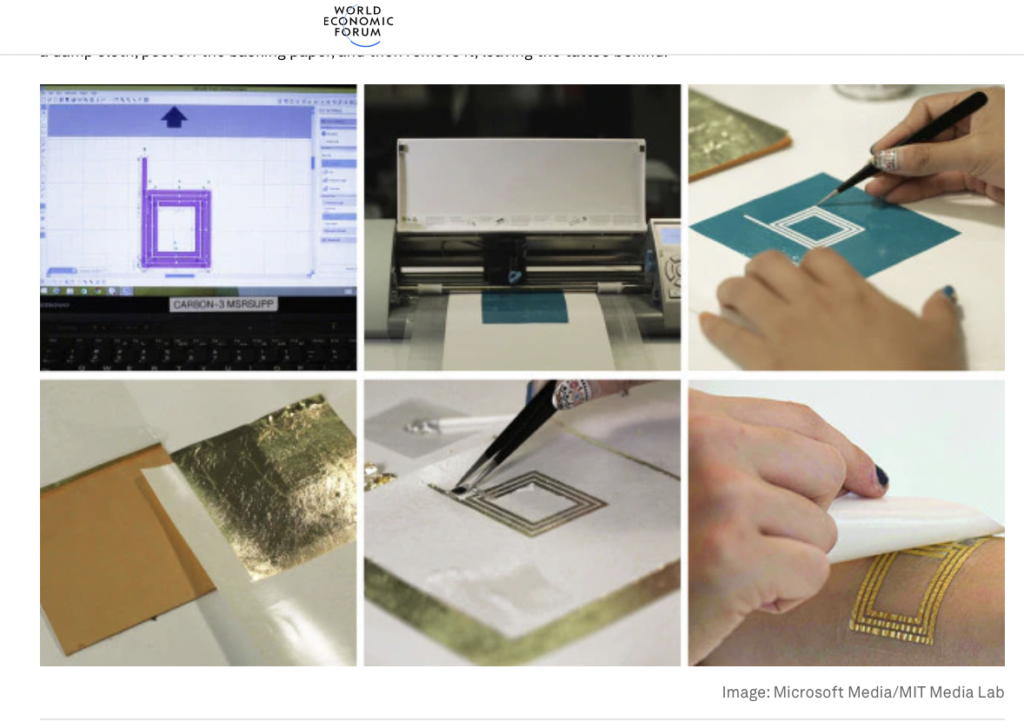
- Material Use:
- DuoSkin tattoos use gold leaf, a material often seen in arts and crafts, as a conductor. This choice is practical because gold leaf is flexible and aesthetically pleasing, making it ideal for moving with the skin as the body shifts.
- Interactive Functions:
- These tattoos are not just for decoration; they can serve several purposes:
- Touchpad or Button: They can act as a control for devices like smartphones. Imagine using your skin as a trackpad, allowing you to swipe and click without a physical gadget.
- Display Information: Featuring thermochromic technology, these tattoos can change colors in response to your body temperature, giving visual feedback about your health.
- Wireless Communication: By incorporating NFC tags, these smart tattoos can store data, functioning like a digital ID or a ticket for events.
- These tattoos are not just for decoration; they can serve several purposes:
- Accessibility and Creation:
- The researchers envision DuoSkin not merely as a product but as a project for others to replicate. To create your own DuoSkin tattoo, you would:
- Design the circuit using a graphic design program.
- Cut stencils from tattoo paper and apply gold leaf on top.
- Mount the electronics and apply the tattoo just as you would with a regular temporary one.
- Cost: The initial setup might cost around $175 (including a craft electronic cutter and materials). While the cost may seem high for a single use, once you have the cutter, making additional tattoos becomes cheaper.
- The researchers envision DuoSkin not merely as a product but as a project for others to replicate. To create your own DuoSkin tattoo, you would:
The lead researcher, Cindy Hsin-Liu Kao, acknowledges that while not everyone might want to DIY their tattoo, there is a commercial opportunity for temporary tattoo parlors where custom designs can be created for customers.
Beware of tattoos! Learn about the potential risks of tattoos and the link to lymphoma. Stay informed before getting inked.
Smart Tattoos – The Future of Wearable Health Technology
Smart tattoos, also known as electronic tattoos, e-tattoos, or biosensing ink, represent a fusion of art, biotechnology, electronics, AI, and real-time diagnostics. Unlike traditional wearables such as smartwatches or fitness bands, smart tattoos transform the skin itself into a living interface that monitors health continuously and intimately.
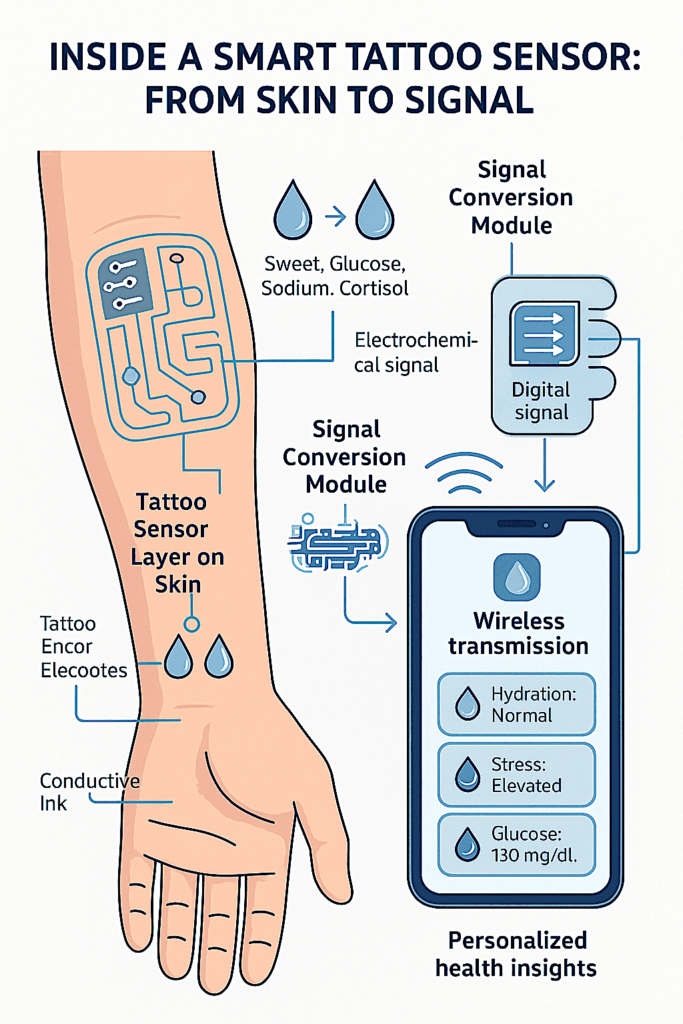
Core Technology and Types of Smart Tattoos
Smart tattoos are ultra-thin, flexible circuits integrated on or beneath the skin, utilizing various innovative inks and components:
| Type of Tattoo Ink/Technology | Function |
| Conductive metallic inks | Printed tiny circuits that send electrical signals |
| Biochemical sensing inks | React to internal chemicals such as glucose or hydration |
| Thermochromic & electrochromic inks | Change color based on temperature or electric signals |
| Micro-LED embedded tattoos | Emit light under the skin to display icons, warnings, or health data |
| AI-connected nano-sensors | Sync with apps and AI to provide real-time health analytics |
Characteristics:
- Soft, flexible, waterproof, sweat-resistant
- Visible or invisible
- Temporary, semi-permanent, or permanent
Medical and Health Applications
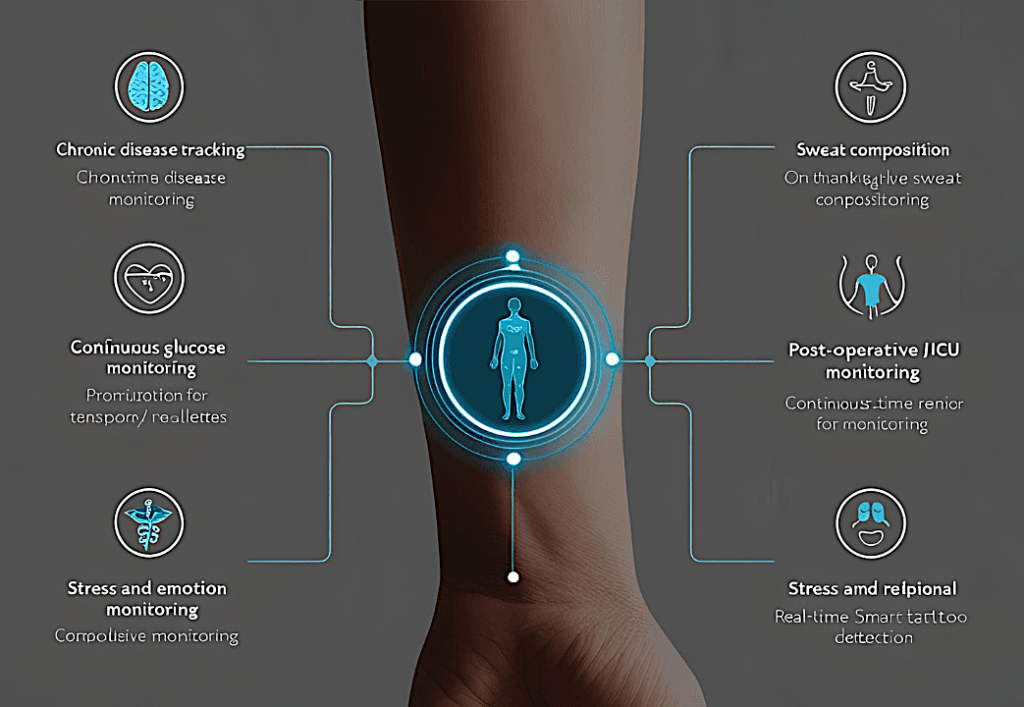
Smart tattoos are poised to revolutionize healthcare by enabling continuous, non-invasive monitoring, early diagnosis, and even predictive analytics:
- Diabetes management: Tattoos change color to indicate blood sugar highs or lows, eliminating the need for finger pricks or glucose meters.
- Hydration monitoring: Color shifts alert athletes and outdoor workers to electrolyte loss.
- Fever and infection detection: Tattoos glow or change pattern with rising body temperature or inflammation.
- Heart monitoring: Ultra-thin printed ECG tattoos detect heart rate and rhythm anomalies in real time.
- Chronic disease management: Early warning signs for kidney, liver, respiratory, and blood pressure conditions.
AI Integration and Digital Health
Smart tattoos connect with AI health assistants, creating a 24/7 personalized health monitoring system that learns from and interprets data such as:
- Sleep cycles
- Stress levels
- Eating habits
- Workout activity
- Blood chemistry trends
AI can alert users to potential health issues like mood swings, dehydration, infections, hormonal imbalances, or nutrient deficiencies. Future versions will integrate with hospitals, insurance companies, fitness coaches, diet apps, and emergency services — potentially enabling automatic medical alerts or emergency calls.
Fashion and Lifestyle Innovations
Smart tattoos are also transforming fashion and personal expression:
- Mood-responsive tattoos: Change colors based on stress hormones or heart rate.
- Light-up tattoos: Embedded micro-LEDs produce sparkling, pulsing, neon-like effects for festivals, clubs, or cosplay.
- Interactive music tattoos: Respond to touch or music beats with sound or vibration.
- Digital identity tattoos: Function as door passes, payment devices, digital signatures, or personal keys, enabling seamless digital interaction.
Sports and Fitness Enhancements
Smart tattoos offer athletes and coaches advanced biometrics without bulky devices:
- Track muscle fatigue, lactate levels, oxygen use, sweat composition, body temperature, and joint strain.
- Provide injury prevention alerts by detecting stress or muscle imbalances early.
- Supply coaches with live data on energy levels, recovery times, and optimal substitution moments.
Privacy and Ethical Concerns
Privacy Concerns: When Your Skin Becomes Data
While smart tattoos offer exciting possibilities, they also raise significant privacy concerns. As these devices become more prevalent, we must address important questions regarding data ownership, security, and ethical implications.
- Who owns your body data?
- Is it you, the individual wearing the tattoo?
- Does the tattoo company have rights to the data collected?
- What about your healthcare provider or insurance company?
- Can your tattoo be hacked?
- If a smart tattoo regulates critical medical functions, a security breach could have severe consequences.
- Forced medical transparency
- Could future employers require job applicants to have health-monitoring tattoos?
- Is there a risk that governments might misuse this technology to surveil citizens?
- Tattoos revealing mental states
- Mood-reactive tattoos could inadvertently reveal emotions individuals wish to keep private.
- Permanent digital footprint
- Unlike a social media post that can be deleted, information stored in a smart tattoo is harder to erase, raising concerns about data permanence and security.
Duration and Permanence of Smart Tattoos
| Tattoo Type | Duration | Typical Uses |
| Temporary | 24 hours to 2 weeks | Sports events, concerts, military missions, hospital monitoring, fashion shows |
| Semi-permanent | 3 months to 1 year | Diabetes monitoring, post-surgery care, long-term fitness tracking |
| Permanent | Years | Medical diagnostics, integrated nano-sensors, flexible microchips |
Permanent tattoos represent the future of long-term health diagnostics and body-integrated technology.
Global Innovation and Adoption
Research and development in smart tattoos are leading in various countries:
- United States: MIT, Harvard focus on glucose-reactive inks and flexible circuits
- Japan: Electronic skin technologies
- South Korea: LED-integrated skin circuits
- Germany: Biochemical inks
- India: Affordable smart medical inks
- China: Wearable microchip tattoos
Hospitals may soon distribute smart tattoos as routinely as medical wristbands.
Projected Timeline for Smart Tattoo Integration
| Year | Predicted Milestone |
| 2027 | Smart tattoos replace most fitness bands |
| 2029 | Hospitals adopt tattoo-based diagnostics |
| 2031 | Neon LED tattoos become mainstream fashion |
| 2033 | Smart tattoos connect directly to AI doctors |
| 2035 | Emergency tattoos trigger automatic medical responses |
| 2037 | Tattoos replace passwords, ID cards, and debit cards |
Insights
- Smart tattoos blur the lines between art, identity, medicine, technology, AI, and emotion.
- They represent a permanent, intimate, and accurate wearable technology that could transform healthcare, sports, fashion, and digital identity.
- Integration with AI enables personalized, real-time health monitoring and predictive care.
- Despite promising benefits, privacy, security, and ethical challenges demand urgent attention.
- The coming decade will see smart tattoos evolve from niche innovations to ubiquitous digital interfaces on human skin.
On May 8, 2017, the WEF website indicated that Bill Gates is pretty good at predicting the future. This is what he thinks will happen next.

Bill Gates, has publicly supported the concept of electronic tattoos as a potential replacement for smartphones . Developed by Chaotic Moon (later acquired by Accenture), these bio-interactive wearables are envisioned to blend communication, health tracking, security, and computing into a seamless, skin-based interface, eliminating the need for screens or physical devices. These temporary tattoos would utilize smart ink and nanocapacitors to send and receive messages, make payments via biometric authentication, monitor real-time health data, and access digital content through gestures. Gates believes smartphones have reached a “ceiling” and that a more integrated solution is on the horizon, potentially making them obsolete by 2030. He has a history of accurate technological predictions, including the rise of tablets, video conferencing, and mobile connectivity.
The notion that smartphones will be obsolete by 2030 is a prediction made by several technology leaders, most notably Nokia CEO Pekka Lundmark, who stated that with the advent of 6G networks, the smartphone as we know it today will no longer be the most common interface. Instead, he anticipates that many functionalities currently housed in smartphones will be integrated directly into our bodies or manifest as other forms of wearable technology.
Nokia's CEO says that by 2030 "smartphones will be implanted directly into our bodies" as 6G becomes fully operational.
— Nicolas Hulscher, MPH (@NicHulscher) December 23, 2025
President Trump just signed a Memorandum to accelerate 6G deployment, with a stated goal to "operate implantable technologies."
This is a dangerous path. https://t.co/8aDrpcgEPJ pic.twitter.com/m2z0YVTiyF
This prediction is rooted in the rapid evolution of technology, particularly in areas like artificial intelligence (AI), augmented reality (AR), and brain-computer interfaces (BCI) . Experts suggest that the current smartphone format has reached a point where significant innovation beyond existing capabilities is challenging, leading to a “boring” user experience. The next generation of digital companions is expected to be more discreet, less expensive, and heavily boosted by AI.
Technologies and Concepts Driving the Post-Smartphone Era:
- 6G Connectivity: Expected to be commercially available around 2030, 6G networks will offer speeds 100 to 1,000 times faster than current networks, enabling real-time applications like remote surgery and autonomous vehicles. This ultra-high-speed connectivity is crucial for supporting the massive computational resources required for concepts like the “digital twin of everything” and the metaverse.
- Augmented Reality (AR) and Virtual Reality (VR): Leaders from companies like Meta and Google believe that AR and VR glasses will become the primary interface for interacting with digital content. These devices could project real-time directions, translate conversations instantly, and allow users to virtually try on clothes. Google previously experimented with Google Glass, and Meta has launched its Ray-Ban Smart Glasses, indicating a strong industry push towards this form factor. Apple’s Vision Pro also represents a significant step in this direction, though it is seen as a stepping stone.
World Economic Forum panel moderator, Andrew Ross Sorkin: The wealthy will be able to travel, but the poor will need to use virtual reality headsets to travel to the same place, from the confines of their own couch.
— Wide Awake Media (@wideawake_media) June 15, 2024
"In many ways, it's actually going to create even more distance… pic.twitter.com/ak2tbhAwaq
- Wearable Technology: Beyond AR glasses, a variety of other wearables are emerging as potential smartphone replacements. These include AI Pins that can be pinned to clothing to listen to emails or make calls, smart rings for health data tracking, and AI-assisted earbuds with cameras. Companies like Humane and Rabbit are developing devices like the AI Pin and Rabbit R1, which aim to offer intuitive, AI-powered interactions without a traditional screen or keyboard.
- Brain-Computer Interfaces (BCI): Companies like Elon Musk’s Neuralink are developing electronic devices that can be implanted into the brain, allowing for direct communication with machines and other people. The goal is to enable individuals with paralysis to control smartphones with their minds faster than using their thumbs, and eventually to restore motor functions. Nokia CEO Pekka Lundmark even suggested that 6G could facilitate the integration of smartphones into our bodies through such chips, with implications for health monitoring and disease prediction.
ELON MUSK ON X PHONE:
— Wall St Engine (@wallstengine) October 31, 2025
I am not working on a phone. I can tell you where I think things will go, which is that we’re not going to have a phone in the traditional sense.
There won’t be operating systems. There won’t be apps in the future… you’ll have … AI on the server side… pic.twitter.com/W5pi9FpYaG
- Artificial Intelligence (AI): AI is expected to become a personalized system that learns user preferences and needs, automating tasks like email management and agenda organization. This intelligence will be embedded across various devices, making interactions more seamless and intuitive.
The shift away from smartphones is not merely about new gadgets but a fundamental change in how humans interact with technology and the digital world. The current smartphone, while revolutionary, is seen as a bridge to the next technological era, much like fax machines and landlines were before it. The emphasis will be on more natural mobility, with AI acting as a central assistant, retrieving information and performing tasks without the need for a physical screen or keyboard.
Final thoughts: The tattoo that has a better understanding of you than you
Smart tattoos are a mix of:
- Art
- Identity
- Medicine
- Technology
- AI
- Data
- Emotion
They don’t just stay on your skin — they become a part of your life.
A tattoo that used to show your personality can now show your biology.
The future of health, fashion, and how we interact with machines is already written…
Not on paper.
Not on screens.
But on your skin.
Additional Information:
Mind-Control Technology:
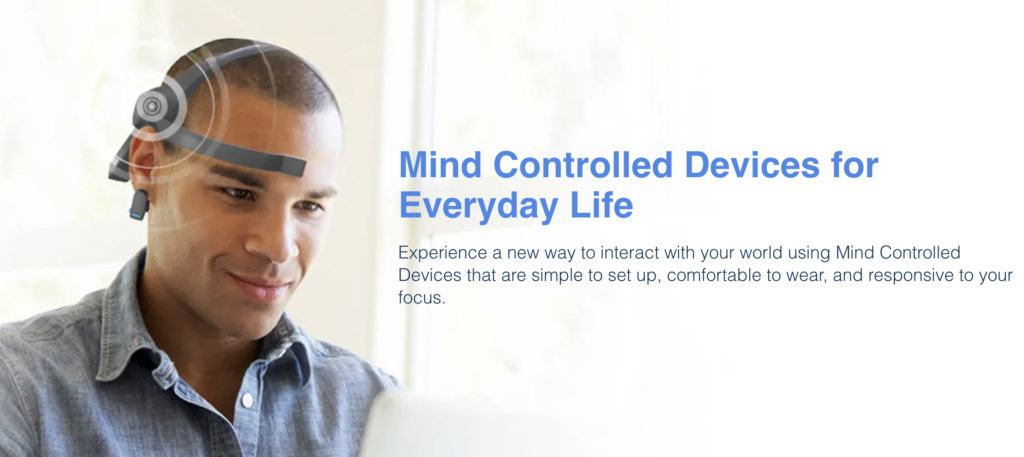
The field of mind control devices, more formally known as Brain-Computer Interfaces (BCIs) or Brain-Machine Interfaces (BMIs), is rapidly evolving, with numerous companies developing technologies for a wide range of applications, from medical rehabilitation to consumer use and even military applications. These devices aim to establish direct communication pathways between the brain and external devices, enabling control through thought alone or by monitoring brain states.
Here is a list of available mind control devices and their manufacturers, categorized by their primary approach and application:
Invasive Brain-Computer Interfaces (Requiring Surgery)
These devices are implanted directly into or onto the brain, offering higher bandwidth and more precise signal capture, but also carrying greater surgical risks.
- Neuralink: Founded by Elon Musk, Neuralink is developing devices with thin, thread-like electrodes that are sewn into the brain. Their ultimate goal is to create a symbiosis between the human brain and AI, addressing neurological problems like paralysis, memory loss, hearing loss, and blindness. In January 2024, Neuralink implanted its first human participant, who by mid-2025 was reportedly using the N1 chip daily to play video games, browse the web, and control external hardware.
- Synchron (Stentrode™): Synchron pioneers the Stentrode™, an endovascular BCI implanted through the jugular vein, sitting inside a blood vessel over the motor cortex. This minimally invasive approach avoids open brain surgery. Six U.S. participants with severe paralysis have used the system to text, email, and control digital devices, with one demo integrating GPT-4 for hands-free chat.
- Blackrock Neurotech (MoveAgain BCI system / Utah Array): Blackrock Neurotech, builders of the famed Utah Array, received FDA Breakthrough Device designation for its MoveAgain BCI system in 2021. They are working towards the first at-home implantable BCI for people with tetraplegia, aiming to restore communication and motor function. The NeuroPort Array, their flagship device, has been implanted in over 30 human patients and can capture high-resolution neurological signals for digital communication, text synthesis, and robotic arm control.
- Paradromics (Connexus®): Austin-based Paradromics is developing Connexus®, a high-bandwidth cortical implant that streams thousands of neural channels simultaneously. In June 2025, the company completed its first-in-human recording during epilepsy surgery, demonstrating safe implantation, data capture, and removal. Their technology aims to assist individuals with severe neurological conditions, particularly for speech restoration, by processing large amounts of data in real time.
- Precision Neuroscience (Layer 7 Cortical Interface): Founded by Neuralink co-founder Benjamin Rapoport, Precision Neuroscience created the Layer 7 Cortical Interface—an ultra-thin, flexible micro-electrode film that conforms to the brain’s surface with minimal tissue disruption. This device rests on the surface of the brain, making it less invasive than deep-brain implants. In December 2024, the company closed a $102 million Series C to accelerate clinical trials and scale manufacturing after reporting record-setting 4,096-electrode human recordings .
- CorTec (BrainInterchange technology): A German company, CorTec creates implantable BCI systems for closed-loop recording and stimulation of brain signals. Their BrainInterchange technology allows physicians to track and modify neural activity in real time, potentially offering therapies for chronic pain, Parkinson’s disease, and epilepsy.
- Motif Neurotech (Digitally Programmable Over-brain Therapeutic – DOT): Motif Neurotech is developing the DOT, a small, battery-free device that only penetrates the skull and sits above the motor cortex. While not designed for high-bandwidth data capture for movement, its ultimate goal is to alleviate mood disorders like treatment-resistant depression by stimulating the brain.
Non-Invasive Brain-Computer Interfaces (External Devices)
These devices do not require surgery and typically use electroencephalography (EEG) to measure brain activity from outside the skull. They are generally safer and more accessible for broader applications .
- Neurable (Enten smart headphones, MW75 Neuro headphones): Neurable focuses on bringing neurotechnology from the lab to everyday life, creating cognitive-measurement tools and developing ways to measure the brain’s emotional state, specifically cognitive load. They made news in 2017 for inventing the world’s first brain-controlled virtual-reality (VR) game. Their Enten smart headphones, launched in 2021, and MW75 Neuro headphones, shipping in 2024, are designed for consumer use, potentially allowing users to control devices with their thoughts.
- Emotiv (EPOC Flex, Insight, MN8 EEG earbuds): Emotiv builds wireless electroencephalogram (EEG) monitoring headsets for scientific research and personal use across various industries, including gaming, interactive television, hands-free control systems, and medicine. Their range includes professional and consumer-oriented devices, supported by software suites. In 2024, Emotiv introduced MN8 EEG earbuds, bringing everyday brain metrics to a true-wireless form factor.
- Kernel (Kernel Flow, Flow 2): Kernel is building next-generation brain-measurement systems using time-domain functional near-infrared spectroscopy (TD-fNIRS). Their Kernel Flow, debuted in 2021, is the world’s first wearable full-head-coverage TD-fNIRS system, with Flow 2 (2023) delivering fMRI-like spatial resolution in a helmet. These non-invasive devices are used for large-scale clinical and psychedelic-medicine studies, aiming to democratize neurotechnology for wellness, cognitive function, and mental health tracking.
- Bitbrain (Diadem dry-EEG headset): Bitbrain combines neuroscience, artificial intelligence, and hardware to develop high-tech EEG sensing devices and other human-monitoring technologies. Their 2024 Diadem dry-EEG headset offers 12-channel coverage for quick-fit, real-world research settings like neuromarketing and cognitive-workload assessment.
- Cognixion (Non-invasive BCI headsets): Cognixion merges augmented reality (AR) and BCI technology to create systems that allow users to control AR devices using only their brain signals. Their non-invasive BCI headsets are designed to assist people with disabilities by enabling intuitive interaction with digital platforms.
- NeoSensory: NeoSensory focuses on sensory augmentation, creating non-invasive brain-machine interfaces that convert sound into tactile sensations. Their flagship product allows individuals with hearing loss to experience sound through touch.
- NeuroLutions (IpsiHand™ Upper Extremity Rehabilitation System): NeuroLutions develops BCI systems for stroke and brain injury patients, aiming to help individuals with limited motor control communicate and regain independence. Their IpsiHand™ Upper Extremity Rehabilitation System has received dual certifications for medical device quality standards.
- OpenBCI (Cyton, Ganglion boards, Ultracortex Mark IV, Galea): OpenBCI is an open-source BCI platform that develops affordable, high-quality biosensing tools to measure and record electrical activity from the brain (EEG), muscles (EMG), and heart (EKG). Their products include various boards and 3D-printed EEG headsets. Galea, their latest product, is an enterprise, multi-modal biosensing headset designed to interface with the human mind, combining AR/VR/XR display technology with comprehensive biosensing.
- NeuroSky: NeuroSky has been a leader in mind control devices for over a decade, trusted by researchers, educators, gamers, and wellness enthusiasts. They design products that are simple to set up, comfortable to wear, and responsive to focus, allowing users to interact with their world using brainwave patterns.
- MindX: MindX uses smart glasses to create a link between human brains and technology, aiming for a “look-and-think” interface for spatial computing applications. The glasses connect to the mind from eye movements and brain waves, signaling what the wearer is thinking and where they are looking.
- NextMind: NextMind uses a non-invasive BMI that translates brain signals instantly from the user’s visual cortex into digital commands for any device in real-time. Users wear the device on the back of their heads to create a symbiotic connection with the digital world.
- Neurosity (Notion): Neurosity’s Notion is an EEG headset with eight sensors designed to help developers get focused faster and stay focused longer. It aims to detect human intent and quantify the self, acting like a fitness tracker for the brain.
Other Notable Companies and Approaches
- MindMaze: MindMaze is known for developing neurorehabilitation solutions by fusing BCI and virtual reality (VR). Their medical-grade solutions, like MindMotionTM PRO, help stroke and traumatic brain injury patients recover using VR simulations and real-time brain data processing.
- Beijing Xinzhida Neurotechnology: A leading BCI company in China, focused on developing implantable neural interface systems for medical rehabilitation, including treatments for stroke rehabilitation, motor dysfunction, and cognitive impairment.
- BrainChip (Akida™): BrainChip is developing neuromorphic processor chips that function more like a human brain than a traditional computer. Their flagship product, Akida™, uses neuromorphic principles to process sensor data with exceptional efficiency, precision, and low energy consumption, enabling edge learning directly on the chip.
- Nectome: Nectome’s technology is developed to preserve human memory by studying how the brain physically creates memories, with a long-term vision of “uploading” individuals into a digital afterlife.
- CTRL-Labs: Acquired by Facebook (now Meta), CTRL-Labs uses non-invasive neural interfaces to “expand human bandwidth” by listening to muscle twitches and sending signals into machine learning to decode a person’s intention, all with a wristband.
These companies represent the diverse and rapidly advancing landscape of mind control devices, pushing the boundaries of human-computer interaction and offering new possibilities for medical treatment, accessibility, and everyday life.
Ref:
- 9 leading Brain-Computer Interface companies. [ https://rossdawson.com/futurist/companies-creating-future/leading-brain-computer-interface-companies-bci/ ]
- 10 Companies Building Brain-Like Systems for Smarter Machines. [ https://aimresearch.co/generative-ai/10-companies-building-brain-like-systems-for-smarter-machines ]
- Meet 10 Companies Working On Reading Your Thoughts—And Even Those Of Your Pets. [ https://www.forbes.com/sites/cathyhackl/2020/06/21/meet-10-companies-working-on-reading-your-thoughts-and-even-those-of-your-pets/ ]
- Top 10 Companies Leading the Brain-Computer Interface Market in 2025: Key Players, Statistics & Future Trends (2024-2035). [ https://www.sphericalinsights.com/blogs/top-10-companies-leading-the-brain-computer-interface-market-in-2025-key-players-statistics-future-trends-2024-2035 ]
- Take control of your mental health. [ https://www.motifneuro.tech/ ]
- https://evolutionoftheprogress.com/smart-tattoo-sensors/
- Beyond Neuralink: Meet the other companies developing brain-computer interfaces. [ https://www.technologyreview.com/2024/04/19/1091505/companies-brain-computer-interfaces/ ]
- Mind Controlled Devices. [ https://neurosky.com/mindcontrolled/ ]
- Nokia CEO says 6G will arrive by 2030. [ https://www.cnbc.com/2022/05/24/nokia-ceo-says-6g-will-arrive-by-2030.html ]
- Nokia CEO Pekka Lundmark says new technology will make smartphones extinct by 2030. [ https://www.moneycontrol.com/news/trends/nokia-ceo-pekka-lundmark-says-new-technology-will-make-smartphones-extinct-by-2030-8642711.html ]
- Nokia CEO feels smartphones will become extinct by 2030. [ https://www.indiatoday.in/technology/news/story/nokia-ceo-feels-smartphones-will-become-extinct-by-2030-1957508-2022-06-02 ]
- Cómo serán nuestros smartphones en 2030. [ https://www.bbva.ch/en/blog/innovacion/tecnologia/como-seran-nuestros-smartphones-en-2030.html ]
- Smartphones will be obsolete in 10 years, says Meta’s AI Chief. [ https://analyticsindiamag.com/ai-news-updates/smartphones-will-be-obsolete-in-10-years-says-metas-ai-chief/ ]
- Are smartphones doomed to disappear?. [ https://www.lemonde.fr/en/economy/article/2024/03/02/are-smartphones-doomed-to-disappear_6578451_19.html ]
- 6G Network Will Be Available By 2030, Nokia CEO’s Bold Statement At World Economic Forum. [ https://www.india.com/news/6g-network-2030-nokia-ceo-world-economic-forum-5g-network-5g-pekka-lundmark-smartphone-nokia-6g-mobile-networks-wef-davos-6g-smartphones-telecom-operators-geneva-switzerland-5420376/ ]
- The Future of 6G Technology. [ https://www.comsoc.org/publications/journals/ieee-communications-magazine/articles/future-6g-technology ]
- Smartphones could become obsolete by 2030 and what after smartphones: Pekka Lundmark, Yann LeCun. [ https://www.cnbctv18.com/technology/smartphones-could-become-obsolete-by-2030-and-what-after-smartphones-pekka-lundmark-yann-lecun-19441813.htm ]
Also Read: