

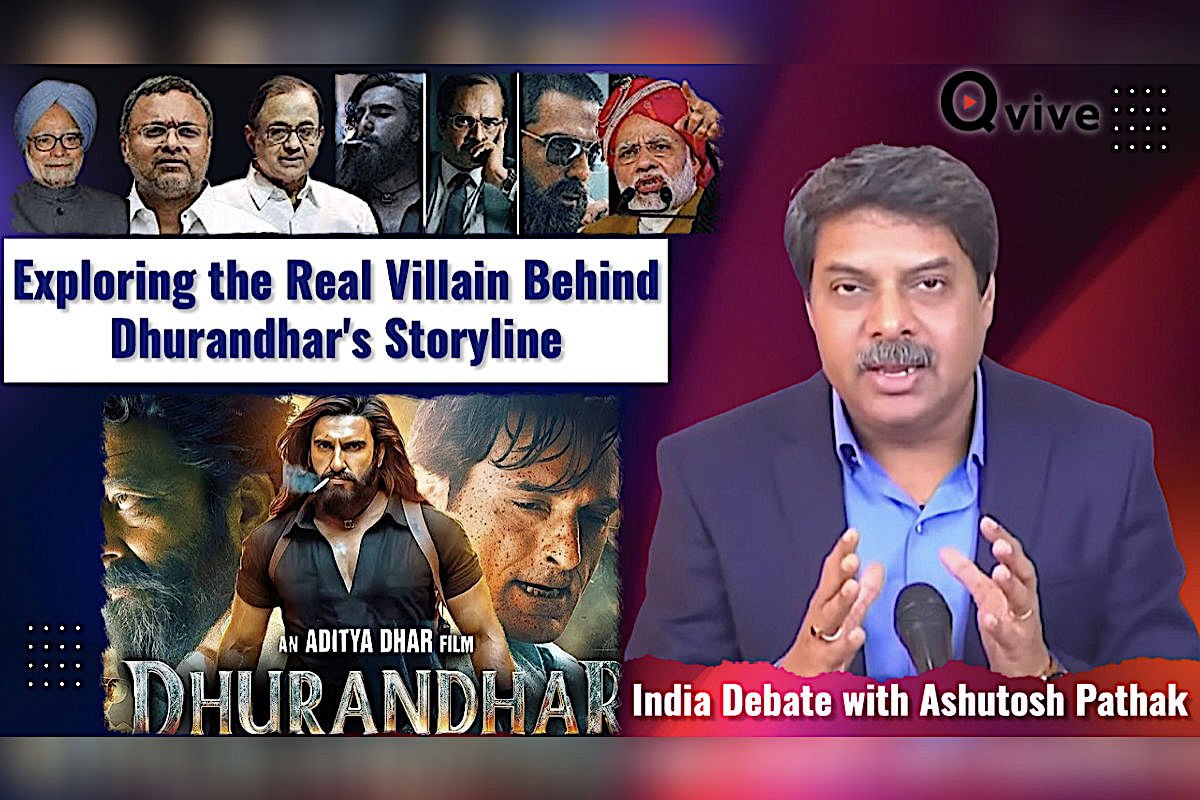
The impact of the Bollywood film “Dhurrandhar”, which is claimed to have shattered longstanding Bollywood narratives, especially those concerning India and a particular religious community’s portrayal over the last 40-50 years.
Qvive Editor-in-Chief, Ashutosh Pathak, emphasizes that the film challenges anti-India narratives subtly promoted by Bollywood, exposing deeper political and national security issues.
The movie has achieved remarkable commercial success, grossing ₹1100 crore in just 24 days, surpassing records set by previous blockbusters like “Baahubali.”
The film insinuates a controversial nexus involving a British company, De La Rue, which supplies currency paper to both India and Pakistan.
India contracted De La Rue in 2004 under Finance Minister P. Chidambaram to supply high-quality currency paper to combat counterfeit currency.
However, De La Rue was also supplying similar currency paper to Pakistan, facilitating the printing of fake Indian currency notes (FICN) by Pakistan’s ISI, which fuels economic and security threats to India.
Chronological Timeline of Events:
| Year | Event | Key Person(s) Involved |
|---|---|---|
| 2004 | India signs a contract with UK-based De La Rue for currency paper supply under P. Chidambaram. | Finance Minister P. Chidambaram |
| 2007 | Alleged secret meeting in Dubai between an Indian minister and his son with Pakistani outfits exchanging printing materials (referred in the film). | Minister and his son; CBI and Intelligence suggest involvement |
| 2010 | De La Rue contract blacklisted by Finance Minister Pranab Mukherjee due to security concerns. | Finance Minister Pranab Mukherjee |
| 2012 | Contract renewed and blacklist lifted under Finance Minister P. Chidambaram, allegedly facilitated by bureaucrat Arvind Mayaram. | P. Chidambaram, Arvind Mayaram |
| 2014 | Modi government ends sourcing of security materials from De La Rue. | Narendra Modi government |
| 2023 | CBI investigates alleged corruption and dubious contract extension involving Arvind Mayaram. | CBI, Arvind Mayaram |
Core Issues Raised:
- The film alleges collusion between Indian political figures and Pakistani handlers, especially highlighting a minister and his son meeting Pakistani agents in Dubai to exchange sensitive currency printing details.
- There is strong suspicion around P. Chidambaram and his son Karti Chidambaram, with ongoing investigations by the CBI into contract irregularities and corruption involving currency printing contracts.
- Despite blacklisting De La Rue in 2010, the contract was controversially reinstated in 2012, raising questions about political interference and national security compromises.
- The film indicates that the real villain is within India’s system, not just external enemies like Pakistan.
- Various media persons allegedly have links with Kashmiri separatists and Pakistani handlers, with some connected to powerful political and financial circles.
Political and Security Implications:
- The film exposes a deep-rooted nexus of corruption, betrayal, and compromise of India’s national security, implicating senior politicians, bureaucrats, and financial interests.
- The narrative demands government transparency and accountability, especially from current leadership, including Prime Minister Narendra Modi and the current Finance Minister.
- There is a call for action and arrests against those responsible for jeopardizing India’s security through these covert dealings.
- It criticizes the lack of decisive action despite clear intelligence reports and ongoing investigations, questioning why implicated individuals remain free.
Additional Observations:
- The film “Dhurrandhar” is based on real events, with some dramatization, but rooted in factual controversies.
- The discussion highlights the issue of counterfeit currency as a tool of economic warfare, and how political corruption undermines efforts to counter it.
- There are references to widespread black money circulation through illicit channels such as butcher shops, suggesting large-scale economic corruption.
- Ashutosh Pathak urges the government to release a white paper on these issues and take strong legal measures against guilty parties.
Public Demand for Action
Ashutosh Pathak appeals to the Indian government to act decisively against any individuals linked to corruption, particularly those who might be leveraging their positions for personal gain while endangering national security.
Concerns are expressed about the apparent lack of action against high-profile figures involved in these substantial allegations, pointing to a growing frustration among the public regarding government accountability.
Insights:
- “Dhurrandhar” challenges Bollywood’s traditional narrative and exposes a complex political and security scandal involving currency counterfeiting and national betrayal.
- The De La Rue contract saga reveals a pattern of political favoritism and security lapses spanning multiple governments.
- P. Chidambaram and his son are strongly implicated but official confirmation and legal resolution remain pending.
- The film’s success indicates public resonance with these hidden truths and demand for accountability.
- There is a pressing need for government transparency, investigation, and prosecution to protect India’s sovereignty.
- The real villain is not external alone but internal, demanding introspection and action from Indian authorities.
Terminology and Entities:
| Term/Entity | Description |
|---|---|
| De La Rue | British company supplying currency paper to India and Pakistan. |
| FICN (Fake Indian Currency Notes) | Counterfeit Indian currency printed and circulated, allegedly facilitated by Pakistan. |
| P. Chidambaram | Former Finance Minister involved in contract decisions relating to De La Rue. |
| Karti Chidambaram | Son of P. Chidambaram; alleged involvement in controversies. |
| Pranab Mukherjee | Former Finance Minister who blacklisted De La Rue in 2010; later became President. |
| Arvind Mayaram | Former Finance Secretary under investigation for contract irregularities. |
| ISI (Inter-Services Intelligence) | Pakistan’s intelligence agency allegedly printing fake currency notes. |
Allegations and Investigative Status:
- The De La Rue contract was initially awarded to control counterfeit currency but compromised due to dual supply to Pakistan.
- Secretive meetings between Indian political figures and Pakistani contacts allegedly facilitated this.
- Despite clear intelligence warnings and blacklisting, political maneuvering reinstated the contract.
- Investigations by CBI and Indian intelligence remain inconclusive publicly; no arrests yet.
- The film “Dhurrandhar” serves as a cultural exposé demanding justice and transparency.
Also Read: