

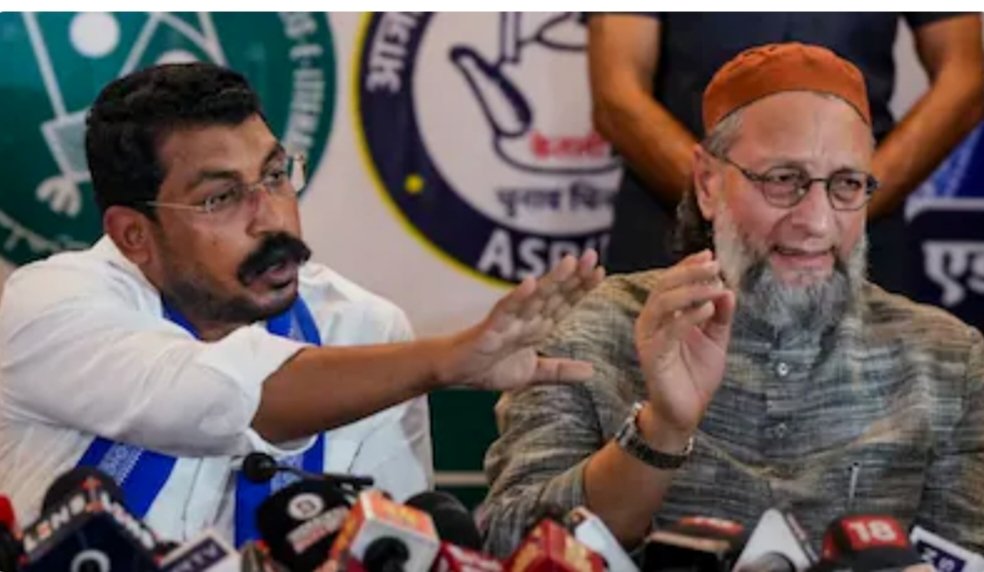
A new front has emerged in Uttar Pradesh politics a few months before the assembly elections. This front is called the Social Change Front. It was announced on Thursday by AIMIM leaders Asaduddin Owaisi and Chandrashekhar Azad. While the two leaders came together to form this alternative, Azad also stated that it should not be called a third front. “We are pursuing mainstream politics.” Thus, an attempt is being made to create a new political equation by combining Dalit and Muslim votes. The Samajwadi Party has been working on the Yadav and Muslim vote alliance, but the Dalit and Muslim alliance has been in the background since the BSP’s weakening. Broadly speaking, both parties are eyeing 150 seats.
Now, efforts are being made to revive that old equation. The question is how much influence this vote bank holds, with the help of which Chandrashekhar and Owaisi are trying to create a new alternative. Akhilesh Yadav is currently talking about the PDA equation in UP politics, but he primarily represents the backward classes. He himself comes from a backward community. Consequently, the Dalit community also has a desire for leadership, a desire that Chandrashekhar Azad is trying to address. Asaduddin Owaisi argues, “Why should an Ahir always become the Chief Minister with Zaheer’s votes?” In this way, he is attempting to polarize Muslim votes away from the Yadav community. This is where the Dalit-Muslim alliance effort began.
Contrasting the efforts of both leaders, it is also important to consider the social dynamics of UP. Uttar Pradesh has approximately 20% Muslim and 21% Scheduled Caste populations. Together, they constitute approximately 40% of the state’s total population, making the Dalit-Muslim alliance a crucial social alliance. Since Mayawati’s BSP no longer holds the Dalit vote as strongly as it did during 2007-12, a significant portion of Dalit voters are no longer tied to any single party. The BJP, SP, Congress, and now the ASP-KR are all trying to attract these voters, particularly in West UP and urban areas. AIMIM’s strategy has always focused on constituencies with significant Muslim populations, such as its focus on Bihar’s Seemanchal region. Similarly, districts like Saharanpur, Muzaffarnagar, Shamli, Meerut, Bijnor, and Moradabad in UP have significant Muslim populations. Dalits are also in majority here. Furthermore, districts like Rampur, Sambhal, Amroha, and Bareilly in Rohilkhand also have significant Muslim populations. In most districts, the Muslim population is 35 to 40 percent.
Overall, there are approximately 150 seats in the state where the combined Dalit and Muslim populations create a dynamic that determines the election. If these votes come together, the equation could change in many seats. It is believed that the unity between these two leaders will attract opposition voters, directly harming the Samajwadi Party (SP), especially in seats with a low margin of victory. In the 2022 elections alone, the Samajwadi Party won 21 seats with a margin of less than 5,000 votes. In 2017, this figure was 13. Clearly, this alliance could directly harm the Samajwadi Party in seats with low margins.