

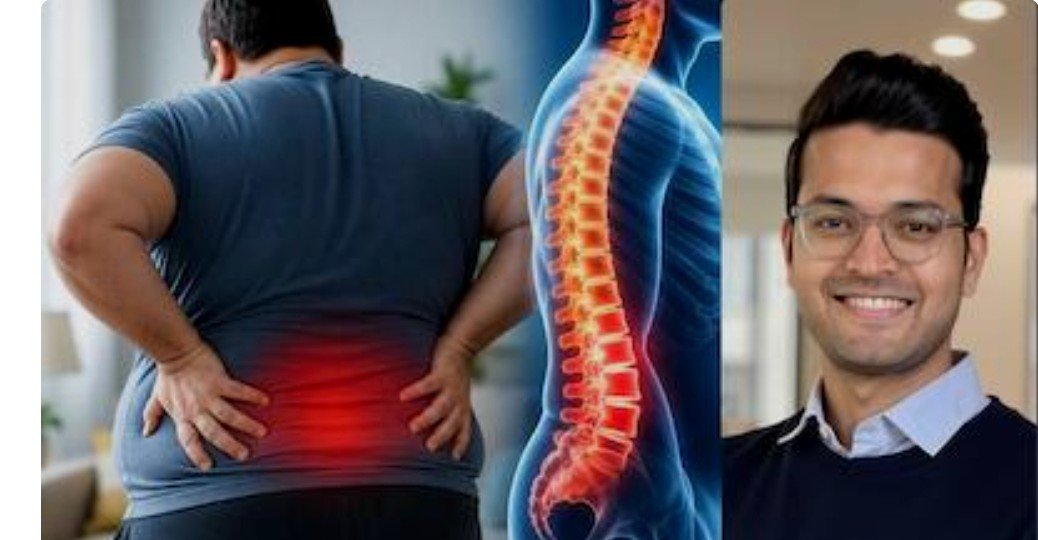
Back pain has become one of the most common health problems today. Obesity has also emerged as a rapidly growing public health challenge. Most of us know that obesity increases the risk of diabetes, heart disease, and high blood pressure. However, few understand that excess body weight also puts tremendous pressure on our spine.
My clinic receives many patients in their 30s or 40s who suffer from back pain. This isn’t due to aging, but rather, their excess weight has caused premature wear and tear on their spine. This problem has become even more serious, especially in our Indian lifestyle, where physical activity has decreased. But there’s some good news.
Obesity is a risk factor that we can change. This simply means that if you control your weight, you can improve the health of your spine and avoid many major problems in the future.
Our spine is designed to support our entire body weight, help us move, and keep our spinal cord completely safe. Even a pound of weight increases directly impacts the vertebrae, the cushioned discs between them, the joints, and the muscles that support them.
Especially when abdominal obesity increases, the body’s center of gravity shifts forward. This puts a significant strain on the spine. Let’s understand this with a simple example. Think of your spine as the suspension or shock absorber of a car. If a car is designed to seat five people, and you drive ten people in it every day on rough roads, what will happen? Obviously, the vehicle’s suspension will wear out very quickly.
The same thing happens with our spine. When our spine has to carry a load that exceeds its capacity every day, it puts tremendous stress on it. This extra load causes rapid wear and tear on the spinal structure, leading to persistent pain.
Chronic Lower Back Pain
Many medical studies have clearly shown that obesity is directly linked to lower back pain. Patients often tell me about these problems:
A persistent, dull ache in the lower back.
Feeling extreme stiffness in the lower back when getting out of bed in the morning.
Difficulty standing in one place for long periods of time in the kitchen or for other tasks.
Fatigue or back failure after even a little walking.
Excess body weight significantly increases the pressure on the rubber-like discs between the vertebrae. This causes the discs to lose water, dry out, and their height to decrease over time. While it’s normal for discs to wear out with age, obesity significantly accelerates this process. Just as an old car’s tires wear out faster, discs also wear out faster under a heavy body.
When mechanical stress on the spine increases, the risk of disc damage or rupture also increases significantly. When the outer layer of the disc weakens, the jelly-like material inside it leaks out. This material compresses nearby nerves, causing a variety of serious problems, including:
Sciatica (a pain that feels like an electric current from the waist to the heel).
Severe pain in the legs.
Tingling or ants-like sensation in the legs.
Numbness in the legs.
Weakness in the legs while walking.
It’s not necessarily the result of obesity that causes a slipped disc, but excess weight increases the risk and prevents it from healing easily.
The ongoing changes in the spine caused by obesity can cause the spinal canal (the tube through which our nerves pass) to narrow from within. Patients often experience the following:
Severe back pain.
Stretching and pain in the legs even with a short walk.
Heavy and numb legs.
Extreme difficulty walking long distances.
Many patients tell me that they experience significant relief when they bend forward or sit in a chair.
Facet joints are very small joints located at the back of the spine. As a person’s body weight increases, these joints become increasingly stressed. This causes the cartilage in these joints to wear out rapidly, which in turn becomes a major cause of arthritis and chronic back pain.
However, it’s important to understand that obesity is just one risk factor; it’s not the sole cause of back pain. Many people are overweight but never experience back pain. Meanwhile, many people who are of normal weight still develop serious spinal conditions. Spinal problems are often the result of a combination of factors.
This includes factors like your genetics, your age, your daily physical activity, your work schedule, whether you smoke, your bone strength, and your overall fitness.
The pressure and stress on the spine is dramatically reduced.
Your ability to walk and run improves dramatically.
Inflammation in the internal organs of the body is reduced.
Your overall physical fitness improves significantly.
Strain on muscles and knee joints is also reduced.
If you ever need spine surgery, recovery is much faster and the results are excellent.
But it’s also true that losing weight alone won’t fix all chronic bone problems. If you have severely compressed nerves, severe spinal instability, or significant pressure on your spinal cord, you’ll need specialized treatment from a qualified spine doctor. Our goal shouldn’t be simply to lose weight on the scale, but to improve your overall spinal health long-term.
Simply popping over-the-counter painkillers isn’t enough to permanently cure obesity-related back pain. This will only provide relief for a few hours. You need a proper and comprehensive treatment plan that includes the following:
Regular physical activity:
For most patients, walking every morning and evening is one of the safest and most effective exercises. Additionally, exercises or yoga poses that strengthen your core muscles (abdominal and back muscles) provide strong support to your spine and improve your posture.
Healthy Nutrition
It’s important to eat a balanced diet that includes:
Protein-rich foods like pulses and cottage cheese.
Calcium for bones.
Vitamin D from sunlight and diet.
Fresh fruits.
Lots of green vegetables.
Whole grains.
All of these things strengthen your bones and muscles from within and help you manage your weight without causing weakness.
A unique physiotherapy plan is tailored to each patient’s condition, which can significantly improve:
Body flexibility
Core strength
Body balance
Your daily activities and movement patterns
Lifestyle changes
Small changes in your daily routine can have a significant impact:
Avoid sitting in one place for long periods of time in front of the TV or laptop.
Make sure your office or workspace chair and table are comfortable for your height.
Stay away from cigarettes and tobacco, as they weaken bones.
Get at least seven to eight hours of sound sleep at night.
Make every effort to reduce work stress.
Medical and Surgical Treatment
When lifestyle changes and exercise don’t provide complete relief, these advanced treatment methods may be considered:
Special pain-relieving medications
Image-guided spinal injections, which are given directly to the painful area.
Minimally invasive procedures (those that involve very small incisions)
Endoscopic spine surgery
Spinal fixation or decompression surgery
Which of these treatments is right for you depends not only on your obesity, but also on the underlying condition and the extent of your nerve compression.
The best time to protect your spine is before any significant damage or pain has already occurred. By maintaining a healthy weight throughout your youth and into old age, you are reducing the unnecessary stress placed on your spine every day.
Exercising regularly, developing a habit of eating good home-cooked meals, and getting proper treatment for back pain as soon as it starts, rather than ignoring it, are all excellent investments in your future. These habits will keep you mobile and independent for the long term.
Losing even a little weight and increasing your daily physical activity can make a significant and positive difference to your back pain, your work capacity, and your overall health.
Serious spinal conditions can affect anyone, regardless of their weight. But a healthy and strong spine is the foundation for an active and fulfilling life. Therefore, if you’re taking care of your weight gain today, it simply means you’re strengthening your back and waist for years to come.