

By Mayank Jain
Following Prime Minister Narendra Modi’s invocation of the term “dimagi Naxals” in his Independence Day address, a section of India’s social-media-savvy Gen Z began reclaiming the Naxal name. An online outfit calling itself the “Dimagi Naxal Party” appeared on social media with the motto “Think | Research | Resist”. The phenomenon followed the earlier emergence of the Cockroach Janta Party (CJP) and appears to borrow from its style of youth-oriented political mobilisation. The Dimagi Naxal Party describes itself as a sibling of CJP and presents itself as a youth-centred civic and satirical platform. Yet the willingness of a section of young Indians to embrace the historically loaded word “Naxal”, even as political provocation or satire, raises a question far larger than social-media wordplay: do those adopting the name understand the ideology, history of violence and human cost associated with it?
The word ‘Naxal’ has become synonymous in India with communist militancy and terrorism. It evokes images of armed aggression, ambushes, IED explosions and a bloody insurgency that has taken a particularly heavy toll on the country’s uniformed forces and tribal population in the forests of central and eastern India. The human cost is not something that can be wished away. According to the Union Home Ministry, 8,956 people were killed by Left Wing Extremists across India between 2004 and 30 November 2025. The Ministry says that the majority of civilians killed were tribals, often after being branded ‘police informers’.
This grave internal-security challenge, officially described as Left Wing Extremism (LWE), is today confronting India in a very different arena. Just when the security forces have succeeded in shrinking the geographical footprint of armed Maoism, the romance of the Naxal label appears to be travelling from the forests of the tribal belt to the virtual world of social media.
A section of young Indians seems quite willing to wear the expression ‘Dimagi Naxal’ as a badge of rebellion. Dimagi means cerebral or intellectual and in this context suggests identification with the ideological side of Naxalism. What is disturbing is the apparent absence of inhibition about appropriating a name inseparable from an armed movement that has killed civilians, tribals and men in uniform. What might begin as satire or political provocation can acquire a life of its own in the age of Instagram and X. A provocative label becomes a hashtag, a hashtag becomes an identity and an identity can eventually become a political worldview.
This does not mean that every young person calling himself or herself a ‘Dimagi Naxal’ is a militant or intends violence. Such an accusation would be both irresponsible and unsupported. But if Maoist revolutionary politics is being repackaged for a new generation as fashionable rebellion while its record of bloodshed is pushed conveniently out of sight, we should certainly be worried.
The ideological advocate who consciously preaches an armed and bloody revolution can, in one important sense, present an even more insidious challenge than the gunman who finally emerges from the forest. The man carrying the gun can be seen. The ideology that persuades another generation that the gun is a legitimate instrument of political change can travel quietly through words, slogans and romanticised notions of revolution. The armed cadre may eventually pull the trigger against a tribal villager or a uniformed policeman but somebody first has to create the intellectual justification that makes such violence appear heroic, necessary or inevitable.
That is why defeating extremism cannot mean only defeating armed cadres in the forests. A democracy must also defeat the glorification of political violence through argument, history and facts. Under no circumstances should terrorism, militancy or armed revolution be romanticised or promoted — whether by Gen X, millennials or Gen Z.
There is nothing objectionable about young Indians questioning authority. Democracy would be considerably poorer if they stopped doing so. Governments must be questioned, inequality must be debated and political orthodoxies must be challenged. But there is a fundamental difference between dissenting against the government and glorifying armed revolution. Before a revolutionary label becomes fashionable, should we not ask what history that name carries? Who were its ideological fountainheads? What happened when similar revolutionary ideas acquired state power? Most importantly, what happened to ordinary human beings who found themselves standing in their way?
This becomes particularly relevant because Mao Zedong remains an ideological inspiration of Indian Maoism. The history of twentieth-century communism is not merely a history of manifestos, revolutions and promises of equality. It also contains political purges, forced-labour camps, catastrophic famines, executions and deaths on an almost incomprehensible scale.
The Arithmetic of Red Terror
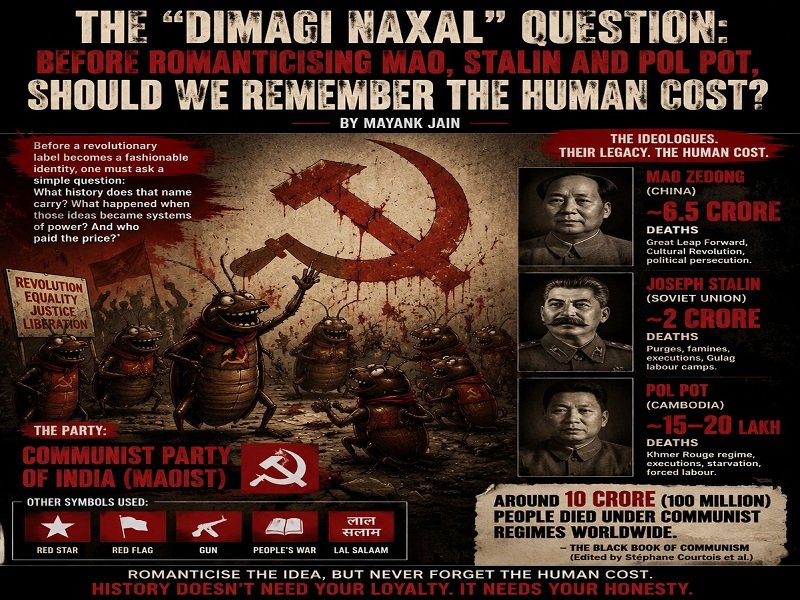
One of the most frequently cited attempts to quantify that history appeared in The Black Book of Communism: Crimes, Terror, Repression. In his introduction, Stéphane Courtois advanced an overall estimate approaching 10 crore deaths — — associated with communist regimes and movements worldwide.
China occupies a particularly grim place in this history. Some of the higher estimates associated with Mao-era Chinese Communist Party catastrophes and repression run to approximately 6.5 crore deaths. The Great Leap Forward produced a famine whose victims are counted in crores while the Cultural Revolution unleashed another period of persecution, humiliation, political violence and social destruction. Yet Mao became an icon for revolutionary movements far beyond China. The promise was intoxicating: peasants would become the agents of history, the existing order would be smashed and exploitation would disappear. That is precisely why the consequences matter.It is easy to romanticize a revolution when you don’t have to dig its graves.
The Soviet experience carries the burden of its own horrifying record. Estimates of deaths attributable to Stalinism vary considerably according to whether executions, Gulag deaths, deportations, famine and other categories are included. The figure of around 2 crore has been broadly estimated by experts. The evil machinery of coercion constructed under Stalin: forced collectivisation, deportations, purges, executions and a sprawling system of prisons and forced-labour camps are well known now.
Alexander Solzhenitsyn gave that machinery perhaps its most unforgettable literary testimony in The Gulag Archipelago. He was not an academic studying Soviet repression from a comfortable distance. He had experienced imprisonment himself. His work demonstrated how repression could become an administrative routine and how a state could create entire categories of human beings whose suffering was justified in the service of an allegedly greater historical objective.
Stalinism mastered the techniques of making mass imprisonment acceptable to society by developing a specialized political vocabulary. A neighbour was easily transformed into a reactionary, a class enemy, an enemy of the people or an obstacle to history. Once a human being is reduced to an ideological category, cruelty becomes simple to rationalise. Physical violence may come later, but intellectual permission always comes first.
Harry Wu supplied another extraordinary testimony from communist China. Wu spent 19 years in China’s Laogai forced-labour system after being imprisoned as a political offender. After leaving China he devoted much of his life to documenting the camps and exposing the Laogai system internationally. The Laogai Research Foundation has documented over 1,000 camps. Human rights researchers estimate that over its history,unimaginable numbers of people passed through the system, resulting in millions of deaths from starvation, exhaustion, torture and executions
Belgian writer Koenraad Elst, in discussing communism and ideological violence, has referred to research and testimony concerning repression in Maoist China including Harry Wu’s work. Jean-Luc Domenach is another important scholar of Mao-era China and its systems of political control. Researchers may disagree over figures and methodology but the larger historical record makes romanticisation exceedingly difficult: behind the vocabulary of liberation existed an enormous apparatus of coercion.
Then came Cambodia. Under Pol Pot and the Khmer Rouge, the pursuit of an agrarian communist utopia became one of the twentieth century’s most concentrated episodes of mass killing. Cities were emptied, institutions destroyed, educated people persecuted, families torn apart and enormous numbers of people subjected to brutal labour. Approximately 15 to 20 lakh Cambodians died through execution, starvation, disease and overwork.
These victims were not merely members of some abstract capitalist ruling class. Many were peasants, workers and ordinary families — precisely the people in whose name revolutionary politics purported to speak.
Government of India Banned CPI (Maoist) as a Terrorist Organisation
The 1967 Naxalbari uprising initiated India’s Maoist insurgency following localised agrarian unrest over land rights. Leaders like Charu Mazumdar drew directly on Maoist ideology and rejected parliamentary democracy in favour of armed struggle to overthrow the state. The movement later mutated and consolidated into the Communist Party of India (Maoist). Owing to its violent campaigns the Indian government designated the CPI (Maoist) along with its front organisations as a terrorist entity under the Unlawful Activities (Prevention) Act (UAPA). The central contradiction of this insurgency remained stark because a movement claiming to represent tribal populations routinely brought conflict into tribal villages and inflicted severe harm on the very communities it purported to champion.
What I Saw in Chhattisgarh
In 2008, while making my film Chhattisgarh Now, I travelled deep into the conflict-affected areas of Chhattisgarh. The journey, the people and their testimonies are on camera. I travelled through Bastar into areas where the Maoist conflict was not an intellectual abstraction discussed by people sitting hundreds of kilometres away. It was everyday life.
I interviewed Salwa Judum members, former Naxalites, tribal men and women and security personnel. Tribal people narrated horrifying allegations of atrocities, intimidation and violence committed by Naxalites. They spoke about families, women and children and about villagers living under pressure from armed cadres. Former Naxalites gave me accounts from their experience of the movement. Security personnel spoke as men expected to operate in extraordinarily difficult terrain where an apparently ordinary stretch of road could conceal an explosive device.
These were not stories handed to me in a press release. They were testimonies I recorded on the ground and they remain in Chhattisgarh Now. They changed the way I understood the enormous gulf between the romance of revolution and the experience of people actually living inside an insurgency.
One sequence from the film remains particularly relevant. Chhattisgarh Now recorded a gathering described on screen as 65,000 forest dwellers protesting against Maoist atrocities. I also filmed Special Police Officers and people who said they had resisted the Maoists. Whatever arguments one may subsequently have about the politics surrounding Salwa Judum, these were flesh-and-blood tribal people. They were not comfortable urban intellectuals romanticising revolution over coffee. They lived where its consequences could arrive at their doors.
The Blood-Soaked Record of LWE
The Home Ministry’s figure of 8,956 deaths between 2004 and 30 November 2025 provides the national scale. It says the overwhelming majority of civilians killed by LWE cadres were tribal people, often killed after being branded police informers. These are figures worth remembering whenever Maoist violence is repackaged as revolutionary romance.
Some attacks remain etched in national memory. Seventy-six security personnel were killed at Dantewada in April 2010. The Darbha Valley attack of 2013 killed senior Congress leaders, security personnel and others. Twenty-two security personnel were killed in the Sukma-Bijapur encounter in April 2021. Beyond such headline-making massacres lie numerous smaller attacks, killings and explosions that disappeared quickly from national headlines but permanently changed the lives of the families involved.
The Maoists have attacked infrastructure too. Roads, railway installations, electricity infrastructure and other manifestations of the state have been targeted. Schools have been damaged or demolished in conflict areas amid Maoist claims that some buildings were being occupied by security forces. Whatever revolutionary explanation is advanced, the irony is difficult to miss: destroying infrastructure in India’s poorest regions ultimately punishes many of the same tribal and rural people in whose name the revolution claims legitimacy.
When Raman Singh Raised the Lashkar-e-Taiba Question
An extraordinary episode in May 2010 demonstrated how seriously the Maoist threat was being viewed. Then Chhattisgarh Chief Minister Raman Singh publicly said that intelligence agencies had supplied feedback concerning terrorist organisations that might be aiding Maoists in Naxal-affected regions. He specifically raised the possibility of assistance from Pakistan-based Lashkar-e-Taiba (LeT).
Singh pointed towards the precision with which certain IED attacks had been executed and argued that the sophistication suggested expertise beyond an ordinary local operative. According to his statement, the state had received information from intelligence agencies about possible assistance. Coming from the Chief Minister of the state then at the epicentre of Maoist violence, it was an allegation that could hardly be ignored.
The figures Singh gave about Chhattisgarh were themselves devastating. He said that during the preceding ten years Naxalites had killed more than 1,000 civilians and more than 650 policemen in the state. He also accused them of blowing up 132 electricity towers, 106 school buildings and three hospitals.
When a Section of Gen Z Embraces Extremism: Where Does Indian Law Draw the Line?
Indian law draws an important distinction between holding an opinion and deliberately assisting an outlawed organisation. Studying Marx, Lenin, Mao or Charu Mazumdar does not by itself amount to terrorism and neither does the mere expression of a radical political opinion. But the law draws a much harder line when thought turns into intentional support for a terrorist organisation. Section 39 of the Unlawful Activities (Prevention) Act, 1967 deals with support for a terrorist organisation, including specified acts such as inviting support or organising, managing, assisting or addressing certain meetings where the statutory requirements, including the necessary intention, are satisfied. The offence can attract imprisonment of up to 10 years, or fine or both. Section 38 deals with association with a terrorist organisation with the intention of furthering its activities while Section 40 deals with raising or providing funds for one. Intention and evidence therefore matter in determining criminal liability. But legality is not the only question before us. What escapes criminal liability does not automatically become worthy of admiration. When a section of Gen Z embraces or romanticises an extremist ideology with a documented history of political violence, young people deserve to know what happened when revolutionary slogans were translated into action. They must know the consequences before wearing such labels as badges of rebellion. An ideology should be judged not merely by the utopia it promises but also by the human consequences it leaves behind.
The Battle Is First Fought in the Mind
This is where Indian thinkers Ram Swarup and Sita Ram Goel become relevant. Both subjected communism to sustained ideological criticism. Their concern was not merely the gun after it had been fired but the intellectual system capable of making political coercion appear virtuous. Totalitarian ideologies can divide humanity into permanent categories of oppressor and oppressed, friend and enemy and progressive and reactionary until coercion itself begins to appear morally necessary.
Solzhenitsyn’s experience leads us towards the same uncomfortable territory from within the communist world. The Gulag was built from concrete, steel and barbed wire but the intellectual permission for the Gulag preceded the camps. Before a man could disappear as an ‘enemy of the people’, somebody first had to create and legitimise a category called ‘enemy of the people’.
That is why the dimagi part of ‘Dimagi Naxal’ deserves considerably more thought than those casually adopting the expression may realise.
An armed extremist who emerges from a forest carrying a gun presents an obvious danger. The ideological advocate who deliberately glorifies a bloody armed revolution presents a different and potentially more insidious challenge because ideas can reproduce themselves. The gunman can kill until he is stopped. An idea that teaches successive generations to regard political murder as revolutionary virtue can keep producing new gunmen.
The answer, however, cannot be to police people’s minds. The democratic answer to a dangerous idea is to expose it, debate it and confront it with history and evidence. That is precisely why the victims of revolutionary violence matter so much.
Before Wearing the Label, Meet Its Victims
Revolutionary politics has always possessed a peculiar attraction for the young. It converts a complicated world into an apparently simple one. There are oppressors and oppressed, heroes and villains, revolutionaries and reactionaries. The youngster is invited not merely to hold an opinion but to imagine himself or herself as an actor in history.
Gen Z has every right to be angry about unemployment, inequality, corruption, cronyism, failures of governance or anything else it believes India’s political establishment has failed to address. A confident democracy should withstand furious criticism and emerge stronger for it. The answer to dissent cannot be to extinguish dissent.
But rebellion without historical memory can become dangerously naïve.
If somebody proudly calls himself or herself a ‘Dimagi Naxal’, I would not begin by asking that person to stop thinking. I would ask them to think more.
Read Mao but also read the history of the Great Leap Forward. Read revolutionary communism but also examine The Black Book of Communism and the arguments surrounding its 10-crore estimate. Encounter Stalin through his speeches but encounter Stalin’s system also through Solzhenitsyn. Read about Maoist China but listen to Harry Wu describing the Laogai. Study Pol Pot’s revolution but remember the 15 to 20 lakh Cambodians who did not survive it.
And before romanticising India’s Maoists, go to Bastar — or at least listen to the people who lived there while the guns were firing.
I did.
In 2008 I carried my camera into Chhattisgarh and listened. I listened to Salwa Judum members, former Naxalites, security personnel and tribal people who narrated what the conflict had done to their lives. Their testimony remains on camera in Chhattisgarh Now.
Some of those people wanted something considerably less glamorous than a revolution.
They simply wanted to live.
That is what gets lost when an insurgency becomes a fashionable label on a screen. For the people I met, Naxalism was not a poster, a hashtag or an intellectual game. It was something capable of walking out of the forest and arriving at their homes.
Under no circumstances should terrorism, militancy or a bloody armed revolution be promoted or romanticised — whether by Gen X, millennials or Gen Z. Democracy gives us the freedom to question power and that freedom must be defended fiercely. It gives us the freedom to read revolutionary literature, condemn governments, attack orthodoxies and imagine radically different arrangements for society. Those freedoms distinguish an open society from the totalitarian systems whose histories should warn us.
But freedom of thought carries one unavoidable responsibility: the responsibility to think honestly.
Before embracing the romance of revolution, read its history. Before choosing its heroes, meet its victims. Before wearing its name as a badge, understand what that name meant to people who encountered its armed manifestation not on Instagram or X but outside their homes.
History belongs not only to the revolutionaries who carried the flags. It belongs equally to the people who paid for those revolutions with their lives. And before another generation turns an old and bloody ideology into a fashionable new identity, those voices deserve to be heard…