

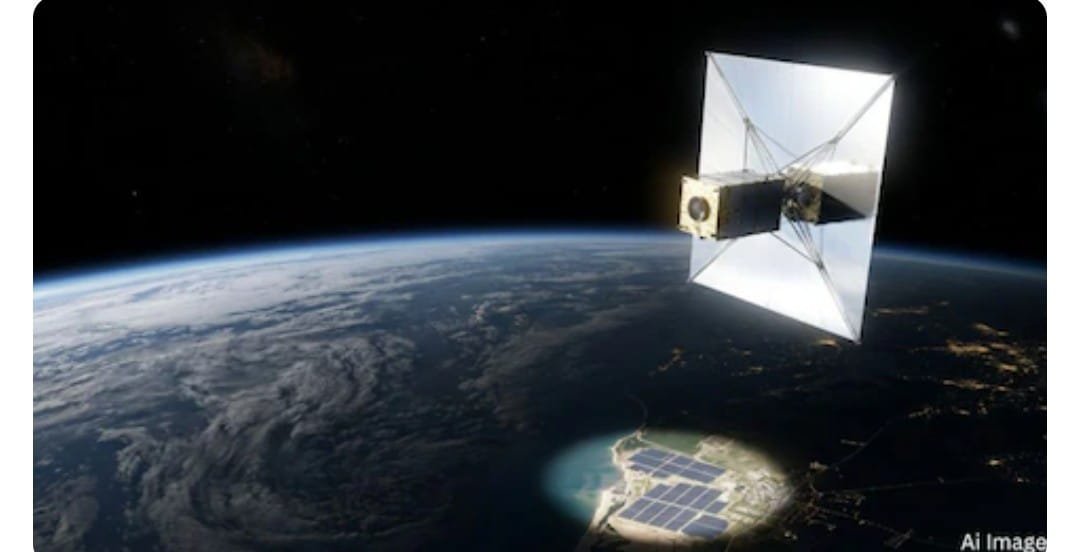
Surprising news is coming from the world of space technology, which has worried scientists worldwide. The United States has approved a project that has the power to directly alter the cycle of day and night. A large mirror is being installed in space, which will illuminate a large area of the Earth even during the darkest hours. This decision has raised a significant question: will this tampering with nature for human benefit prove dangerous for the world?
The United States has approved a unique and astonishing space project. A satellite will be sent into space that will reflect sunlight back to Earth during the darkest hours.
The US regulator, the Federal Communications Commission (FCC), has given Reflect Orbital, a California-based startup, the green light to launch its first test satellite, Erendil-1, into low Earth orbit. The company claims that this technology will provide daylight for solar farms even at night.
Reflect Orbital’s prototype satellite, a 60-foot-tall mirror, will be the size of a small refrigerator. However, after reaching an altitude of approximately 400 miles (640 kilometers) in space, it will open a 60-foot-wide square mirror.
This mirror will bend sunlight and project it within a specific 5-kilometer radius of the Earth.
According to the company, this will enable electricity to be generated from solar panels even after sunset. This will also help with disaster rescue operations and nighttime construction or road lighting.
The company has big visions. Their goal is to send 1,000 such satellites into space by 2028 and approximately 50,000 by 2035. These future mirrors will be approximately 180 feet wide and will provide as much light as 100 full moons.
This project has caused considerable anger and concern in the scientific community. The American Astronomical Society has written to the FCC stating that the project is not in the public interest. Scientists believe that such bright mirrors in space will interfere with the functioning of highly sensitive telescopes and make it impossible to see faint planets or stars in space.
This will impact humans and wildlife. Artificial sunlight at night will disrupt the biological clocks of humans, animals, and plants, adversely affecting their sleep, wake, and migration patterns.
Sudden flashes in the sky can distract airplane pilots and road drivers.
Regarding this controversy, the FCC says that its job is only to regulate satellite communications and radio frequencies, not to examine their environmental impact. According to US regulations, activities conducted in outer space do not require any environmental review.
This is not the first attempt to install a mirror in space. Earlier in 1993, Russia also tested an 80-foot space mirror to illuminate areas of Siberia, but after the next mission failed, they abandoned this project. Now it remains to be seen whether this experiment by Reflect Orbital will create history or remain just another failed attempt.