

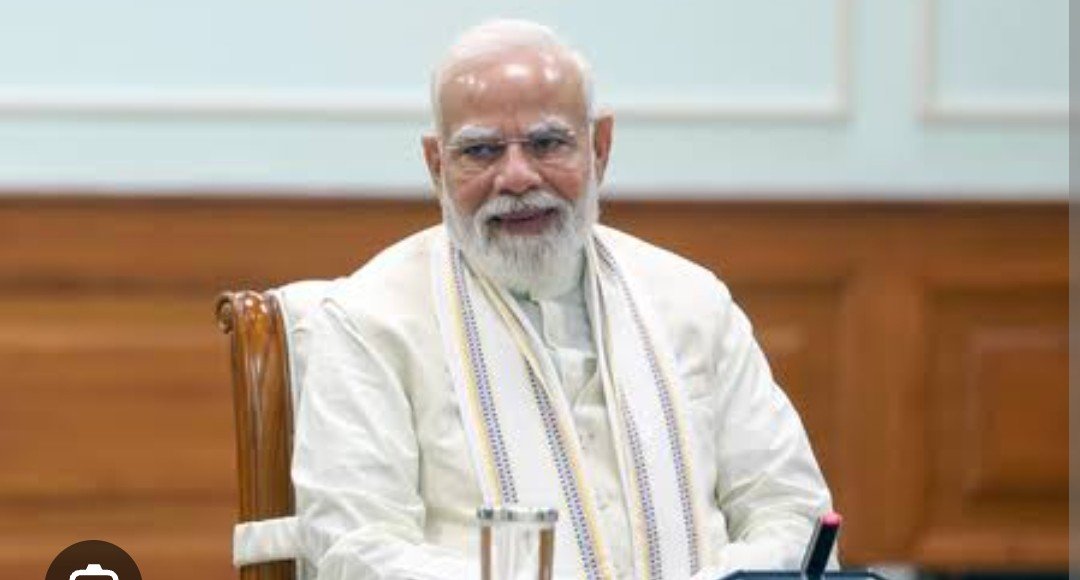
As Prime Minister, Narendra Modi has set a record that any leader would dream of achieving. He has broken Pandit Jawaharlal Nehru’s record for the longest-serving Prime Minister in independent India.
On May 26, 2014, Narendra Modi assumed the Prime Minister’s post for the first time and has completed 4,399 days of continuous tenure. He surpassed the record of Pandit Jawaharlal Nehru, the country’s first Prime Minister, of 4,398 days in office since 1952. Thus, Narendra Modi has become the country’s longest-serving Prime Minister.
As Prime Minister, Pandit Jawaharlal Nehru institutionalized a fragmented India after independence and undertook the task of nation-building. Narendra Modi, furthering this vision, laid the foundation for a developed India and established 21st-century India as a global power. The biggest question on the minds of the nation and the world is: what next?
Narendra Modi has completed 12 years as Prime Minister. The country’s first Prime Minister, Pandit Jawaharlal Nehru, was sworn in as Prime Minister for the first time on May 13, 1952, after the Constitution of India was implemented. After this, Nehru served as Prime Minister for 4,397 consecutive days, or 12 years and 14 days. On June 9, PM Modi broke Nehru’s record for the longest-serving Prime Minister.
Narendra Modi has completed 4,398 days, or 12 years and 15 days, as Prime Minister. PM Modi was sworn in as Prime Minister for the first time on May 26, 2014. Subsequently, on June 9, 2024, he was sworn in as Prime Minister during the NDA’s third term, becoming the longest-serving Prime Minister in the history of the NDA and the longest-serving Prime Minister in the history of the NDA.
Although Nehru became Prime Minister on August 15, 1947, he headed the interim government for five years, until the 1952 Lok Sabha elections. Nehru served as Prime Minister from 1947 to May 27, 1964. Pandit Jawaharlal Nehru’s full term is 6,130 days, but for approximately five years, he served as Prime Minister as the head of the interim government.
Under Prime Minister Narendra Modi’s leadership, the BJP has gained political strength, resulting in its government in one and a half dozen states across the country. From Bengal to Rajasthan, from Assam to Gujarat, the BJP has governments. Surpassing Nehru’s record is the biggest proof of Narendra Modi’s political popularity. Coming to power three times in a row and remaining in power demonstrates the strength of the Modi brand.
Prime Minister Narendra Modi has created history by setting records, but now the test is ahead. PM Modi’s agenda now is to make India a developed country, as well as the world’s third-largest economic powerhouse. The year 2026 has become the year of the “Reform Express” for India. The Modi government aims to increase India’s GDP in the next two to three years to a level where India surpasses Germany and Japan, placing it just behind the United States and China.
PM Modi’s vision is far-reaching. His biggest and most ambitious project now is “Developed India 2047.” To transform India into a developed country, the Modi government is working at a record pace on semiconductor hubs, green hydrogen, and digital governance.
In 2014, there were only a few hundred startups in the country, but by 2026, their number has surpassed 2.3 lakh. Modi’s next vision is to expand India’s “space economy” from the current $9 billion to $45 billion within a few years, with the private sector playing a major role.
When the country celebrates its 100th anniversary of independence, India aims to become a developed nation, not a developing one. Bullet train projects, a nationwide network of expressways, modern railway stations, and the world’s largest digital payment ecosystem are being established. PM Modi’s vision is to connect every corner of India with world-class infrastructure. In this way, efforts are being continuously made to transform India into a global superpower.
Transforming the youthful energy of the country’s population of over 1.46 billion into skilled labor and global leaders is a key part of Modi’s vision. During Pandit Nehru’s era, India adopted a policy of “non-alignment,” but under Modi, India’s foreign policy is one of “active participation” and “world brotherhood.”
PM Modi’s vision is to establish India as a global leader in governance. India is no longer merely a silent spectator on global platforms, but rather sets the agenda. Whether it’s appealing for peace in the Russia-Ukraine conflict, becoming the voice of the Global South, or strengthening its bid for permanent membership in the United Nations Security Council (UNSC).
If we were to view the development journey of Indian history as a metaphor, Prime Minister Narendra Modi is building a grand and modern edifice on the strong foundation laid by Pandit Jawaharlal Nehru. While the eras are different and the challenges are different, the goal is the same.
When India gained independence in 1947, India didn’t even manufacture a needle. Amidst the pain of Partition, extreme poverty, and illiteracy, Pandit Nehru faced the challenge of building a nation from scratch. Nehru established IITs, AIIMS, ISRO (then INCOSPAR), Bhakra Nangal Dam, and heavy industries (PSUs) established “modern India.” This was to put India on its own feet and nurture democratic institutions. Times changed, and after 2014, Narendra Modi took charge of the country.
Modi combined the fundamental strengths built by Nehru with the modernity and speed of the 21st century. Modi’s vision is of a “self-reliant India” and “developed India 2047.” While AIIMS and IITs were few in number during Nehru’s time, their number has more than doubled under the Modi government.
PM Modi faces many challenges. Maintaining India’s momentum amidst the constraints of a coalition government, the demand for employment on the domestic front, and the global economic recession will be PM Modi’s biggest challenge.
Nehru laid India’s strong foundation, and Modi is building a grand edifice on it. If Nehru institutionally unified India, Modi is building a grand edifice on top of that. If Nehru made India institutionally ‘united’, then Modi has made it ‘superior’ and digitally ‘integrated’. Now it remains to be seen to what new heights Modi takes India in this journey of ‘Mission 2047’.