

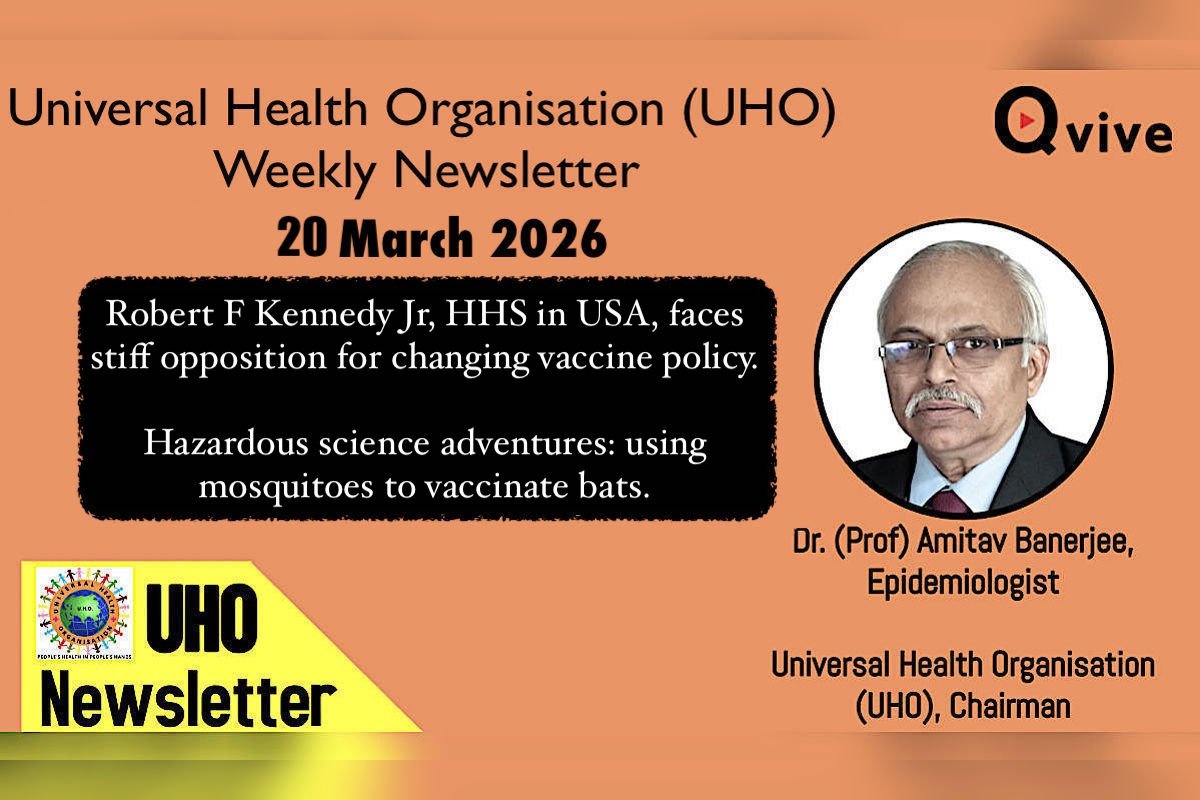
Highlights:
- Wars & the Vulnerable: Impact of Iran-Israel-USA War on children and patient care.
- Hazardous science adventures: using mosquitoes to vaccinate bats.
- Robert F Kennedy Jr, HHS in USA, faces stiff opposition for changing vaccine policy.
- Violence against doctors in the UK: An erosion of doctor-patient relationship?
Website: https://uho.org.in
Download: https://uho.org.in/nl/2026-03-20-newsletter.pdf (copy and paste the link)
By Dr. Amitav Banerjee, Chairperson of the Universal Health Organisation (UHO)
Wars & the Vulnerable: Impact of Iran-Israel-USA War on children and patient care.
Wars pose the greatest threat to public health. They lead to huge collateral damage in form of loss of lives of vulnerable like children and patients.
In the current war between Iran-Israel-USA, huge direct collateral harms have occurred such as a girls’ primary school in Minab, in Iran’s Hormozgan province, was struck during the United States of America’s and Israeli military attacks on 28 February 2026, reportedly killing at least 165 schoolgirls and injuring many others. This shocking incidence was rightly condemned by the UN.
According to reports, a missile struck the Shajareh Tayyebeh girls’ school during school hours. The victims were mainly girls aged between 7 and 12, and large parts of the school building were destroyed while classes were underway. This attack occurred amid escalating hostilities in the region.
Schools are civilian objects and children are expressly protected under international humanitarian law, the experts underlined. Directing attacks against civilian objects, including schools, unless they become military objectives, is prohibited under treaty and customary international humanitarian law, and indiscriminate attacks are strictly prohibited. Intentional attacks on educational buildings that are not military objectives are war crimes listed in the Rome Statute under article 8.
Besides this direct impact, the long drawn war has potential to affect patient care by way of interrupted supplies of medical devices and accessories == used in hospitals and health centres. This is being experienced by the Indian medical devices industry which is facing the brunt of the Iran war with a looming shortage of polypropylene (PP), a thermoplastic polymer used as raw material for syringes, IV bags, catheter components, blood bags, and surgical drapes among others.
India imports a large share of its medical accessories, most of which move through the logistics corridors of the Middle East. The interrupted supply can adversely affect healthcare. The deepening gas crisis is also impacting the production of critical devices like syringes.
An editorial in the British Medical Journal titled, “Profiting from Death: the arms trade,” has brought out the vested interests of the arms trade in wars, and calls for health professionals and their organisations to recognise that the arms trade is detrimental to health and press upon governments to divert spending from military to health and education.
UHO strongly seconds this position.
Hazardous science adventures: using mosquitoes to vaccinate bats.
Mosquitoes that have been designed to carry vaccines in their saliva have been used to inoculate bats against the rabies and Nipah viruses1. Scientists are investigating whether this technique could stop such viruses from ‘spilling over’ from bats to people. But other researchers are sceptical about whether the strategy could be implemented in the wild.
Bats carry a wide range of zoonotic viruses, often without becoming ill, acting as long-term reservoirs. Vaccinating bats could reduce the risk of these viruses infecting other animals, including people, but delivering vaccines to animals that roost in caves, form large colonies and travel long distances poses logistical challenges.
Nipah is a rare bat-borne virus that has infected people in several Asian countries. It has a fatality rate of up to 75% in people. Bats can also carry rabies, which is nearly 100% fatal in people once symptoms appear.
In a study published in Science Advances, researchers in China fed Aedes aegypti mosquitoes blood that contained a vaccine against either Nipah virus or the rabies virus. The viruses contained in the vaccines replicated inside the insects and reached their salivary glands, allowing them to pass on the vaccine when feeding on bats or when the bats ate the insects.
Laboratory experiments showed that mice and bats that were exposed to vaccine-carrying mosquitoes developed neutralizing antibodies against rabies. When the animals were exposed to the virus, they survived the infection.
Similar experiments showed that mice, hamsters and bats also developed antibodies against Nipah virus. Aihua Zheng, a co-author of the study and virologist at the Chinese Academy of Sciences in Beijing, says the team didn’t have access to a high-level biosecurity laboratory to conduct challenge trials on Nipah-vaccinated bats. Instead, the researchers report that when hamsters had the similar levels of antibodies as vaccinated bats, the rodents were protected from succumbing to the virus.
Fruit bats, or flying foxes, are the natural hosts of Nipah virus. But because these bats do not eat mosquitoes, the team designed saline drinking stations laced with the vaccine. Experiments in mice and bats showed that this vaccination route triggered neutralizing antibodies against rabies and Nipah virus.
Although the results are promising, researchers say the overall approach to vaccinate bats raises ethical and practical questions.
UHO expresses similar concerns and would like to bring to attention that the SARS-Cov-2 virus which triggered the Covid-19 pandemic was also an accident during failed attempts to inoculate bats in caves, and then in the lab, with a mild lab engineered coronavirus to create herd immunity among the bats. The experiment misfired leading to a lab leak and human to human spread.
Robert F Kennedy Jr, HHS in USA, faces stiff opposition for changing vaccine policy.
A court decision has halted Health Secretary Robert F Kennedy Jr’s rapid changes on US vaccine recommendations.
According to mainstream professional societies like the American Academy of Pediatrics (AAP), which get heavy funding from the pharmaceutical industry, Kennedy’s cutting down on the number of childhood vaccine recommendations is unscientific which will endanger children’s health.
Among the criticisms by the AAP is the recommendation for Universal Newborn Hepatitis B Vaccination, which according to them has brought down hepatitis B infections by 99%. AAP said in their litigation against Kennedy that this recommendation was dropped without any scientific evidence. The HHS has also discontinued the recommendation for childhood Covid-19 vaccination.
UHO is of the view, that while Hepatitis B vaccination at birth may have over the years, brought 16,000 to fewer than 20 due to this, giving the impressive figure of 99% reduction, the same could also have been achieved by targeted vaccination of newborns whose mothers are detected to be carriers of the Hepatitis B virus during screening tests during pregnancy.
This targeted approach would also bring down the healthcare costs and avoid adverse effects, if any, from the vaccine. Of course it would cut down the profits of the pharmaceutical industry which have strong associations with the AAP.
The HHS recommendation of cutting down on the Covid-19 vaccines for children is also scientific as data during the pandemic did not reveal the children are at risk from the coronavirus nor were they responsible for transmitting it to adults.
These objections by the AAP reveal that they are driven more by commercial interests rather than science. We hope that on appeal the higher court gives the ruling in favour of the HHS, Robert F Kennedy, Jr.
Violence against doctors in the UK: An erosion of doctor-patient relationship?
A report in the BMJ has brought out that doctors in the NHS are facing “toxic” racism as well as increasing violence and abuse. Notably, it found that white doctors were more likely than their counterparts from ethnic minorities to experience physical attacks and abuse or harassment from patients or members of the public. While, in contrast, doctors from all other ethnic groups were more likely to experience attacks or abuse from managers or colleagues.
When asked about physical violence at work, almost one in six (16%) resident doctors reported experiencing at least one attack from patients or their families or members of the public in the past year.
This was higher than the NHS staff average of 14.5%.
The results of the survey have interesting implications. White doctors faced more violence from patients while doctors from ethnic minorities faced more violence from their managers and colleagues. This would suggest that non-white doctors built more trust with their patients compared to their white counterparts.
Having said this UHO concedes that violence against doctors is an universal problem and may be increasing with eroding doctor patient relations due to advances in medical technology and poor communications between the doctor and the patient. Medical training and on job training should focus on these aspects to reduce violence against doctors.
The weekly newsletters bring the updates on the science, battered and bruised during the pandemic, legal updates and impact of activism for a just society, across the world. These are small steps to promote Transparency, Empowerment and Accountability – the ethos of the UHO.
Announcement: Membership & endorsements to the UHO invited: https://uho.org.in/member.php
Also Read: